1. Introduction
Impressum 5.20 - Beta version
Publisher: International Federation for the Economy for the Common Good e.V.
Author: Matrix Development Team
Release: 2026-04-13 v0.84 => Click here for the 0.85 version
Version 5.2 editors: Marta Avesani, Walter Kern, Sabine Lehner, Renata Sommer, Wolfram Sommer.
Previous editors: Angela Drosg-Plöckinger, Manfred Blachfellner, Monika Culka, Susanna Fieber, Peter Frank, Gerd Hofielen, Lutz Knakrügge, Sigrid Koloo, Carlos Lopez-Monllor, Susanna Mur, Pedro Olazabal, Ulrich Rücker, Karla Schimmel, Regina Sörgel, Lea Strub, Moritz Teriete, Christine Unterrainer, Carlos Adolfo Viale.
With thanks to: Christian Felber, Christian Loy, Christian Rüther, Christoph Spahn, Dominik Sennes, Eva Wagner.
Stakeholder feedback team: Sabine Lehner, Renata Sommer, Carlos Adolfo Viale.
Our heartfelt thanks go to everyone who sent their feedback and suggestions for revising this manual
Citation: ECOnGOOD Handbook for Organisations – Version 5.20, 2026, Matrix Development Team, International Federation for the Economy for the Common Good e.V
 Licence: Workbook ECOnGOOD Balance Sheet 5.20 - Beta version © 2026 by International Federation for the Economy for the Common Good e.V. is licensed under Creative Commons Attribution-ShareAlike 4.0 International. To view a copy of this license, visit https://creativecommons.org/licenses/by-sa/4.0/
1.1 List of abbreviations and glossary
Welcome to the 5.2 version of the Common Good Balance Sheet Handbook. Before starting, please find below a list of abbreviations and a glossary.
In general, the glossary offered by EFRAG for the European Sustainability Reporting Standards (ESRS) is also used for this handbook. Some additional terms will be defined below, which are complementary to the ESRS one.
– Actions and measures – All initiatives and projects that an organisation carries out to ensure that it achieves its defined goals and targets. Actions and measures can already be fully implemented, initiated or planned.
– Active mobility – The collective term that encompasses all forms of transport that are based wholly or partly on muscle power; cycling and walking are the most prominent examples, but it also includes forms of mobility such as scootering and skateboarding, which may not immediately spring to mind.
- Balancer or balancing organisation - These terms are used to refer to the organisation using this handbook to write its Common Good Balance Sheet.
– Consensus – Approach to decision-making where everyone must agree to proceed. Any person can block a decision if they strongly disagree. The approach prioritises unanimity and collaborative agreement. Core question: “Do we all agree on this?”
– Consent – Approach to decision-making where a decision is accepted as “good enough for now, safe enough to try” even if not everyone fully agrees. Core question: “Is it safe to proceed? Do you object?”
– Fundamental human needs – According to economist and humanist Manfred Max-Neef, fundamental human needs are the finite, few, and universal requirements that all humans share — regardless of culture, era, or context. Unlike traditional models (like Maslow’s hierarchy), Max-Neef argued that needs are not hierarchical but interrelated and simultaneous. What differs across societies is not the needs themselves, but the ways (satisfiers) by which they are met.
– Goal – General, medium-long-term idea of the future or desired result that the organisation envisions, plans, and commits to achieve. A goal should not be confused with a target, an action, or a measure.
– Human development – Human development is about enabling people to live the lives they value by expanding their capabilities, ensuring equality, and promoting well-being and dignity for all. The concept was founded by economist Amartya Sen.
– Self-employed without personnel offering working time to the organisation – An individual who works under the direction of the organisation as a freelancer.
– Workforce – Includes both employees and self-employed without personnel offering working time to the organisation, independent of the type of contract.
– Systemic consensus – Approach to decision-making where, instead of voting for an option, participants indicate how much they resist or object to each option. The option with the least total resistance is chosen. The approach shifts the focus from agreement to minimising objection. Core question: “Which option causes the least resistance in the group?”
– Target – A precise, measurable outcome that an organisation aims to achieve within a certain timeframe as a milestone towards a broader and longer-term goal. A target should be drafted to be:
– Specific – (in what it desires to achieve),
– Measurable – (through KPI(s)),
– Achievable – (given resources, time, and skills),
– Relevant – (aligned with the overarching goal), and
– Time-bounded – (with a clear deadline or timeframe).
A target should not be confused with 'actions and measures'.
– Undertaking – Term used by the VSME standard for “organisation”. The term is only used in VSME datapoints.
# Glossary
- CGBS – Common Good Balance Sheet
- C.U. – Currency Unit
- FTE – Full Time Equivalent
- KPI – Key Performance Indicator
- T.T. – Temporal Trend
- PDCA – Plan Do Check Act
- VSME – Voluntary Sustainability Reporting Standard for Non-Listed Small and Medium Enterprises
# Abbreviations
1.2 Common Good Matrix and Common Good Balance Sheet
The Common Good Matrix is a 20 theme framework designed from the perspective of organisational processes for organisations willing to draft a Common Good Balance Sheet: an evaluation of business activities and a practical management-tool for organisational transformation towards the common good. The 20 themes, corresponding to the Matrix cells (e.g.: A1), are generated from the intersection between 4 value groups (columns) and 5 stakeholder groups (rows). Every theme is made of different sub-themes called aspects (e.g.: A1.1). Aspects can be positive, if they positively contribute to the Common Good, or negative, if they negatively contribute to the final Common Good assessment.
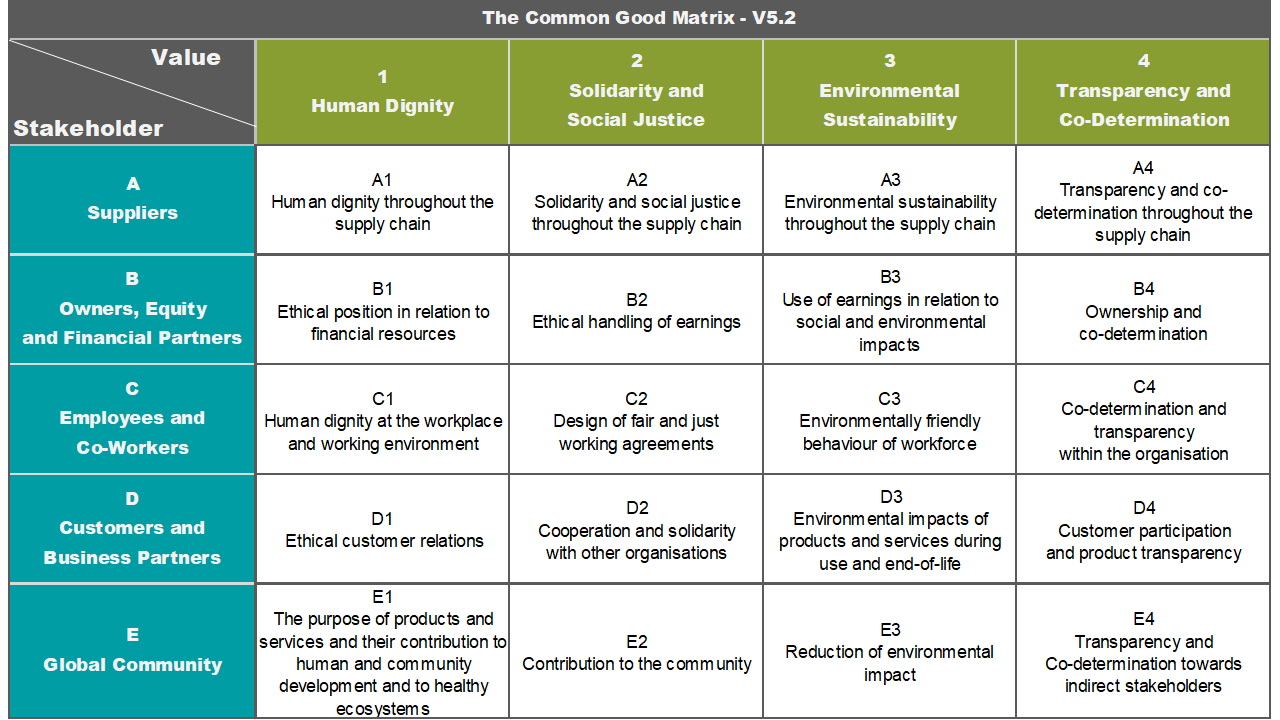
This handbook enables organisations to understand, evaluate, and prepare a Common Good Balance Sheet. It contains all you need to understand the themes and aspects of the Common Good Matrix. It is aimed for organisations, consultants, and auditors, but also for anyone interested to deppen the understanding of the Economy for the Common Good applied to organisations.
For each stakeholder group (row) the handbook offers a short introduction and some reporting questions and verification indicators useful for organisations to offer contextual and general information on each specific stakeholder group. The information gathered can be analysed under the lens of each value. This section helps to reduce repetition in the themes and aspects.
For each theme (cell) the handbook offers a short introduction, a list of behaviours typical of a common good oriented organisation for that theme (“An ECOnGOOD organisation…”), and some “Initial questions” thought to support internal reflection and discussion.
For each aspect (sub-theme), the handbook offers a short introduction, a list of reporting questions to guide the narrative reporting, a list of verification indicators to help the organisation identify the right level of evaluation and demonstrate that the right level/score is applied with evidence-based facts and figures, the levels of evaluation to guide the self-assessment and its external validation, and some “Guidance on indicators and evaluation” to support the assessment phase.
The main goal of a Common Good Balance Sheet is to evaluate an organisation's contribution to the common good by analysing its social and environmental impact and supporting the organisation to take actions within its field of influence, increasing the contribution to the common good but also improving its own resilience and strategy. This process encourages reflection on value-based business decisions and supports the organisation’s transformation journey through practical organisational development. The ultimate goal is to promote a common good orientation and to transform the economy.
For the ECOnGOOD movement, money and finance are just means. The goal is the common good. For this reason, the Common Good Matrix framework also invites some basic disclosure about the financial impact of an organisation’s social and environmental issues through some risk analysis questions and indicators.
A Common Good Balance Sheet is made of a Common Good Report and an Attestation.
The Common Good Report includes a narrative and data-based description of how the organisation’s activities relate to each of the 20 common good themes by answering the reporting questions and assessing the organisation according to the verification indicators laid out in this handbook. This will show how developed each value is within the organisation.
The ECOnGOOD Attestation documents the evaluation of each aspect, gives an overall score (Common Good Points), and presents results in the layout of the Matrix. A Common Good Attestation is awarded by a certified ECOnGOOD auditor.
Common Good Reports can be prepared by downloading the online version of this handbook in the reporting template version. Common Good Points can be calculated using the E-Calculator online at https://balance-sheet.econgood.org/.
1.3 Types of balance sheet
There are two types of Common Good Balance Sheet:
- CGBS only. This option is intended for organisations interested value-based reporting. It is a strategic and transformational tool that directs organisations towards the common good. This option does not cover the full VSME standard. It includes only those VSME indicators that support organisational transformation as mentioned above. Each aspect of the matrix shows the VSME indicators related to it. All indicators in the section: "VSME relevant indicators" shall be reported in order to complete the CGBS. When the "CGBS only" option is selected, these indicators will be displayed. In addition, users can select only mandatory datapoints - shall (CGBS and VSME are aligned in this categorisation).
- CGBS + VSME. This option is intended for organisations that wish to provide stakeholderswith sustainability information in line with the voluntary standard for small and medium-sized enterprises developed by EFRAG and endorsed by the European Commission (VSME), while strategically transforming itself towards the common good. Organisations choosing this option are expected to also disclose the "Extra VSME" datapoints, which are VSME datapoints not required under the "CGBS only" option. These are included in a dedicated section within each matrix aspect to ensure completeness of VSME reporting. Choosing this option means the display of ECOnGOOD’s original reporting questions and verification indicators plus “VSME relevant indicators” datapoints plus the “Extra VSME” datapoints. In addtional users can select basic or comprehensive module of VSME for display. This option enables full VSME coverage while using the value-based approach from the Common Good Framework as a strategic foundation for organisational transformation.
In case the “CGBS + VSME” option is chosen:
- All datapoints marked with “VSME” should be considered, though non-applicability and omission are always possible, if motivated.
- The user shall use the Euro as the currency for reporting.
- The organisation shall choose between Basic or Basic + Comprehensive Modules. The Basic Modules is the target approach for micro-undertakings (not exceeding two of the following thresholds: i. €450,000 in balance sheet total; ii. €900,000 in net turnover; iii. an average of 10 employees) and constitutes a minimum requirement and prerequisite for applying the Comprehensive Module.
By using the online ECOnGOOD html handbook it is possible to select which type of reporting to display for download.
All CGBSs completed with audit or peer validation are published in the ECOnGOOD database and are available to anyone. The balancer shall publish the CGBS on its website.
1.4 Preparing a report
In order to prepare the Common Good Report, the organisation should answer the reporting questions, verification indicators and VSME relevant datapoints provided in the handbook.
Reporting questions are thought to guide the narrative description of the context and the management approach through the disclosure of policies, measures, actions, and future goals and targets for each aspect.
Verification indicators are concrete facts and figures meant to demonstrate the effectiveness of common good-oriented transformation.
Policies might also be oral, especially in the case of micro-organisations whose culture is not often based on written documentation.
The handbook provides numerous reporting questions and verification indicators to encourage deep transformational reflection and evaluation in the greatest number of organisations, diverse in size, sector, and geography. This means that it is not expected that every organisation answers all datapoints. Datapoints are labelled with “shall”, “may”, or “if”.
“Shall” datapoints should always be answered. In case it is not possible, the “comply or explain” principle should be applied, using the “final datapoints sheet” provided.
“May” datapoints are optional. A selection based on relevance, depending on size, sector, geography, and, in general, risk assessment, is possible and encouraged. However, being completely optional, the “comply or explain” principle does not apply in this case.
“If” datapoints are mandatory only in specific cases, for instance, over a certain level of evaluation, or if applicable, or above a certain size threshold. If an “If” datapoint is applicable, the “comply or explain” principle should be applied, like in the case of “Shall” indicators. In all other cases, “If” datapoints correspond to “May” indicators.
Micro and small organisations often do not have extensive written policies or procedures, or do not conduct systematic, documented pilot tests or Plan-Do-Check-Act cycles. For these user typologies, it is sufficient to describe how the specific aspects are addressed. Also, these types of organisation might lack resources to commit to goals and targets for each ECOnGOOD matrix theme. The approach here is not to cover all themes with goals and targets but to start the transformative process, prioritising the most relevant ones. Lastly, they might choose to only focus on “Shall” and “If” questions.
In order to make the report lighter, it is not necessary to explain reasons for omission, non-applicability, or non-relevance in the narrative report. This means that it is enough to skip the question or indicator if the organisation does not want or need to answer it. A final “datapoints sheet” provided by ECOnGOOD here shall be used to note down reasons for omissions or any other notes. This sheet will be useful both internally as a final checklist, for ECOnGOOD auditors, and for users reporting under the CGBS + VSME option. In fact, the VSME standard explicitly requires organisations to state any omission of classified or sensitive information. If no data is available for verification indicators, other appropriate indicators can be used, and the reason why they were used should be explained.
In addition to the verification indicators, the organisation makes its own decision regarding what content to include and how detailed this should be. It should, however, be presented clearly and comprehensively using the SMART Principles (Specific, Measurable, Assignable, Realistic, and Time-bound) wherever possible to facilitate the subsequent audit of the report. In general, the organisation shall report information that is relevant, faithful, comparable, understandable, and verifiable. Every user is free to choose which currency to express financial figures in. However, since the E-Calculator weighting is based on some indicators expressed in euros, organisations reporting with other currencies should translate the relevant E-Calculator indicators into euros. This should be done using the average exchange rate over the reporting period.
Verification indicators might be asked in terms of trends. When this is the case, indicators are marked with the abbreviation “T.T.”, standing for “Temporal Trend). For all CGBSs after the first one, the trend over time is reported starting from the year when the datum is available (from the first year when a datum is available, even if this is before the first year of reporting). Trends shall be used for VSME indicators (in case of CGBS compliant with VSME reporting option), outcome/impact indicators (that is, indicators assessing effective transformation or positive change), and are recommended for any relevant indicator.
Auditors ensure that quality standards of reports are met and comparability is maintained. They can also request more detailed information.
The ECOnGOOD audit or peer assessment shall be repeated every two years. However, annual common good reporting is highly recommended to give a good pace to transformation and to align with normal business management timing. In case annual reporting is chosen, the ECOnGOOD audit can be repeated every two years, and the report for the non-audit year can also be published in the form of a delta report, only focusing on changes compared to the previous reporting period. For organisations who want to be compliant with VSME, it is sufficient to report on VSME indicators annually, though annual an Common Good Report is also recommended in this case.
Balancing organisations can also request a “Delta Audit”. In this case, the organisation is given the possibility to highlight changes in the current report compared to the previous one by marking them, thereby reducing the audit effort. However, a full report should still be published in the end.
Clearly, both a delta report and a delta audit are only possible within the same Matrix version.
The organisation should decide whether to report by calendar or financial year. Disclosed information should be consistent with the financial statement and prepared for easy cross-referencing.
The CGBS is generally prepared on an individual basis. However, a consolidated version can be considered if the reporting organisation has centralised processes for human resources management, purchasing, financial planning, and, in some cases, customer service. However, this must be considered on a case-by-case basis with the assigned ECOnGOOD auditor.
1.5 Evaluating the impact on the Common Good
The purpose of the evaluation is to assess the impact of an organisation’s activities on the common good. As part of the process, the organisation places itself along a scale from baseline to exemplary. This is not, however, intended to be a measurement, but rather a means of using Common Good Values to assess an organisation’s activities and the impact they have on each of the stakeholder groups of the matrix.
The evaluation will be made for each aspect according to the “Levels of evaluation” section proposed in each aspect. The levels of evaluation include 5 levels of evaluation: Baseline, First Steps, Advanced, Experienced, and Exemplary. The criteria for each is described according to each aspect whilst being based on general levels of evaluation, as in the table below. In case of inconsistencies between aspect-specific levels of evaluation and the general ones, the latter prevails.
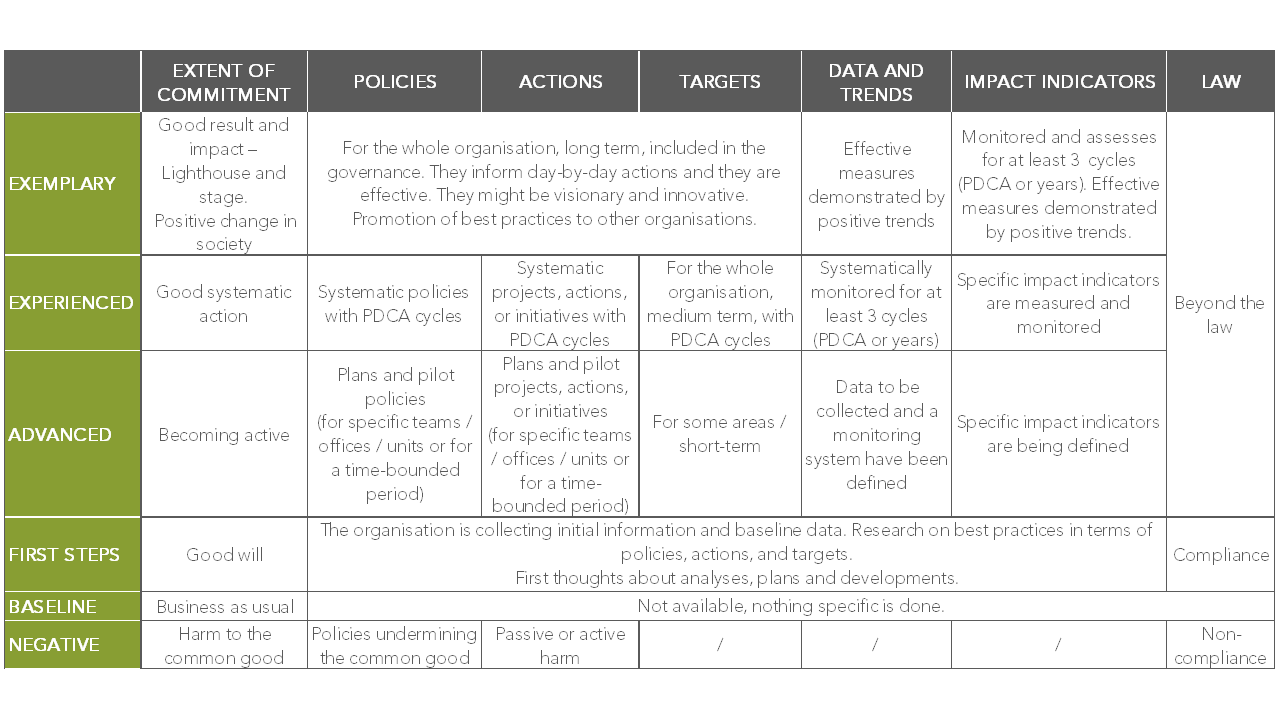
A baseline is given for all aspects, which describes business as usual when the topic is not reflected on. The evaluation process is informed by reporting questions and verification indicators. Moreover, the section “Guidelines for indicators and evaluation” within each aspect offers more information and interpretation guidelines to help with the evaluation process.
The association with a level of evaluation involves adhering to all relevant information and indicators and viewing them as a whole. Each level builds on the previous one, and achievement of the previous level is a prerequisite for a higher level. For example, to be awarded the level of experienced, all criteria under advanced must be met. This rule, however, is to be interpreted pragmatically. Minor discrepancies do not necessarily lead to a level downgrade. Each evaluation level is given a score depending on how common good driven the theme is within the organisation, and the extent to which the criteria for each level have been met.
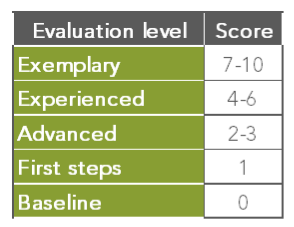
Every aspect is rated on a scale from 0 to 10 and is weighted according to its relative importance within each theme (low/medium/high/very high).
Scores are recorded using the E-Calculator. This is a simple, automated aggregation of all the scores of each aspect according to their relative weighting. The more important an aspect is for the common good, the greater its overall value within the theme. The overall value of a positive aspect is rated on a scale from 0 to 10. The maximum value for a negative aspect is -200.
The final score is the weighted sum of each theme’s individual score.
The Common Good Matrix allows for a degree of flexibility, so that companies and organisations can make their own contribution to their ongoing development. You are encouraged to identify your own ways and means to implement Common Good Values. The Matrix provides specific guidance for all themes and aspects. This includes clear aims (e.g. ‘consensual decision-making within the organisation’) and offers examples of how to implement these (e.g. ‘systemic consensus’). It is possible, however, for organisations to develop their own comparable implementation steps. In this way, organisations are given room for creativity, and common good auditors are given leeway in the evaluation process.
1.6 Allocating Common Good Points
In addition to evaluating each theme, an overall evaluation is made by allocating Common Good Points. These Common Good Points may be important in the future concerning legal consequences and benefits arising from publishing an audited Common Good Balance Sheet. The maximum number of Common Good Points that can be scored is 1,000; the minimum is a negative score of -3,600. The Common Good Balance Sheet was developed for use by organisations in any sector, and of any size and legal structure - from non-profit organisations and small and medium-sized family businesses, right up to listed organisations and academic institutions. These organisations play very different roles within society, so the potential and effective impacts associated with their respective activities are also different. A variable weighting of themes reflects these differences in sector, scope, and scale of organisations.
As a starting point, each of the 20 themes is allocated an equal score of 50 points. To determine the overall score, the balance sheet calculator adjusts the weighting for each theme according to the following factors:
- The size of the organisation.
- Financial flows to and from suppliers, investors, and employees.
- The social impact of the raw materials in their country of origin.
- The sector and its associated environmental and social impact.
The total score that can be allocated remains the same, but the weighting of each theme is adjusted according to its relevance to the organisation. For detailed explanation about the functioning of the weghting system refer to this document.
1.7 New features of Matrix 5.2
Reports and evaluations prepared using version 4.1 or earlier versions of the Matrix are not directly comparable in terms of Common Good Score. The changes in Matrix Version 5.2 are designed to have little impact on the scoring in comparison with Matrix Versions 5.0 and 5.1. Some minor changes in the final scoring could still occur because questions and indicators are clearer, and, therefore, the evaluation could be affected as well.
Find below a list of major changes in Matrix 5.2:
- 2 types of reporting: “CGBS only” and “CGBS+VSME”.
- For standardisation purposes, this version of the matrix offers complete alignment with the VSME (For this reason, the word “undertaking” is used for VSME datapoints, while the handbook normally uses the word “organisation”). Therefore, all data points addressed by the VSME are presented as developed by EFRAG. Original datapoints from ECOnGOOD with similar content have been removed. Refer to the section on reporting options for more details.
- Old reporting template and E-Calculator datapoints are all integrated in the handbook to have everything in one place.
- Full/Compact versions are abandoned in favour of “Shall”/”May”/”If” tags applied both to reporting questions and verification indicators.
- The online digital handbook includes filters for: “CGBS only” or “CGBS+VSME" reporting options; VSME datapoints (Basic or Comprehensive); “Shall”/”May”/”If” datapoints.
- Levels of evaluation have been improved both by adding a general initial overview on the rationale behind them and working on aspect-specific ones. Specific adaptations have been completed to make the Baseline always applicable and to the Exemplary level.
- In order to reduce repetition, an intro has been added to each row with questions and indicators useful to provide a context to the whole row.
- A “Report introduction” section has been created to include general facts and figures, methodology, the Attestation, and a table with the prioritised goals and targets.
- VSME-inspired management approach questions have been consistently implemented in all aspects to report on policies, practices, measures taken, and future goals and targets.
- In order to make the CGBS more transformative, temporal trends have been introduced for some indicators and in the general levels of evaluation description for the highest levels, in addition to a table with prioritised goals and targets in the reporting introduction.
- It is now possible to report in any currency unit and is not obligatory in to report in euros.
- A final “datapoint xls sheet” (checklist) will make it fast and easy to monitor answered datapoints and to note down explanations for non-compliance with any datapoints.
1.8 ECOnGOOD Label
The ECOnGOOD Label is a comprehensive seal assessing the real impact of an organisation’s operations, management, and supply chains, providing a transparent evaluation based on the Common Good Matrix. It provides clear, evidence-based information, and offers real-time transparency through a QR code linked to the organisation’s Common Good Balance Sheet report and result.
There is strict criteria for eligibility:
- Payment of the association membership fees (or equivalent) in full to a national or regional ECOnGOOD Association.
- Possession of a valid Attestation (less than two years old).
- Completion of a Common Good Balance Sheet with an audited positive result.
- Registration in the ECOnGOOD audit database.
- Compliance with all publication requirements, included the publication of the Common Good Balance Sheet on the organisation's website.
- Validity of the contract between the organisation an the International Federation for the Economy for the Common Good e.V.
By meeting these requirements and displaying the ECOnGOOD Label, organisations demonstrate their commitment to sustainable and ethical practices, enabling consumers, investors, and policymakers to make informed decisions that support responsible business models.
2. Stakeholders
A. Suppliers
This group includes individuals, organisations, and companies supplying directly to the organisation, as well as indirect suppliers i.e. the entire supply chain. All products and services purchased from others are evaluated. Every organisation can take co-responsibility for its suppliers when making purchasing decisions, for example, by choice of suppliers, with contractual terms, and with some influence over its business partners.
How this shared responsibility is put into practice depends on the balance of power within the market and the distance between that link in the supply chain and an organisation. It is important to be especially alert to procurement procedures throughout the supply chain when buying products and services that have a significant commercial value for the organisation, are quantitatively important, or are high-risk components for an organisation’s products and/or services.
A list of the most important suppliers for an organisation and the products and services they provide can act as a guide for this. Important suppliers are those who deliver up to a total value of approx. 80% of the purchase volume, or 80% of purchase costs if volume is not available. Products and industries that carry a social or environmental impact (potential or effective) should be closely examined, even if the amount of purchase is small.
B. Owners and financial partners
Different types of organisations have legally different forms of ownership. Ownership of assets is associated with property rights and decision-making. These are protected and limited by constitutional, private, and public law. Forms of responsibility and liability are always associated with this. In the economy, private ownership by individuals commonly takes the form of sole ownership, as a personal partner, or as a shareholder in a corporation. Managing directors or the board of directors then assume ownership functions, accompanied by supervisory bodies. Similar forms are found in associations, self-governing bodies, co-operatives, steward-ownership, and companies owned by the workers. These representatives are obliged to act in the welfare of the organisations, taking into account the interests of the stakeholders, the restrictions imposed by the statutes or supervisory bodies, and the resolutions of general meetings. Under certain circumstances, personal liability may also arise.
We consider all financial market participants that provide financing and/or financial services to be financial partners, regardless of the type of products or services they offer. Here, the product type is deliberately not taken into account to avoid double-counting. In addition, most services are related to financing or the use of funds and are subject to the special conditions of the financial market.
C. Workforce
Stakeholder group C includes everyone who performs essential tasks for the organisation, is included in its regional, organisational, or social structures, and for whom at least one of the following criteria applies:
- People with whom the organisation has an employment relationship.
- People who have worked for the organisation for a period of at least six months.
- People who have worked for the organisation for at least four hours per week.
- People who are assigned tasks that are performed regularly and are recurrent (e.g. every summer).
Regarding external staff, it must be considered whether the organisation buys a service or buys working time. The former is stakeholder group A (suppliers), and the latter is stakeholder group C. Subcontractors who are deployed as personnel and work for and with the organisation and colleagues should be treated as internal staff when one of the mentioned criteria applies.
D. Customers and other organisations
Customers are the target group for a company or an organisation to buy or use their products and services. For example, customers of products and services, distributors, companies using the organisation’s product or service, contractors.
Other organisations (“competitors”) are organisations who may have the same (regional) target group and offer a comparable product or service. How an organisation behaves towards and interacts with others operating in similar markets is also taken into account.
E. Local and global community and ecosystems
Stakeholder Group E is defined more broadly than in the traditional business context. A common good approach recognises that everything in an ecosystem, economic system, or shared space in general, is interconnected, and that decisions and actions taken in one area can have far-reaching impacts on other areas.
Stakeholders in this sense are
- People: This is not about the people or groups directly affected (these are mentioned under stakeholder groups A to D), but about indirect dependents, future generations, and people in distant geographical areas, who may be indirectly and adversely affected by decisions.
- Local communities where the organisation operates.
- Animals: All animal species can be considered stakeholders if human activities affect their habitats or wellbeing.
- Plants and other life forms: Plants and microorganisms play a crucial role in many ecosystems and can be affected and threatened by human interventions.
- Ecosystems and natural habitats: Whole ecosystems, such as forests, oceans, rivers and deserts, can be considered stakeholders because they support the lives of numerous species and are central to ecological balance and the climate.
- Abstract or non-physical entities: Artefacts, cultural or spiritual values, traditions or concepts could also be considered stakeholders, especially if human activities affect these intangible aspects.
- The physical environment: Aspects such as air, water, and soil that may be altered or polluted by human activities.
In general, E row encompasses all those stakeholders that do not have a direct relationship with the organisation. This might also include employee families, for instance.
3. Values
The common good: A timeless value across borders
The common good is our founding value and principle. It is much older and broader than the relatively younger terms “sustainability” and “wellbeing”. It is deeply anchored in state theory and constitutional law due to its long historical backtrack. The philosopher Claus Dierksmeyer writes: “From Aristotle via Thomas Aquinas, up to and including Adam Smith, there was a consensus that both economic theory and practice needed to be legitimated as well as limited by a certain overarching goal (Greek: telos) such as the “common good”” (2016: 35). Timo Meynhard adds: “There is no culture that does not know the value of the common good” (2016: 174). According to Encyclopedia Britannica, the “common good” is “that which benefits society as a whole”. It is not the simple sum of individual goods but an ethical, relational, and inclusive goal, which requires mutual care, trust, and a perspective that leaves no one behind (Zamagni, Bruni, 2004). In the view of the Economy for the Common Good, it is a combination of relational values (respect, empathy, care, cooperation) and constitutional values (human dignity, solidarity, social justice, ecological sustainability, democracy).
There are two different philosophical approaches that define what the common good actually includes. The first one,"substantial definition", associates the decision to a metaphysical or autocratic instance. The second one, the one the ECOnGOOD movement adheres to, states that the concrete content of the common good can only be defined - or "composed" - by all members of a democratic community; accordingly, we call for the participatory development of Common Good Products as the successors of GDP from which an ethical compass for businesses can be later derived. For the time being, we work with the most frequent constitutional values mentioned above: human dignity, solidarity, social justice, ecological sustainability, and democracy, as they enjoy the highest possible legitimacy since they are enshrined in our constitutions.
3.1 Human dignity
For us, human dignity means that every human being is equally valuable, worthy of respect and protection, and unique, regardless of origin, age, gender, medical treatments, religion, or other characteristics. Human dignity is an inalienable right and denotes a moral entitlement that every human being has the right to expect simply by being alive. Human beings, and ultimately all living beings, have a right to exist and are deserving of appreciation, respect, and esteem. The human individual stands above every material thing. The human being as a person is the focus and must not be treated as a commodity, for example, a means of production as a unit of labour. Human dignity is independent of the usefulness of a human to provide labour and is inviolable and unassailable. Human dignity is a fundamental principle that promotes respect for, and protection of, the rights, health, and wellbeing of all people. Human dignity should act as a guiding principle for action, “Act that you use humanity, whether in your own person or in the person of any other, always at the same time as an end, never merely as a means,” according to Immanuel Kant, from the Metaphysics of Morals.
3.2 Solidarity and social justice
Solidarity and social justice are closely related values, both aim at strong social cohesion and a fair and just society; based on the equal opportunities and equal rights of all humans, as well as non-exclusion. While solidarity is based more on voluntary action and motivation, justice is more a legal pillar of the social contract. More concretely, solidarity is based on a feeling of togetherness, which, from the ECOnGOOD point of view, means an attachment to people as a whole, rather than to a defined group, which is how the term has been interpreted historically. The word stems from the Latin term “solidus” which means firm or to stand together and not allow to be divided. Solidarity aims to ensure that no one is left behind or excluded. Solidarity manifests itself as a mutual and unselfish willingness to help in times of need, to overcome difficult situations, and to voluntarily co-operate with one another. Solidarity may also entail specific community-based obligations and liabilities when the collective assumes responsibility for the weak. Social Justice provides equal opportunities and equal rights for all members of society. Social Justice aims to ensure that no one is disadvantaged or excluded. Social Justice aims to achieve a fair distribution of goods, resources, power, opportunities, and obligations. Social Justice is accomplished through social and legal mechanisms, such as a just organisation of the economy, the state, and the design of the democratic system, including strong individual and collective rights. As a general rule, these provisions should be brought under the control of law.
3.3 Environmental sustainability
This value is about meeting today’s needs without compromising the ability of future generations to meet their needs. It concerns the complex interactions between humans, other living beings, and the environment, which provides the basis for their existence and life. Human activity can pose a significant threat to the environment, thereby threatening all life forms that depend upon it for their existence. ECOnGOOD organisations are expected to have a net-positive impact concerning (“Do more good”) and not only a sustainability mindset (“Do less bad”). It is important to consider that actions taken are often associated with social change, which can be positive or negative. This aspect is very complex, and there is much literature about it. We cannot possibly cover everything, but we want to highlight a few key topics to inspire discussions.
- Life cycle perspective: For products, assess the impacts of design, raw materials, production, packaging, transport, use, and end-of-life. For services, assess the impacts of resources needed to provide them (e.g. servers, hardware, travel, energy, etc.) as well as the impacts of how clients use the service (e.g. enabling mining or shipping). Risk and impact assessments are recommended.
- Circularity: Shift from a linear journey from creation to waste towards closed material and energy loops.
- Eco-efficiency: Reduce resources and pollution per unit of output. Negative rebound effects should be monitored: efficiency gains lower costs and may lead to higher production and, thus, more impact.
- Eco-effectiveness: Go beyond eco-efficiency by achieving an absolute reduction of ecological footprint.
- Sufficiency: Reduce impacts to ensure all can live well within planetary boundaries.
- It is furthermore important not to fall into traps, like the carbon tunnel vision, which prioritise climate change mitigation at the expense of other important environmental impacts (such as biodiversity loss, water, etc.).
3.4 Transparency and co-determination
Transparency is a prerequisite for stakeholders to be able to participate in decision-making. Transparency means the disclosure of all information relevant to the common good, including critical data such as the minutes of executive committee meetings, salaries, internal cost accounting, and recruitment and dismissal procedures. Co-determination of stakeholder groups aims to ensure that all individuals directly or indirectly affected by actions (or inactions) are involved in decision-making processes. All individuals or groups who are affected by decisions and actions, or by the lack of decisions and actions, or have a legitimate interest in them, should be included. This expanded concept of participation aims to enhance the legitimacy and quality of decisions by ensuring that all those affected are heard. Stakeholders should be able to voice their concerns, provide information, and participate in decision-making processes. This contributes to greater transparency, accountability, and broader acceptance of decisions. Stakeholder co-determination also promotes the idea of social justice and inclusive organisational policymaking. It allows previously marginalised groups to raise their voices and participate in decision-making. By involving all those affected, the goal is to establish a balanced power relationship and ensure that the interests of those who usually have less influence are also taken into account. Co-determination involves the participation of each stakeholder in the decision-making process. There are different levels ranging from information provision, consultation, and participation, to collaborative decision-making.
4. Report introduction
Find below a list of general reporting questions and indicators meant to offer an overview of the reporting organisation with some facts and figures, reporting information and methodology, CGBS results and future goals, and targets. When reporting, you can delete all instructions and only keep the relevant information. It is also possible to draft a text including all the relevant answers.
4.1 General facts and figures
Reporting questions
- (shall) Name of the organisation.
- (shall) Logo.
- (shall) The date of the first operating year.
- (IfApplicable) List of relevant legal non-compliance, incident, and/or fine related to environmental, social, and governance issues in the reporting period.
- (shall) List of the organisation’s main risks.
Verification indicators
- (shall) Profit/loss at the end of the reporting period (in C.U.).
- (shall) The undertaking shall disclose the key elements of its business model and strategy, including: (d) if the strategy has key elements that relate to or affect sustainability issues, a brief description of those key elements. Example
address Item 1 Item 1 – address Item 2 Item 2 – address Item 3 Item 3 – address
ECOnGOOD Relevant VSME Indicators
- B1.24.e.i: (e) the following information:
i. the undertaking’s legal form; - B1.24.e.vi: vi. country of primary operations and location of significant asset(s); and
- B1.24.e.vii: vii. geolocation of sites owned, leased or managed.
- B1.24.e.ii: i.i. NACE sector classification code(s);
- B1.24.e.v: v. number of employees in headcount or full-time equivalents;
- B1.24.e.iv: iv. turnover (in Euro);
- B1.24.d: The undertaking shall disclose:
(d) in case of a consolidated sustainability report, the list of the subsidiaries, including their registered address4, covered in the report; and - C1.47.a: The undertaking shall disclose the key elements of its business model and strategy, including:
(a) a description of significant groups of products and/or services offered; Exampletitle description turnover Item 1 Item 1 – title Beschreibung zu Item 1 (Holzbau GmbH). Item 1 – turnover Item 2 Item 2 – title Beschreibung zu Item 2 (Holzbau GmbH). Item 2 – turnover Item 3 Item 3 – title Beschreibung zu Item 3 (Holzbau GmbH). Item 3 – turnover - C1.47.d: The undertaking shall disclose the key elements of its business model and strategy, including:
(d) if the strategy has key elements that relate to or affect sustainability issues, a brief description of those key elements. Exampledescription Item 1 Beschreibung zu Item 1 (Holzbau GmbH). Item 2 Beschreibung zu Item 2 (Holzbau GmbH). Item 3 Beschreibung zu Item 3 (Holzbau GmbH). - B1.24.e.iii: iii. size of the balance sheet (in Euro);
Guidelines for indicators and evaluation
For “CGBS only” users:
- In case that an ECOnGOOD relevant VSME datapoint is asked in Euros, any currency unit can be used instead.
- When reporting the NACE code, please, also explicitly state the sector.
- Both number of employees in headcount and in full-time equivalents should be reported for, though the VSME datapoint allows to choose only one of the two.
- The list of subsidiaries or legally connected organisations is also required for the individual reporting option.
- when disclosing ECOnGOOD relevant VSME datapoint on "key elements of its business model and strategy, including: (d) if the strategy has key elements that relate to or affect sustainability issues, a brief description of those key elements", please, briefly describe what links the organisation to the Common Good)
Nace code identification Users can identify their NACE code using this European Union page.
Additional activities to foster the common good – the organisation is asked to briefly describe any other activities pursued in the reporting period to foster the common good that are not explicitly addressed in the themes of the report.
Life cycle approach – the organisation is asked to describe the whole life cycle of the main product or service categories from cradle to grave/cradle to evaluate relevant ecological impacts. The life cycle includes the following stages: design (A3/D3/E3): 1) raw material acquisition, 2) purchasing and procurement (A3), 3) transportation, 4) production (E3), 5) use (D3), and 6) end-of-life (D3 and E3). The organisation has to consider and disclose the Life Cycle of its main products and services, deciding which environmental aspects are relevant by taking into account their ability to control and/or influence them. This does not require a detailed life cycle assessment. A thorough consideration of the life cycle stages that can be controlled and/or influenced (ISO 14001 / EMAS) is sufficient, or of those stages where the environmental impact is significant. If the life cycle is not sufficiently described, this leads to a devaluation by one evaluation point in the themes A3, D3, and E3. Sufficient means that accurate information is given on at least 5 of the 6 stages for products and services, focusing on resources needed to offer the service and environmental impact in the use phase. Accurate information means disclosure of the organisation’s ability to control and/or influence these stages and naming the possible measures.)
4.2 Methodology and reporting information
Reporting questions
- (shall) Reporting period. Example
start date end date Item 1 Item 1 – start date Item 1 – end date Item 2 Item 2 – start date Item 2 – end date - (shall) Matrix version
- (shall) Type of balance sheet (CGBS only/CGBS + VSME).
- (ECOnGOOD+VSME) The undertaking shall disclose which of the following options it has selected: (i.) OPTION A: Basic Module (only); or (ii.) OPTION B: Basic Module and Comprehensive Module.
- (shall) Currency unit used.
- (shall) Engagement process.
- (shall) Contact person for this report.
ECOnGOOD Relevant VSME Indicators
- B1.24.c: (c) whether the sustainability report has been prepared on an individual basis (i.e. the report is limited to the undertaking’s information only) or on a consolidated basis (i.e. the report includes information about the undertaking and its subsidiaries);
- B1.24.b: (b) if the undertaking has omitted a disclosure as it is deemed classified or sensitive information (see paragraph 19), the undertaking shall indicate the disclosure that has omitted.
Extra VSME Indicators
- B1.24.a: The undertaking shall disclose:
(a) which of the following options it has selected:
i. OPTION A: Basic Module (only); or
ii. OPTION B: Basic Module and Comprehensive Module;
Guidelines for indicators and evaluation
- Engagement process – the organisation is asked to briefly describe the engagement process for the preparation of the CGBS: who led the process (roles/organisational units/stakeholders), doing which activities, using what channels (workshops, surveys, etc.), and at which levels of engagement (information, consultation, partnership, co-determination, etc.).
- The ECONGOOD data-points xls sheet can be used to mark omitted disclosures.
4.3 Common Good Balance Sheet results and improvement plan for transitioning towards an Economy for the Common Good
Reporting questions
- (shall) Peer/audit certificate (when issued).
- (shall) Prioritised goals and targets.
ECOnGOOD Relevant VSME Indicators
- C2.48: If the undertaking has put in place specific practices, policies or future initiatives for transitioning towards a more sustainable economy, which it has already reported under disclosure B2 in the Basic Module, it shall briefly describe them. The undertaking may use the template found in paragraph 213 for this purpose.
- C2.49: The undertaking may indicate, if any, the most senior level of the undertaking accountable for implementing them.
Extra VSME Indicators
- B6.26: If the undertaking has put in place specific practices, policies or future initiatives for transitioning towards a more sustainable economy, it shall state so. The undertaking shall state whether it has:
(a) practices. Practices in this context may include, for instance, efforts to reduce the undertaking’s water and electricity consumption, to reduce GHG emissions or to prevent pollution, and initiatives to improve product safety as well as current initiatives to improve working conditions and equal treatment in the workplace, sustainability training for the undertaking’s workforce and partnerships related to sustainability projects;
(b) policies on sustainability issues, whether they are publicly available, and any separate environmental, social or governance policies for addressing sustainability issues;
(c) any future initiatives or forward-looking plans that are being implemented on sustainability issues; and
(d) targets to monitor the implementation of the policies and the progress achieved towards meeting such targets. Exampledescription practices Beschreibung zu practices (Holzbau GmbH). policies Beschreibung zu policies (Holzbau GmbH). any future initiatives Beschreibung zu any future initiatives (Holzbau GmbH). targets to monitor Beschreibung zu targets to monitor (Holzbau GmbH).
Guidelines for indicators and evaluation
The Common Good Balance Sheet can help organisations in evaluating their activities and in their transformation towards the common good. As a practical management tool, this section is forward-looking and is intended to help the user link the assessment phase with the definition of goals and targets for improvement and to operationalise goals and targets with proper resources (financial, human, etc.) and power.
In the VSME context, “practices” may include, for instance, efforts to reduce the undertaking’s water and electricity consumption, to reduce GHG emissions, or to prevent pollution, and initiatives to improve product safety, as well as current initiatives to improve working conditions and equal treatment in the workplace, sustainability training for the undertaking’s workforce, and partnerships related to sustainability projects.
While specific policies, practices, strategies, measures, and future goals, targets, and actions have been described for each Matrix aspect, the recommendation here is to only focus on the main ones, as well as on prioritised goals and targets.
Prioritised goals and targets can be disclosed in tabular form. The following columns are suggested: Aspect/theme; long-term goal, related target(s) specific to the goal; identified KPI to measure that the target has been successfully achieved; year when the target will be met; ownership, and concrete finance and/or investment needed to achieve it might also be added. It is recommended to draft the prioritisation based on identified main risks – see 4.1 section indicator – and impacts.
5. Let’s start with organisational purpose
Organisations offer their employees a workplace, pay them fairly, and, thus, enable them and their families to earn a living. Organisations are part of society, and they can serve and advance society by fulfilling human needs or broader societal needs to foster well-being. Organisational purpose clarifies the reason why an organisation exists and does business, and the deep meaning that it has for the world. The organisational purpose clarifies what life improvements for all stakeholders (particularly society, the environment, and clients), now and in the future, an organisation is committed to. Defining the organisational purpose means being aware of one’s impact and managing it in the most positive way. An organisational purpose is the organisation’s overarching reason for existing.
A Purpose Statement is a tool to communicate and articulate purpose in a concise and inspirational way. It consists typically of one or two sentences that convey how the organisation fulfils human needs or solves human problems. A purpose statement can also present a risk if it is not actually lived as the core of the business strategy. For this reason, in the introduction section of each matrix row, the handbook offers some questions which can help organisations to reflect and describe how organisational purpose is actually lived in the organisation and in the relationships with all stakeholders. The following questions may seem more suitable for organisations with substantial impacts on society, but even for small organisations, they can help to have a clearer view. The questions help clarify how an organisation is embedded in its social, economic, and geographic environment, its sphere of influence, and what its responsibilities are.
How to report on Purpose
The questions and indicators considered relevant below can be answered in the introductory section of the report. The section should give a complete view of the reasons and motivations for why an organisation exists and how these influence strategies, actions, and results across the matrix themes. However, some answers are also recalled in other sections of the report, where it makes sense, and where it is helpful for the evaluation of the theme. It can be helpful for organisations to see the connection to the themes and how organisational purpose is put to action. Another useful tool for organisations at the beginning of their common good journey is the ECOnGOOD Business Canvas. It includes purpose and links to each row and can help initial reflections on purpose in connection with all ECOnGOOD values and stakeholders.
5.1 Organisational purpose
Reporting questions
- (shall) To which local, regional, or global challenge does the organisation offer a solution or a contribution towards a solution? Is this contribution part of the core business strategy or voluntary actions?
- (If_fromFirstSteps) Has the organisation ever thought of giving a broader sense to business itself by connecting its business to local, regional, or global challenges to contribute to an answer?
- (shall) What is the social, environmental, and economic role of the organisation through its business?
- (shall) How does the organisation’s business contribute to the needs of customers and stakeholders?
- (If_PurposeStatementExists) Does the purpose statement of the organisation explicitly set out the positive impact it has on stakeholder needs and aspires to have on future stakeholders?
- (If_OrgWithPurpose) Is the organisation’s business strategy developed and adapted based on the organisation’s purpose?
- (If_OrgWithPurpose) How does the organisation ensure that its purpose can be fulfilled during times of socio-economic stress?
- (If_PurposeStatementExists) When, and by whom in the organisation, was the organisational purpose developed, and when was it last amended? (Please report literally.)
Verification indicators
- (may) Purpose Indicator 1 in the reporting period (T.T.). Example
2025 2024 2023 Beispielwert Beispielwert Beispielwert - (may) Purpose Indicator 2 in the reporting period (T.T.). Example
2025 2024 2023 Beispielwert Beispielwert Beispielwert
Guidelines for indicators and evaluation
Indicators should be self-defined by the organisation. They should measure how the organisation’s behaviour in economic, social, and environmental contexts meets the purpose of the organisation over time. They should be understandable, measurable over time, and clearly related to your contribution. The indicators should relate to the output of your organisation (your service or product, and your internal organisational management) or to the outcome for society you aspire to. Note: An organisation chooses its purpose-indicators for their first ECOnGOOD balance sheet and in the next balancing periods the same indicators are used to monitor changes and improvements.
A. Suppliers
Suppliers are key stakeholders, enabling organisations that offer their products and services. Cooperation on different levels will be analysed in the A-Row, from positive aspects like transparency, cooperation, and joint development to negative aspects like hidden human rights infringements, externalised costs, and pollution. Each organisation’s sphere of influence and its scope vary depending on its size and other factors. With greater power comes a greater responsibility!
Find below a list of general reporting questions and indicators meant to offer an overview of the reporting organisation, with facts, figures, and methodology. If there is repetition of questions, choose the most appropriate place to report. Whenever possible, give practical examples/situations showing how values are lived in practice.
In the first analysis, please consider your most important direct suppliers, and in the second analysis, dive deeper into the supply chain, especially for items of high value, of critical environmental or social impact, or critical to offering your products/services. Please choose the most adequate reporting method, like directly from your organisation’s management tool (if available), and use tables, graphs, trends, and/or free text.
Reporting questions
- (shall) Which raw materials are used in the production process and in what quantity?
- (shall) Has the organisation performed an impact analysis of its supply chain? Please describe.
- (may) How are the organisation’s suppliers involved in product design?
- (may) How have the organisation’s suppliers changed local conditions, impacted the local community, and the environment?
- (shall) How much value is added by a specific supplier vs. what is the impact of their product/service (on environment, social, externalised, etc)
- (may) Is the purpose statement of the organisation communicated to suppliers?
- (may) Do the organisation’s suppliers share the same purpose?
- (may) Are there any action programmes to share and implement the organisational purpose with suppliers and/or the organisation’s supply chain, e.g. shared policies, code of conduct/ethics, agreements, etc.?
- (may) Does the purpose of the organisation entail global challenges related to supply chains, and does the organisation address these challenges in its supply chain policies?
- (may) Can the organisational purpose help to increase cohesiveness among partners in the supply chain, while respecting the peculiarities of organisations?
- (IfApplicable) Which certifications are available in the organisation’s supply chain?
- (shall) What policies and practices exist in the organisation regarding supplier selection and supply chain assessment?
- (shall) What strategies and measures have been put in place before (short-list) and during the reporting period, for direct suppliers and the whole supply chain?
- (shall) What results have been reached so far concerning suppliers and the supply chain? (If possible, evaluate the effectiveness of the actions taken.)
- (shall) What future goals, targets, and actions have been planned concerning suppliers and the supply chain? What are the main actions to achieve these targets?
Verification indicators
- (shall) Main geographic location of direct suppliers, expressed as a percentage of the purchase volume (T.T.). Example
2025 2024 2023 DE – Teil 1 10.6 72.4 32.9 DE – Teil 2 60.5 4.1 58.5 TOTAL 71.1 76.5 91.4 AT – Teil 1 45.9 63.1 86 AT – Teil 2 89.7 46.6 31.8 TOTAL 135.6 109.7 117.8 CH – Teil 1 28.7 43.9 73.1 CH – Teil 2 33.7 70.4 71.9 TOTAL 62.4 114.3 145 UK – Teil 1 39 40.7 69.6 UK – Teil 2 70 24.2 41.5 TOTAL 109 64.9 111.1 US – Teil 1 86.6 62.4 19.4 US – Teil 2 14.2 84.7 64.5 TOTAL 100.8 147.1 83.9 - (shall) Country of origin of goods/services/raw materials, expressed as a percentage of the purchase volume. Please go as far back in the supply chain as feasible (T.T.). Example
2025 2024 2023 DE 70.4 7.1 34.4 AT 13.6 86.6 78.4 CH 68.2 32.2 12.8 UK 6.2 13 65.7 US 72.4 36.7 61.6 - (may) Percentage of purchased products, services, and raw materials for which the supply chain can be traced back to the origin, out of the total procurement volume.
- (shall) Total purchases from suppliers.
- (shall) Enter the 5 most important industry sectors whose products or services you use. Example
countryCode industryCode costs Item 1 Item 1 – countryCode Item 1 – industryCode Item 1 – costs Item 2 Item 2 – countryCode Item 2 – industryCode Item 2 – costs Item 3 Item 3 – countryCode Item 3 – industryCode Item 3 – costs
ECOnGOOD Relevant VSME Indicators
- C1.47.c: The undertaking shall disclose the key elements of its business model and strategy, including:
(c) a description of main business relationships (such as key suppliers, customers distribution channels and consumers);
Guidelines for indicators and evaluation
- Suppliers considered in A-Row can be suppliers of material and services. Suppliers related to finance/ money and insurance will be considered under the B-Row
- If helpful suppliers can be clustered into a) infrastructure, b) core-processes, c) support-processes, d) administration in order to allow focus on: greatest leverage, possibility of action and change
- Please consider the main suppliers, which could e.g. be the ones providing 80% of the purchase volume or expenses. Alternatively focus could be on the top 10 suppliers and consider how much purchasing volume/expenses these cover.
- Products and industries that carry a high social or environmental risk should be closely examined, even if the amount of purchase is small.
- As mentioned in the general intro, whenever possible, please note down potential actions and targets in the SMART format and then prioritise them.
- Specifically for the supply chain, it may be important to distinguish between items hard to change (like infrastructure) and where change is possible through conscious purchasing, supported by criteria and a strategy.
- Do the policies, practices, and future initiatives aim to reduce negative and enhance positive social and environmental impacts? e.g.: human rights, climate change, pollution, water and energy resources, biodiversity, and the circular economy (VSME - principles of preparation).
- An impact analysis could consider accidents, likelihood of disruption, availability of alternative suppliers, transition events like climate change, stakeholder perceptions, pricing, etc.
- Purchasing criteria: e.g. standards, certificates, surveys, visits, audits, etc. It may be important to make a two-way assessment and look at supplier satisfaction with your organisation’s practices, conditions, etc., as well as compliance with their own promises.
- Product design could cover areas like continuous improvement, cradle-to-cradle, circular economy, etc.
- Please answer the above questions for your direct suppliers and then your indirect suppliers. In A2 and A4, there is a specific aspect for this; in A1 and A3, there is not, since, unfortunately, that couldn’t be standardised for this workbook.
- Some indicators may be hard to accurately measure (and express as percentage for example), in this case please make an estimation and be clear about the underlying premisses.
A1 Human dignity throughout the supply chain
All goods and services purchased by an organisation have an associated impact on society, which can be either positive or negative. One of the most important aspects is the working conditions along the entire supply chain and the impact on local communities. An organisation is co-responsible for the well-being of their direct and indirect suppliers, their workers, and communities.
An ECOnGOOD organisation...
- purchases goods and services that are provided under ethical and fair conditions.
- is alert to impacts throughout the supply chain, where the violation of human dignity is a common occurrence.
- actively promotes behaviour that improves human dignity throughout the supply chain.
Initial questions
- What do we know about our suppliers‘ commitment to respecting human dignity, especially that of our key suppliers?
- What potential negative impacts exist throughout the supply chain concerning the violation of human rights that relate to our business activities?
- How does our organisation contribute to the implementation of ethical and fair working practices, and how do we help to solve problems and meet challenges throughout the supply chain?
A1.1 Ethical working conditions in the supply chain
Organisations should be actively involved in how the goods and services they purchase are created and provided. In the first analysis, please focus on your direct suppliers and in the second step focus on the entire supply chain.
Reporting questions
- (shall) What are the criteria related to ethical working conditions for selecting suppliers?
- (shall) How are impacts related to ethical working conditions in the supply chain assessed?
- (IfApplicable) What influence is exerted on suppliers to ensure they respect the human dignity of all their stakeholders?
- (IfApplicable) Please detail your analysis regarding the management questions from the intro about existing policies and practices, as well as strategies and measures, results reached, and future goals, targets, and actions for this aspect of ethical working conditions.
- (may) How does your organisation evaluate the integration of key suppliers into their local communities?
Verification indicators
- (shall) Percentage of purchased goods and services produced under fair and ethical working conditions out of total purchased goods/services in the reporting period (T.T.). Example
2025 2024 2023 54.94 32.64 58.95
Levels of evaluation
Exemplary: Ethical supply management is part of the organisation’s corporate identity and positioning. Effective (and possibly innovative and/or visionary) procedures for ethical sourcing have been considered in all areas of business.
Experienced: Comprehensive purchasing guidelines have been established, outlining how suppliers are assessed, selected, and supported in implementing required fair and ethical conditions. Almost all key suppliers have above-average working conditions.
Advanced: Initial measures to ensure the fair and ethical working conditions of direct suppliers have been established. The supply chain is evaluated in the most critical parts and/or for the main indirect suppliers with regard to fair and ethical working conditions. Initial exclusion criteria are met when making purchases.
First Steps: Information is being gathered about how to assess direct suppliers according to their working conditions. Criteria and strategies for improvement are being discussed.
Baseline: Business as usual, no specific impact assessment/analysis for this aspect.
Guidelines for indicators and evaluation
A1 and A3 do not have a separate aspect considering the whole supply chain, as have A2 and A4. Therefore, please still perform this analysis, but within the existing aspect.
Purchasing behaviour should be evaluated according to exclusion criteria, positive criteria and/or processes. The following criteria will be evaluated in different aspects:
- The extent to which direct suppliers have implemented working practices that promote human dignity (C1).
- The extent to which suppliers purchase from sources that respect human dignity (A1).
- How ethical suppliers’ approaches are when handling funds and interacting with clients (B1 and D1), and whether the social impact of their goods and services contributes to the common good (E1).
The following aspects may help when preparing a self-evaluation:
- Great importance should be attached to any process in the supply chain that is associated with a high social impact. If organisations in critical supply chains operate significantly above current standards, this scores positively when determining the level of evaluation.
- Any significant impact on society may not lie directly with the supplier, but much earlier in the supply chain. Attention should be focused on where the impact is greatest.
- As an organisation grows, its procurement management policies become increasingly important. The longer the supply chain, and the greater the impacts associated with it, the higher the standards must be.
- Strong integration of suppliers in local communities can help to improve working conditions and generate lasting local positive impact.
- Smaller organisations are not expected to have individual impact assessment investigations for the supply chain, but should systematically assess publicly available information to identify violations to human dignity in the supply chain.
A1.2 Negative aspect: Violation of human dignity in the supply chain
Significant problems related to working conditions can be associated with the production of many goods that are used on a daily basis. If one takes into consideration global, complex production processes, it is almost impossible for organisations and individuals to completely exclude all violations of human dignity.
Reporting questions
- (shall) Which steps in the supply chain pose a particular threat to human dignity?
- (may) How are violations of human dignity in the supply chain identified?
- (shall) What measures are being taken to reduce these impacts?
- (shall) What measures are being taken to prevent these impacts?
- (IfApplicable) If the organisation has been convicted or fined, what measures have been taken to avoid new convictions and fines in the future? How is the effectiveness of these measures assessed?
- (IfApplicable) Has the organisation conducted due diligence to ensure it complies with all relevant laws?
Verification indicators
- (shall) Percentage of purchased goods and services that present risks related to human dignity (out of the total volume of purchased goods/services).
- (IfApplicable) Number of convictions and fines on specific law non-compliance on this aspect in the reporting period.
ECOnGOOD Relevant VSME Indicators
- C7.62.c: Severe negative human rights incidents
(c) Is the undertaking aware of any confirmed incidents involving workers in the value chain, affected communities, consumers and end-users? If yes, specify.
Levels of evaluation
- Baseline: The organisation has low impacts in its supply chain and/or reduces any potential negative social impact to a minimum.
- 20 negative points: The organisation obtains goods and services from questionable/untransparent sources. The measures taken so far are not sufficient to adequately mitigate the negative social impacts.
- 50 negative points: The organisation has been convicted or fined for specific law non-compliance on this aspect in the reporting period.
- 100 negative points: The organisation obtains essential goods and services from questionable/untransparent sources, and has made little effort to introduce measures to improve this.
- 200 negative points: The organisation’s business practices contribute significantly to negative impacts on ethical working conditions in the supply chain.
Guidelines for indicators and evaluation
Attention should be focused on those goods and services that significantly risk violating human dignity. Impacts can stem from their point of origin (e.g. they are sourced from countries with low standards) or from the industry sector itself. Most individuals and organisations purchasing electronic goods and batteries probably have an (involuntary) negative impact, also caused by a lack of transparency in a highly complex supply chain. Please distinguish between items hard to change (like infrastructure), and assign fewer negative points, and where change is possible through conscious purchasing supported by criteria and a strategy, and apply negative points more strictly.
A2 Solidarity and social justice throughout the supply chain
Today‘s economic activity is frequently characterised by predatory pricing, selfish efforts to maximise market power, and, in global supply chains, by exploitative business and working practices. Organisations are responsible for fair and just interactions when dealing with their direct suppliers and, within their scope to exert influence, throughout their entire supply chain.
An ECOnGOOD organisation...
- ensures that business relations with their direct suppliers are fair and just.
- recognises its co-responsibility for solidarity and social justice throughout the supply chain, and develops its business practices accordingly.
Initial questions
- In which areas do direct and indirect suppliers expect fairness and solidarity from us?
- To what extent do our direct and indirect suppliers behave with fairness and show solidarity towards their stakeholders?
- What is our level of influence along the supply chain, and what can we do to create a positive impact?
A2.1 Fair and just business practices towards direct suppliers
It is essential that the organisation commits to a fair distribution of added value along the supply chain, ensuring economic security for all involved. Fair and equitable business practices around pricing, payment terms, delivery conditions, payment period, payment behaviour, delivery reliability and timeliness, behaviour in the event of faults, liability conditions, guarantee and warranty conditions are practical examples.
Reporting questions
- (shall) How does the organisation define fair and equitable business relationships and practices with its key direct suppliers?
- (may) What measures or sanctions are in place in case of violations?
- (IfApplicable) How satisfied are the organisation’s suppliers with regard to pricing and terms of payment and delivery, as well as with their share of added value? How is this evaluated?
- (may) Assessment of the organisation’s market power. Market power can be used for positive or negative influence. Please analyse the real or potential positive impacts.
- (IfApplicable) Please explain the analysis conducted in detail regarding the management questions from the intro about existing policies and practices, as well as strategies and measures, results reached, and future goals, targets, and actions for this aspect of fair and just business practices towards direct suppliers.
Verification indicators
- (shall) Average duration of the business relationship with direct suppliers out of the number of active years of the organisation (T.T.). Example
2025 2024 2023 Beispielwert Beispielwert Beispielwert - (shall) Percentage of relevant direct suppliers who are satisfied with the business relationship and perceive it to be fair in the reporting year (T.T.). Example
2025 2024 2023 18.47 75.25 71.99 - (shall) Percentage of all goods and services purchased from suppliers/producers locally and regionally (T.T.). Example
2025 2024 2023 locally – Teil 1 24.5 48.4 53 locally – Teil 2 63 49.8 46.5 TOTAL 87.5 98.2 99.5 regonally – Teil 1 11.6 44.3 12.1 regonally – Teil 2 14.2 21.5 61.7 TOTAL 25.8 65.8 73.8 country – Teil 1 59.4 69.2 12.2 country – Teil 2 0.3 37.2 70.8 TOTAL 59.7 106.4 83
Levels of evaluation
Exemplary: Fair business relationships, based on strict ethical principles, have been established with all direct suppliers. The average duration of the relationship with direct suppliers is at least ten years (or 80% of the organisation’s existence time for start-ups), and/or all key direct suppliers are very satisfied with pricing and terms of payment and delivery, as well as with the distribution of the added value through the supply chain.
Experienced: Fair business relationships have been established with all key direct suppliers. The average duration of the relationship with suppliers is at least five years (or 50% of the organisation’s existence time for start-ups), and/or most suppliers are very satisfied with pricing and terms of payment and delivery.
Advanced: Plans and measures to establish a fair business relationship with key direct suppliers are being implemented. The average duration of the relationship with direct suppliers is at least three years (or 30% of the organisation’s existence time for start-ups), and/or some direct suppliers are satisfied with pricing and terms of payment and delivery.
First Steps: Business relationships with direct suppliers are checked for fairness and solidarity, and research for improvement is happening.
Baseline: Business as usual, the organisation does not specifically consider fair and just business practices towards its suppliers.
Guidelines for indicators and evaluation
Key suppliers are those:
- the organisation has market power over.
- with which the organisation has a relationship and not just an order/pay relationship.
- that supply critical components.
- that have a large share in the organisation’s procurement expenses. With regard to fair prices, information provided by NGOs can act as a guide for some products. An innovative approach to establish fair pricing and terms of payment and delivery could be to develop a system, in collaboration with direct suppliers, that allows for planning that is fair to both parties (e.g. joint volume planning with fixed prices and purchase guarantees). When assessing supplier satisfaction, this can be done via survey or other documented ways, depending on the size of the organisation, available resources, etc. If a survey is used, to check the robustness of the results, the share (%) of direct suppliers who answered the consultation out of the total relevant suppliers should be disclosed.
For smaller, organisations no surveys are necessary. It is sufficient to document supplier complaints and their handling.
A2.2 Fair and just business practices throughout the supply chain
Within their sphere of influence, organisations have a responsibility to ensure that, in addition to their direct suppliers, all other stakeholders throughout the entire supply chain are treated fairly and justly.
Reporting questions
- (shall) What policies/strategies does the organisation have in place to ensure fair and just treatment of all stakeholders within its sphere of influence along its entire supply chain?
- (IfApplicable) To what extent has the organisation identified actual or potential adverse impacts regarding fair and just business practices and what actions has the organisation taken to prevent and mitigate these impacts?
- (IfApplicable) How does the organisation monitor the effectiveness of its policies and measures?
- (shall) How does the organisation ensure that stakeholders are able to place their complaints?
- (may) How does the organisation ensure a fair distribution of added value along the supply chain?
- (IfApplicable) Please explain the analysis conducted in detail regarding the management questions from the intro about results reached and future goals, targets, and actions for this aspect of fair and just business practices towards indirect suppliers.
Verification indicators
- (shall) Percentage of purchased goods and raw materials for which fair and just business practices throughout the supply chain were considered relevant criteria for buying (T.T.). Example
2025 2024 2023 52.62 85.97 72.76 - (IfApplicable) Percentage of suppliers that were selected on the basis of a fair and just treatment of their suppliers and other stakeholders and/or with whom this topic was addressed (i.e. as part of a supplier code of conduct) (T.T.). Example
2025 2024 2023 64.76 11.85 65.41 - (may) Percentage of purchased products and raw materials that can be traced back to the origin, and for which the respective trading partners are known throughout the supply chain (T.T.). Example
2025 2024 2023 86.21 70.17 18.16
Levels of evaluation
Exemplary: Within its scope of influence, the organisation has taken an (ideally innovative and/or creative) approach to guaranteeing the fair and just treatment of all stakeholders along the supply chain. For all purchased goods, services, and raw materials, it can be proven that fair and just business practices have been considered as mandatory buying criteria, and that all suppliers throughout the respective supply chains have been selected on this basis.
Experienced: For at least half of all purchased goods, services, and raw materials, it can be proven that fair and just business practices have been considered as mandatory buying criteria. The whole supply chain is monitored regularly for impacts and shortcomings and, where appropriate, measures and/or sanctions are implemented. A fair distribution of added value along the supply chain is monitored and/or implemented. For organisations with some market power, extensive measures have been put into place to support all stakeholders throughout the entire supply chain to implement fair and just treatment of all involved. The organisation requests some key suppliers to treat stakeholders in a fair and socially just manner, and selects them on this basis.
Advanced: Within its scope of influence, the organisation has initial concrete measures to guarantee fair and just treatment of all stakeholders throughout the entire supply chain. For some purchased goods, services, and raw materials, it can be proven that fair and just business practices have been considered as mandatory buying criteria while the supply chain is monitored for impacts and shortcomings. For organisations with some market power, initial measures have been put into place to support stakeholders involved in the supply chain.
First Steps: The organisation is acquiring information. Measures to positively influence a fair and socially just treatment of all stakeholders are being considered.
Baseline: Business as usual, the organisation does not explicitly concern itself with the fair and just treatment of stakeholders throughout the supply chain.
Guidelines for indicators and evaluation
Impacts or shortcomings in the supply chain with regard to solidarity and social justice include:
- Non-compliance with living wage requirements and/or minimum wage or collective bargaining agreements.
- No anti-corruption policy.
- Abuse of market power.
Ways to exert a positive influence include:
- Feedback and discussions with suppliers.
- Supplier evaluation.
- Development of purchasing guidelines and/or supplier codes of conduct.
Support measures include:
- Joint development of strategies.
- Joint introduction of appropriate certifications.
Sanctions can include:
- Delisting certain goods to the termination of the business relationship
Buying criteria can include accredited labels.
A2.3 Negative aspect: Abuse of market power against suppliers
A power imbalance between organisations and their direct and indirect suppliers can lead to unfair conditions and create dependencies. Concrete examples of this are price dumping and contracts of adhesion.
Reporting questions
- (shall) Does the organisation have market power over direct and indirect suppliers, and how is it used?
- (shall) Has the organisation conducted due diligence to ensure it complies with relevant supply chain regulations and laws?
- (may) Does the organisation have evidence that its suppliers are adversely affected by its market power, especially with regard to terms of payment and delivery?
- (IfApplicable) If the organisation has been convicted or fined, what measures have been taken to avoid new convictions and fines in the future? How is the effectiveness of these measures assessed?
- (may) How are risks for non-compliance assessed and managed for what concerns this aspect?
Verification indicators
- (IfApplicable) Number of convictions and fines for specific law non-compliance on this aspect in the reporting period.
- (IfApplicable) Total sales by key suppliers to the organisation out of total sales. Example
Value Item 1 Item 1 – Value Item 2 Item 2 – Value Item 3 Item 3 – Value
Levels of evaluation
- 0 minus points: The organisation rarely uses its market power over direct and indirect suppliers negatively, and any potential adverse impacts associated with it have been reduced to a minimum.
- 50 negative points: The organisation been convicted or fined for specific law non-compliance on this aspect in the reporting period.
- 100 minus points: There is conclusive evidence that the organisation uses its market power to adversely affect some direct and/or indirect suppliers.
- 200 minus points: There is conclusive evidence that the organisation uses its market power to adversely affect many direct and/or indirect suppliers.
Guidelines for indicators and evaluation
All organisations must identify their potential exploitation of their market power. Evidence for this can be found using supplier surveys, and by evaluating (general) supplier contracts, purchasing guidelines, and bonus systems. Organisations should calculate suppliers' dependency on them, i.e. if a specific supermarket chain buys a big share of its prodcuts from a specific food supplier. Dependency tends to be higher the smaller the supplier is.
A3 Environmental sustainability throughout the supply chain
Every organisation is faced with environmental impacts and can influence these when purchasing raw materials, goods, and services. Organisations are therefore co-responsible for environmental sustainability throughout their supply chain and should aim to reduce any negative environmental impact wherever possible.
An ECOnGOOD organisation...
- evaluates the life cycle and supply chain of goods and services according to any negative environmental impact they may have.
- chooses the most environmentally friendly options when making purchases.
- avoids, as far as feasible, any goods and services with a significant impact on the environment.
Initial questions
- What do we know about the environmental impact of our supply chain, especially with regard to our main suppliers, or those goods and services that are associated with a high environmental impact?
- How does our organisation, and all stakeholders throughout the supply chain, contribute to a reduced environmental impact?
A3.1 Environmental impact throughout the supply chain
The purchase of raw materials, goods, and services is associated with environmental impacts. In the first analysis, please focus on your direct suppliers and in the second analysis, focus on the entire supply chain. Energy consumption and GHG emissions (scope 1 and 2) will be considered under E3. Only GHG Emissions under scope 3 upstream should be considered here if operating in a significant emission industry. Scope 3 downstream will be considered under D3.
Reporting questions
- (IfApplicable) Please describe the life-cycle for the organisation’s main products and services.
- (IfApplicable) What harmful environmental impacts occur along the supply chain during the production of purchased goods?
- (IfApplicable) How does the organisation compare to competitors with regard to environmentally friendly purchases?
- (IfApplicable) How is sufficiency encouraged across the entire supply chain, ensuring only essential products and materials are used?
- (IfApplicable) Please explain the analysis conducted in detail regarding the management questions from the intro about existing policies and practices, as well as strategies and measures, results reached, and future goals, targets, and actions for this aspect of ethical working conditions.
- (IfApplicable) If the organisation has purchasing criteria in place, how are the responsible people trained and held accountable?
Verification indicators
- (IfApplicable) Percentage of materials used which are circular (e.g. coming from recycling) vs. first use materials (coming from freshly mined materials, etc) out of the total number of materials used (T.T.). Example
2025 2024 2023 51.5 8.9 11.31 - (shall) Share of suppliers that comply with the organisation’s environmental criteria (T.T.). Example
2025 2024 2023 Beispielwert Beispielwert Beispielwert
ECOnGOOD Relevant VSME Indicators
- 53: When reporting its Scope 1 and Scope 2 emissions, if the undertaking discloses entity-specific information on its Scope 3 emissions, it shall present it together with the information required under B3 – Energy and greenhouse gas emissions. (B3.30 The undertaking shall disclose its estimated gross greenhouse gas (GHG) emissions in tons of CO2 equivalent (tCO2eq) considering the content of the GHG Protocol Corporate Standard (version 2004).) Example
2025 2024 2023 Beispielwert Beispielwert Beispielwert
Extra VSME Indicators
- C3.54: If the undertaking has established GHG emission reduction targets, it shall disclose its targets in absolute values for Scope 1 and Scope 2 emissions.
In particular, it shall provide:
(a) the target year and target year value;
(b) the base year and base year value;
(c) the units used for targets;
(d) the share of Scope 1, Scope 2 and, if disclosed, Scope 3 that the target concerns; and
(e) a list of main actions it seeks to implement to achieve its targets. Exampleunit scope1 scope2 scope3 actions targetyear targetyear – unit targetyear – scope1 targetyear – scope2 targetyear – scope3 targetyear – actions baseyear baseyear – unit baseyear – scope1 baseyear – scope2 baseyear – scope3 baseyear – actions - C4.57.b: If the undertaking has identified climate-related hazards and climate-related transition events, creating gross climate-related risks for the undertaking, it shall:
(b) disclose how it has assessed the exposure and sensitivity of its assets, activities and value chain to these hazards and transition events;
Levels of evaluation
Exemplary: Ecological purchasing management is part of the organisation’s corporate identity and positioning. Policies for environmentally friendly purchasing and for reducing the environmental impacts of purchased goods are used in all areas of business.
Experienced: Comprehensive purchasing guidelines have been established outlining how purchased goods are assessed and selected according to environmental criteria and, based on the capability to influence them, how suppliers in the supply chain are supported in implementing required environmental standards. Almost all key suppliers fulfil above-average environmental standards.
Advanced: First measures have been put into place to reduce the environmental impacts associated with purchased goods and services. There is a commitment to reduce the use of environmentally damaging products or buy from suppliers with fewer negative impacts. Initial steps have been taken to encourage suppliers to reduce environmentally damaging activities.
First Steps: Purchased goods and services are checked for environmental impact in the supply chain, and environmentally preferable alternatives are sought.
Baseline: Business as usual, no specific impact assessment/analysis for this aspect.
Guidelines for indicators and evaluation
- Services may be difficult to assess, but services like AI and cloud computing have big impacts.
- There are many different types of environmental impact. It is important not to consider only carbon emissions (carbon tunnel vision), but also consider aspects like ocean acidification, topsoil loss, forever chemicals, biosphere integrity, etc.
- Existing measures, environmental labels, and best practices can be used to assess a reduction in the environmental impact along the supply chain. A non-exhaustive list of possible labels and tools is Fairtrade, UNGP, GHG, ISO 14001 and 26000, Organisation Environmental Footprint (OEF), etc.
- Some sectors have a very high impact compared to their monetary value (e.g. energy, transport, raw material production, and agriculture). Given their high impact, it is important to pay particular attention to these sectors.
- If organisations in critical supply chains have operations that are significantly less harmful than current standards demand, this can be viewed positively when determining the level of evaluation.
- As an organisation grows, its procurement management policies become increasingly important. The longer the supply chain, and the greater the impacts associated with it, the higher the standards must be.
- A comparison with other organisations in the same industry may serve as a gauge to assess measures taken.
- The absence of a description of the life cycle for key products/services leads to a devaluation by one scale point for levels Advanced and higher.
Examples of passive behaviour:
- No assessment of environmentally preferable alternatives.
- Suppliers are not assessed and selected based on environmental criteria.
- Suppliers are unable to demonstrate compliance with legal requirements applying to processes with high environmental impacts.
- Production processes in the supply chain do not meet best practice standards.
For scope 3
- Upstream activities include: purchased goods and services, capital goods, fuel and energy-related activities (not included in scope 1 or 2), upstream transportation and distribution, waste generated in operations, business travel, and upstream leased assets.
- Employee commuting will be addressed under C3 (not upstream).
- Downstream activities include: downstream transportation and distribution, processing of sold products, use of sold products, end-of-life treatment of sold products, downstream leased assets, franchises, and investments.
A3.2 Negative aspect: Disproportionate environmental impact within the supply chain
Some industries, goods, and services are regarded as having an especially disproportionate damaging impact on the environment.
Reporting questions
- (shall) Which suppliers or goods in the supply chain have a particularly damaging impact on the environment?
- (may) What measures have been put into place to reduce these impacts?
- (shall) Has the organisation conducted due diligence to ensure it complies with all relevant laws?
- (IfApplicable) If the organisation has been convicted or fined, what measures have been taken to avoid new convictions and fines in the future? How is the effectiveness of these measures assessed?
- (may) How are risks for non-compliance assessed and managed for what concerns this aspect?
Verification indicators
- (shall) Percentage of purchased goods and services that can be regarded as having a disproportionately high impact on the environment out of the total purchase volume (T.T.). Example
2025 2024 2023 59.87 71.52 19.03 - (IfApplicable) Number of convictions and fines for specific law non-compliance on this aspect in the reporting period.
Levels of evaluation
- Baseline: The organisation’s supply chain has low environmental impacts and/or the organisation reduces any potential negative impact to a minimum.
- 20 minus points: The organisation purchases goods and services from environmentally critical areas; measures put into place in the organisation’s sphere of influence do not adequately reduce damaging environmental impacts.
- 50 negative points: The organisation has been convicted or fined for specific law non-compliance concerning this aspect in the reporting period.
- 100 minus points: The organisation purchases essential goods and services from environmentally critical areas, and has made little attempt to introduce measures to improve this.
- 200 minus points: The organisation’s business practices significantly contribute to negative impacts on the environment.
Guidelines for indicators and evaluation
Attention should be focused on those goods and services that are regarded as having a high negative impact. Impacts can stem from the point of origin, but stem, above all, from the industry sector itself: fossil fuels, agriculture, forestry (land use), nuclear power, genetic engineering, fishing , etc.
A disproportionate impact is when the benefit or gain obtained has much less value than the effort/impact/energy/etc. required to generate this benefit. Special attention should be paid to externalised costs.
A4 Transparency and co-determination throughout the supply chain
Transparency in the supply chain is a prerequisite for ethical procurement management, as it is only possible to assess what is known. Transparent information about the supply chain allows other stakeholders to identify: who has produced which goods and under which conditions. Transparency is also the basis for supplier co-determination i.e worker representation, etc.
An ECOnGOOD organisation...
- is transparent towards direct and indirect suppliers, and ensures their co-determination in areas and decisions that concern them.
- recognises its co-responsibility to ensure transparency and co-determination in decision-making throughout the entire supply chain, and develops its business practices accordingly.
Initial questions
- What information about us is of interest and relevance to our direct and indirect suppliers along the supply chain?
- Which of our decisions affect direct and/or indirect suppliers?
- Who are our direct and indirect business partners, and to what extent do they behave in a transparent and participatory manner towards other stakeholders?
- How strong is our direct and indirect influence to ensure transparency and co-determination with regard to all stakeholders?
A4.1 Transparency towards direct suppliers and their right to co-determination
Transparency towards direct suppliers is determined by whether and to what extent information is shared. The depth and type of information shared are key. Co-decision-making plays an important role in strengthening the position of direct suppliers and can also help to improve business processes.
Reporting questions
- (shall) What kind of information is shared with suppliers, and what types of information are not made available?
- (shall) In which situations and through what actions or measures are key suppliers involved in decision-making?
- (shall) What are the reasons for not practising transparency in some areas – and what could help to become more transparent in this regard?
- (may) How well established and managed are complaint procedures for the suppliers?
- (IfApplicable) Please explain the analysis conducted in detail regarding the management questions from the intro about existing policies and practices, as well as strategies and measures, results reached, and future goals, targets, and actions for this aspect of transparency towards direct suppliers.
Verification indicators
- (shall) Percentage of complaints addressed to the suppliers satisfaction out of the total number of complaints received in the reporting period (T.T.). Example
2025 2024 2023 46.25 18.57 65.4 - (may) Percentage of key direct suppliers with co-determined contracts in the reporting period (T.T.). Example
2025 2024 2023 76.41 54.27 9.16 - (IfApplicable) Percentage of suppliers by purchase volume, with whom a participatory business relationship is maintained in the reporting period (T.T.). Example
2025 2024 2023 94.47 66.97 18.87
Levels of evaluation
Exemplary: Transparent and participatory business relationships, based on above-average principles, have been established with all direct suppliers. The direct suppliers are very satisfied with the organisation’s information disclosure policy and their possibilities for co-determination.
Experienced: Transparent and participatory business relationships have been established with most key direct suppliers. With a few exceptions, direct suppliers are very satisfied with the information disclosure policy of the organisation and the possibilities for co-determination.
Advanced: Measures to establish transparent and participatory business relationships with direct suppliers are being planned and implemented. Some direct suppliers are showing satisfaction with the organisation’s information disclosure policy and the possibilities for co-determination.
First Steps: Business relationships with direct suppliers are checked for transparency and opportunities for co-determination. Initial steps have been taken to develop related strategies.
Baseline: Business as usual, no specific impact assessment/analysis for this aspect. Direct suppliers do not have co-determination rights.
Guidelines for indicators and evaluation
The more impacted a direct supplier is by a decision, the more important their involvement in the decision-making process is. Possible areas for consultation include planning the volume of raw materials, terms of payment, and delivery. The possibilities of co-determination for suppliers can range from consultation and dialogue to active participation in the decision-making process. Decision-making, objections, and votes should be documented appropriately.
A4.2 Positive influence on transparency and co-determination throughout the supply chain
Within their scope of influence, organisations have the responsibility of ensuring support and promoting transparency and co-determination for all stakeholders involved throughout the entire supply chain.
Reporting questions
- (may) To what extent has the organisation identified actual or potential adverse impacts?
- (may) What actions has the organisation taken and how does it monitor the effectiveness of these?
- (IfApplicable) Please explain the analysis conducted in detail regarding the management questions from the intro about existing policies and practices, as well as strategies and measures, results reached, and future goals, targets, and actions for this aspect of transparency in the supply chain.
Verification indicators
- (may) Percentage of purchased products, services, and raw materials out of the total procurement volume for which transparency and participation have been considered as mandatory buying criteria in the reporting period (T.T.). Example
2025 2024 2023 27.72 23.75 34.12
Levels of evaluation
Exemplary: Within its scope of influence, the organisation has taken an effective and maybe innovative or creative approach to guaranteeing transparency and co-determination for all stakeholders. For all purchased goods, services, and raw materials, transparency and co-determination throughout the entire supply chain are considered as mandatory buying criteria.
Experienced: At least half of the key suppliers have been selected based on a proven transparency and co-determination track record. The supply chain is monitored systematically for impacts and shortcomings and, where appropriate, measures and/or sanctions are implemented. For buyers with market power, comprehensive measures have been put into place to support all stakeholders in the supply chain to ensure transparency and co-determination for all involved.
Advanced: Within its scope of influence, the organisation has developed plans and measures to improve transparency and co-determination. Some key suppliers have been selected based on a proven transparency and co-determination track record. The supply chain is monitored for impacts and shortcomings.
First Steps: The organisation has started to acquire information about the impacts and shortcomings related to transparency and co-determination in the supply chain. First measures to positively influence this aspect are being prepared.
Baseline: The organisation is not explicitly concerned about transparency and co-determination in the supply chain. Business as usual with no specific impact assessment/analysis for this aspect.
Guidelines for indicators and evaluation
Impacts or shortcomings in the supply chain with regard to transparency and co-determination include:
- Hostile takeovers.
- Violations of competition laws.
- Establishment of subsidiary organisations or affiliates with opaque structures.
Ways of exerting a positive influence include:
- Feedback and discussions with suppliers.
- Supplier evaluation.
- Development of purchasing guidelines and/or supplier codes of conduct.
Support measures include:
- Joint development of strategies.
- Joint introduction of appropriate certifications.
Sanctions can include:
- Delisting certain products to the termination of the business relationship.
- Filing lawsuits against violations of legal regulations.
Regarding the definition of key suppliers, please see evaluation tools in A2.1. Transparency in the supply chain can be supported by using technologies like blockchain besides, if feasible, audits and independent third party certifications.
B. Owners and financial partners
The aim of the B row is to determine the ethical handling of finances. To make this possible, financial independence is required first and foremost, which is what B1 is about. How and for what purpose earnings are used, especially whether they are used in a spirit of solidarity, is the subject of B2. Organisations also makes investments. Whether these meet social and environmental criteria is examined in B3. In organisations, it is the owners or their representatives who regularly make decisions on all of the above-mentioned financial areas. B4 examines whether these decisions are made transparently, to what extent relevant interest groups are involved, and how ownership is extended to stakeholders.
Reporting questions
- (shall) Please indicate the legal form of the organisation, including a brief description.
- (shall) Please provide a brief description of the key stakeholder groups that qualify for stakeholder group B.
- (If_OrgWithPurpose) Is the organisation’s business strategy developed and adapted based on the organisation’s purpose, and if so, how?
- (If_OrgWithPurpose) To what extent is the purpose of the organisation incorporated as a core element in the decision-making processes for the strategic development of the organisation?
- (If_OrgWithPurpose) How is the governance of the organisation built on its purpose and guided by the goal to put its purpose into practice?
- (If_OrgWithPurpose) Does the organisational purpose guide decisions on financial resources and partners, and if so how?
- (If_OrgWithPurpose) How is it ensured that decisions regarding financial resource allocation and investments are consistent with the organisational purpose?
- (If_OrgWithPurpose) How does the organisation ensure that its purpose can be fulfilled during times of socio-economic stress?
- (If_OrgWithPurpose) How is it ensured that external funders share the organisational purpose?
- (may) What new funders can the organisation imagine who firmly believe in its purpose?
Verification indicators
- (shall) Assets at the end of the reporting period in C.U. (T.T.). Example
2025 2024 2023 7584.63 5009.02 6364.35 - (shall) Liabilities/debt at the end of the reporting period in C.U. (T.T.). Example
2025 2024 2023 7130.68 7927.19 2744.95 - (shall) Equity/net assets at the end of the reporting period in C.U. (T.T.). Example
2025 2024 2023 4851.11 9383.32 1787.43 - (shall) Total income in the reporting period in C.U., broken down by source of revenue (T.T.). Example
2025 2024 2023 Item 1 – Teil 1 441.22 337.48 386.9 Item 1 – Teil 2 800.99 922.25 469.49 TOTAL 1242.21 1259.73 856.39 Item 2 – Teil 1 532 468.79 122.35 Item 2 – Teil 2 888.89 420.14 26.65 TOTAL 1420.89 888.93 149 Item 3 – Teil 1 233.33 299.64 785.71 Item 3 – Teil 2 178.02 157.03 903.11 TOTAL 411.35 456.67 1688.82 - (shall) Operating Expenditures (OpEx) during the reporting period in C.U. (T.T.). Example
2025 2024 2023 101.98 9308.09 3053.13 - (shall) Capital expenditures (CapEx) or investments in assets during the reporting period in C.U. (T.T.). Example
2025 2024 2023 3907.47 2102.52 891.53 - (shall) Surplus or deficit (Net Income) at the end of the reporting period in C.U. (T.T.). Example
2025 2024 2023 9636.35 3284.44 5385.31 - (If_Distributions) Distributions to members/owners (where applicable) during the reporting period in C.U. (T.T.). Example
2025 2024 2023 9856.55 5678.92 9442.22 - (shall) Financial costs Example
2025 2024 2023 5864.27 9754.04 8616.88 - (shall) Income from financial investments Example
2025 2024 2023 488.22 5671.67 1066.71
Extra VSME Indicators
- C4.57.b: If the undertaking has identified climate-related hazards and climate-related transition events, creating gross climate-related risks for the undertaking, it shall:
(b) disclose how it has assessed the exposure and sensitivity of its assets, activities and value chain to these hazards and transition events; - C4.58: The undertaking may disclose the potential adverse effects of climate risks that may affect its financial performance or business operations in the short-, medium- or long-term, indicating whether it assesses the risks to be high, medium, low. Example
description short Beschreibung zu short (Holzbau GmbH). medium Beschreibung zu medium (Holzbau GmbH). long Beschreibung zu long (Holzbau GmbH).
Guidelines for indicators and evaluation
-
The Common Good Balance Sheet is aimed at all types of organisations (for-profit and non-profit companies, other non-profit organisations, self-governing organisations, public institutions, state-owned companies, all hybrid forms such as public-private, public-non-profit and private-non-profit hybrids, and churches and religious communities) of all sizes and sectors. Due to great diversity and additional national differences, it is practically impossible to take all the specific features into account. Rather, the aim is to identify the commonalities and differences when it comes to the ethical position on finance. Therefore, please use the metrics that are appropriate for your type of organisation for the report, which may differ from the specific terms used in the text.
-
Commonalities across organisation types
-
Assets: The total value of all tangible and intangible items controlled by the organisation that are expected to bring future economic benefit.
-
Obligations: Commitments to third parties, encompassing all liabilities (including borrowed funds/debt), which must be settled according to agreed terms.
-
Net Worth: Residual interest in an organisation’s assets after deducting all liabilities; represents the value available to owners (equity) or to support the mission (net assets).
-
Financial result: The difference between an organisation’s total income (revenues) and its total expenses (costs) over a specific period.
-
-
Differences between organisation types

- For organisations who do not prepare formal financial balance sheets (e.g. self-governing organisations, micro-enterprises, and freelancers), equity is often calculated using the Net Asset Value Approximation method, by subtracting liabilities (debts, loans payable) from assets for business purposes (equipment, inventory, cash reserves).
- When drafting the prioritisation of goals, targets, and actions at the end of the balancing process (see 4.3 section indicator in the introduction), please reflect on the financial resources required for their implementation and the actual possibility to cover them.
B1 Ethical position in relation to financial resources
A common good-oriented attitude with an ethical approach towards an organisation’s finances considers money only as a means to an end and not as an end in itself, while always respecting human dignity. If an organisation can finance its activities (even in times of crises) primarily from its regular income, as well as its reserves and funds provided by its owners and/or third parties who share the same values, it minimises the risk of violating the ECOnGOOD principles by having to meet the expectations of the broader capital markets, which focus primarily on short-term financial returns. Therefore, the impact of various types of funding on the wellbeing of all stakeholders is critically examined in order to strengthen opportunities and avoid risks.
An ECOnGOOD organisation...
- runs its financial management according to ethical principles.
- works on its financing structure to safeguard this ethical focus.
- strives for funding that ensures its independence and autonomy so that all decisions can be taken without being influenced by financiers who pursue short-term profit maximisation.
Initial questions
- How do we ensure our independence and autonomy?
- How do we implement stakeholder-based financing in our organisation?
- How do we assess the ethical position of our financial partners?
B1.1. Financial independence
Important note in advance: This section focuses in particular on financial independence, in the knowledge that there are other influencing factors. In the public sector in particular, where financing is usually regulated by law, political influence is probably the more decisive factor.
Reporting questions
- (shall) How can you determine that the ownership structure is such that the organisation can make its decisions autonomously and independently and act in accordance with ECOnGOOD's values?
- (shall) To what extent does the organisation depend on only one source or a few sources for its funding (e.g. a major shareholder or a type of shareholder)?
- (shall) To what extent does the organisation depend on only one or a few sources of income (e.g. a main subsidy, dependence on a major customer, etc.)?
- (may) Are risks analysed (and if so, how) to determine whether sufficient funds and/or sufficient income from an organisation’s activities are available to counteract these risks?
- (may) How is it ensured that surpluses (if any) are used to build up sufficient reserves to cover future risks?
- (shall) What policies and practices are in place within the organisation to ensure its long-term financial independence?
- (shall) What measures were implemented prior to the reporting period (shortlist) and during the reporting period to increase the organisation’s financial independence?
- (shall) What results have been reached so far to increase the organisation’s financial independence? (If possible, evaluate the effectiveness of the actions taken.)
- (IfApplicable) What future goals, targets, and actions have been developed to increase the organisation’s financial independence?
Verification indicators
- (shall) Percentage share of equity financing provided by financiers with similar values and goals (T.T.). Example
2025 2024 2023 42.51 99.47 43.88 - (If_fromExperienced) Percentage share of predictable income in relation to total income in the annual budget.
- (If_fromExperienced) Degree of diversification of funding sources: percentage share of the largest funding sources in the annual budget. Example
2025 2024 2023 Item 1 – Teil 1 95.12 71.21 38.89 Item 1 – Teil 2 51.78 13.14 78.49 TOTAL 146.9 84.35 117.38 Item 2 – Teil 1 65.17 33.09 43.83 Item 2 – Teil 2 85.43 5.85 22.72 TOTAL 150.6 38.94 66.55 Item 3 – Teil 1 63.12 79.22 54.59 Item 3 – Teil 2 63.44 2 57.51 TOTAL 126.56 81.22 112.1
Levels of evaluation
Exemplary: The organisation’s own funds are sufficient to cover the expenses of the financial year, make investments, and develop projects that promote the common good. Well above-average equity capital/net assets and/or predictable income allow the organisation to plan independently for the future and make decisions without external influence and with an ethical focus. Financial independence is an integral part of risk management, and surpluses are consistently used (within the scope of legal possibilities) to build reserves to ensure long-term financial independence. Financial independence has been steadily increased over the last five years through appropriate measures.
Experienced: The available independently generated funds are sufficient to cover the expenses of the financial year and investments. Above-average equity capital/net assets and/or predictable income enable the organisation to make decisions largely without external influence and with an ethical focus. Risks are also regularly analysed in terms of their impact on financial independence, and ensuring financial independence is an important criterion when deciding how to use surpluses to build up reserves. Financial independence has been verifiably increased over the last three years through appropriate measures.
Advanced: Independently generated funds and/or predictable annual income cover the expenses of the financial year. The financing strategy is more diversified, the planning and implementation of appropriate measures (e.g. the creation of provisions) to ensure financial independence has begun and initial successes have been achieved.
First Steps: Targets for achieving and maintaining sufficient financial independence are being considered, as is the objective to ensure financial independence through appropriate risk analyses, and suitable measures.
Baseline: The origin and use of funds are in line with standard business practices, with no special considerations to ensure financial independence.
Guidelines for indicators and evaluation
Financial independence for an organisation is strongly linked to both equity/net assets and sustainable revenue streams. High levels of equity or net assets (the difference between total assets and liabilities) offer a financial cushion and increase organisational stability, flexibility, and the ability to take risks or weather economic shocks. Strong net assets mean the organisation can fund its activities, invest in the future, and manage unforeseen expenses without relying on outside support.
Equity financing, provided by financiers who share aligned ethical principles, mission, and strategic objectives with the organisation, ensures the organisation’s independence and autonomy, allowing all decisions to be made on ethical grounds. The percentage share of equity financing provided by financiers with similar values and goals represents how significant this aligned financing is relative to the organisation’s total equity, reflecting the extent to which financing supports not only capital needs but also the organisation’s social or ethical mission.
A budget is a financial plan that estimates expected income and expenses over a specified future period, serving as a blueprint for managing resources. It is used by organisations to allocate finances efficiently and achieve goals.
Predictable income refers to consistent and reliable revenue streams that are expected with a high degree of certainty, such as regular sales contracts, membership or subscription fees, government grants with fixed terms, or long-term service agreements.
The degree of diversification of funding sources means measuring how much the organisation’s budget depends on its single largest source of funding. It indicates the proportion or percentage that the largest funding source contributes relative to the total annual budget. A high percentage means the organisation relies heavily on one funding source, which implies low diversification and higher financial risk if that source changes or disappears. A low percentage implies the funding is spread more evenly across multiple sources, reflecting higher diversification and reduced risk. This metric helps assess financial stability and risk exposure concerning how dependent the budget is on one primary funder.
In short, financial independence arises when solid, well-managed net assets (equity) are combined with predictable income and diversified funding sources to ensure that the organisation can meet its current and future obligations without external influence, thereby maintaining operational autonomy and resilience and enabling all decisions to be made with an ethical focus on contributing to the common good.
B1.2 Common good-oriented borrowing
Note: This section is only relevant if the organisation uses debt capital.
Reporting questions
- (may) How can traditional debt financing be replaced by stakeholder financing?
- (may) What type and amount of financing through stakeholders is appropriate, and can it be implemented?
- (may) Was an assessment made of the alignment between the interests of the financiers and the organisational objectives, and, if so, how?
- (shall) What policies and practices exist in the organisation to ensure common good-oriented borrowing?
- (shall) What strategies and measures for stakeholder financing have been put in place before (short-list) and during the reporting period?
- (shall) What results have been reached so far to ensure common good-oriented borrowing? (If possible, evaluate the effectiveness of the actions taken.)
- (IfApplicable) What future goals, targets, and actions have been planned for stakeholder financing?
Verification indicators
- (IfApplicable) Percentage share of stakeholder financing out of the total debt capital (such as loans, bonds, or credit lines) in the reporting period (T.T.).
- (IfApplicable) Percentage of debt financing from ethical financial partners out of the total debt capital (such as loans, bonds, or credit lines) in the reporting period (T.T.). Example
2025 2024 2023 80.15 37.8 29.13
Levels of evaluation
Exemplary: External financing predominantly comes from stakeholders and/or ethical financial partners (at least 70% of total debt capital). Full replacement or repayment of conventional debt capital is firmly planned.
Experienced: Financing by stakeholders and/or ethical financial partners accounts for a significant portion (40-70% of total debt capital) of the organisation’s external financing. Accelerated replacement or repayment of conventional debt capital is in place.
Advanced: Planning and implementation of external financing by stakeholders and/or ethical financial partners (up to 40% of total debt capital). Replacement or repayment for the remaining conventional debt capital considered.
First Steps: External financing by stakeholders and/or ethical financial partners is being considered. Information is being gathered in order to select the most suitable financial instruments, and/or best practices are being researched.
Baseline: Conventional forms of indebtedness, with no special consideration of stakeholder financing.
Guidelines for indicators and evaluation
The following characteristics typically apply to stakeholder financing:
- The lenders belong to stakeholder groups that are directly or indirectly impacted by the organisation/project or actively involved in shaping it.
- Financing is not primarily market or return-oriented, but is often characterised by solidarity, sustainability, or strategic interest in achieving common goals.
- The terms of such financing may take socio-economic aspects into account, such as flexible repayment terms, or lower interest rates.
- Stakeholder financing often promotes long-term cooperation and strengthens trust and responsibility between the parties.
In summary, stakeholder financing can be described as a form of financing in which stakeholders who have a genuine interest in an organisation, project, or initiative and share the same ethical values provide the necessary capital. Common examples include loans (subordinated, if legally required) from owners, employees, partners, customers, suppliers, local communities, crowd-funding support, or even the government. Loans from development banks can also be included if the funding guidelines are linked to socio-ecological criteria that are consistent with ECOnGOOD values.
B1.3 Ethical position of external financial partners
The ethical management of an organisation’s finances can be aided by its choice of financial partners who themselves are committed to appropriate ethical values. Ethical and sustainability ratings can be helpful in making this choice, but must also be closely evaluated to ensure they provide relevant information.
Reporting questions
- (shall) How and according to which criteria are the organisation’s financial partners currently selected?
- (may) Are financial partners evaluated in terms of ethics and sustainability, and how is this done?
- (shall) What policies and practices exist in the organisation to ensure the ethical position of external financial partners?
- (shall) What strategies and measures have been put in place before (short-list) and during the reporting period in the selection process of financial partners to assess their ethical stance?
- (shall) What results have been reached so far in terms of evaluating the ethical position of financial partners? (If possible, evaluate the effectiveness of the actions taken.)
- (IfApplicable, If_Distributions) What future goals, targets, and actions have been planned regarding the ethical position of financial partners?
Verification indicators
- (shall) For all major financial partners: in each case, the institution (e.g. bank), the financial products or services (e.g. loan), the yearly average business volume with this institution in C.U. in the reporting period, and their ethical assessment based on the available information (see Evaluation Tools) (T.T.). Example
2025 2024 2023 major financial partners – Teil 1 836.41 12.46 86.34 major financial partners – Teil 2 636.14 923.6 632.69 TOTAL 1472.55 936.06 719.03 Products – Teil 1 341 744.87 910.93 Products – Teil 2 65.01 36.4 437.39 TOTAL 406.01 781.27 1348.32
Levels of evaluation
Exemplary: Financial partners only provide ethical financial products and services. They work according to principles comparable to value-based banking and do not participate (directly or indirectly) in unethical financing.
Experienced: Financial partners specialise predominantly in ethical financial products and services and do not directly participate in unethical financing.
Advanced: Financial partners provide a wide range of sustainable and ethical financial products and services, and use demanding negative screening criteria in their financing.
First Steps: Financial partners offer both ethical and/or sustainable financial products and services besides conventional ones and use standard negative screening criteria in their financing.
Baseline: Financial partners offer exclusively conventional financial products and services.
Guidelines for indicators and evaluation
The difference between sustainable finance and ethical finance lies in the core focus and guiding principles, though they often overlap in practice.
Sustainable finance integrates environmental, social, and governance (ESG) criteria into financial decision-making with the goal of ensuring that financial flows contribute to a sustainable economy, balancing profitability with planetary and societal wellbeing.
Ethical finance is grounded in moral values, emphasising transparency, fairness, and social justice. It avoids investments in industries considered harmful or exploitative with the goal of aligning financial practices with ethics.
Financial partners are categorised into several main groups based on the types of services and institutions involved. Common categories include Banking and Credit Institutions, Investment Services and Asset Management, Insurance Companies and Pension Funds, Specialised Finance, and Other Financial Institutions (e.g. mortgage finance companies, leasing companies, and other non-bank financial institutions providing specialised credit and financial services such as crowdfunding platforms and payment services).
Responsibility for ethical cash flows continues to be largely attributed to clients. Nevertheless, there are now also legal requirements for financial institutions to demonstrate the extent to which sustainability risks are considered in their business policies.
Financial partners with a CGBS go well beyond the legal requirements in terms of transparency and business practices, but are still exceptions. They are classified according to an ECOnGOOD rating of ‘advanced’ and above.
Alternatively, financial partners such as banks can also be assessed based on their membership in an ethical banking association. By joining such an association, they commit themselves to adhering to its ethical principles. There are currently two ethical banking associations: the Global Alliance for Banking on Values (GABV) and the European Federation of Ethical and Alternative Banks and Financiers (FEBEA). The websites fairfinanceinternational.org/ and banktrack.org also provide helpful information for assessing the ethical stance of financial partners, particularly banks.
Membership in initiatives under the umbrella of UNEP-FI (UN Environment Programme Finance Initiative), which develops sustainable principles for banks (UN Principles for Responsible Banking), insurance companies (UN Principles for Sustainable Insurance), and investment companies (UN Principles for Responsible Investment), also provides helpful guidance, albeit less demanding.
Last but not least, sustainability ratings (known as ESG ratings) can also be used to assess financial partners. The main providers of sustainability ratings are CDP (formerly known as the Carbon Disclosure Project), MSCI ESG, S&P ESG, and Sustainalytics. The ESG Risk Rating assesses the financial risks arising from sustainability issues. They provide rating results by sector, risk groups, and for individual companies. Unfortunately, only Sustainalytics currently offers free access to its ratings. The situation will most likely improve due to Regulation (EU) 2024/3005 of 27 November 2024 on transparency and integrity of environmental, social, and governance (ESG) rating activities.
B2 Ethical handling of earnings
While B1 dealt with the ethical provision of equity and debt capital for the organisation, B2 addresses the use of earnings in line with common good values. A good life in a world in which the economy is based on ethical values means, from a financial perspective, fairness, supportive and cooperative behaviour, and solidarity with stakeholders.
An ECOnGOOD organisation...
- sees itself as part of a network consisting of organisations and stakeholder groups that together make value-creating contributions to a good life for all.
- prioritises, in accordance with all stakeholders, its own long-term economic health over short-term shareholder returns on investment.
- ensures that its own value creation is not made at the expense of the financial, social, and/or ecological integrity of the stakeholders involved.
- uses its financial resources both to secure its own future viability and to contribute to securing the future viability of its stakeholders, and deals consciously and transparently with any (potential) resulting tensions.
- has owners, who prioritise the further development of the organisation over a return on their investment and refuse any payment which would come at the expense of the organisation’s other stakeholders or generate a new debt.
Initial questions
- Who are our organisation’s most important stakeholders (besides the owners)?
- To what extent and in what ways are these groups financially dependent on our organisation?
- What aspects are considered in our organisation’s financial planning and income targets? Are stakeholder interests taken into account? How does our organisation prioritise expenditures that are considered income for the various stakeholders to secure their future?
- How well is our organisation positioned to deal with current and expected future economic, social, and ecological challenges?
B2.1 Solidarity and common good-oriented use of earnings
An ECOnGOOD organisation uses its earnings in the reporting period primarily to fulfill the organisation's mission, to provide a fair income for its stakeholders, including its owners, and to ensure its development and long-term economic health.
Reporting questions
- (may) How are economic and social risks considered in the organisation’s financial planning?
- (may) How are stakeholders meaningfully involved in risk assessment processes?
- (may) What expenditures are planned to secure the organisation’s healthy development in the future?
- (may) How are expenditures strategically aligned to strengthen long-term resilience and the ability to create benefits for all stakeholders?
- (shall) What policies and practices exist in the organisation to ensure that use of earnings is consistent with the organisation’s mission without compromising the wellbeing of stakeholders?
- (shall) What strategies and measures regarding the common good-oriented use of earnings have been put in place before (short-list) and during the reporting period?
- (shall) What results have been reached so far to ensure that use of earnings is consistent with the organisation’s mission without compromising the wellbeing of stakeholders? (If possible, evaluate the effectiveness of the actions taken.)
- (IfApplicable) What future goals, targets, and actions have been planned to ensure that use of earnings is consistent with the organisation’s mission without compromising the wellbeing of stakeholders?
Verification indicators
- (If_fromExperienced) Risk analysis for the next reporting period with regard to the expected economic, ecological, and social risks for the organisation and its stakeholders.
- (If_fromExperienced) Financial planning for the next reporting period to ensure the organisation’s future viability and manage identified risks for its stakeholders (in particular investments, future-oriented expenditures, and allocation to reserves).
- (IfApplicable) Retained earnings in the reporting period in C.U. (T.T.). Example
2025 2024 2023 4772.95 5225.44 7130.82 - (IfApplicable) Earnings distributed in the reporting period as a percentage of net earnings after taxes (T.T.). Example
2025 2024 2023 9.11 20.66 20.08
Levels of evaluation
Exemplary: The organisation has long-term financial planning that is geared towards securing its future viability and contributing to the common good. Stakeholders are systematically involved in the risk analysis, and the organisation proactively contributes to reducing risks and negative impacts for them. The distribution of earnings (if any) is carried out in a spirit of solidarity.
Experienced: The organisation has a systematic method for stakeholder risk analysis to evaluate its commitment to solidarity and social justice in practice. Its long-term financial planning is adapted to the identified risks and includes opportunities to contribute to the common good. Projects are being implemented to increase the organisation’s viability. The distribution of earnings (if any) is in line with the financial interests of all stakeholders.
Advanced: The organisation has an updated stakeholder analysis and risk assessments for the most important stakeholders. The financial planning has been partially adjusted to reflect the identified risks. Actionable plans are being developed and projects are being carried out to enable contributions to the common good. Distributions of earnings (if any) are discussed and determined, taking into account the financial interests of all stakeholders in a balanced manner. Ensuring the future viability of the organisation takes precedence over the distribution of earnings.
First Steps: The organisation is committing itself to assuming responsibility in line with its position in society and to demonstrating solidarity and social justice toward its stakeholders. Analyses of relevant stakeholders as well as risk identification and assessment are being carried out. Financial planning is reviewed for risks that have not been taken into account.
Baseline: The organisation operates conventionally. Financial planning tends to be short-term, and there is no explicit risk analysis for stakeholders. Risk assessments mainly relate to the economic success of the organisation. Distribution of earnings is in line with market conditions.
Guidelines for indicators and evaluation
Stakeholder analysis A stakeholder analysis is a strategic tool used to identify and understand the individuals, groups, or organisations that have a stake in the organisation and/or its decisions. It should contain a complete overview of the organisation’s stakeholders (including owners), their interests, and influence. The analysis should also provide a comprehensive overview of how the organisation assesses its own influence, responsibility, and economic relevance to impacted stakeholders.
Stakeholder risk analysis The risk analysis referred to here goes beyond traditional outside-in risk analysis and deals also with the inside-out effects, in particular with the negative impacts that the organisation’s behavior could have on the wellbeing of its stakeholders. The more comprehensive and inclusive the risk analysis, the higher the assessment level. Helpful questions for the stakeholder risk analysis may include:
- What economic, social, and environmental risks occurred during the reporting period?
- What negative impacts on stakeholder interests occurred as a result?
- Will these impacts also have an effect in the next reporting period?
- What other risks can be expected in the next reporting period?
Financial planning to meet the identified risks for stakeholders Financial planning is a structured process for managing finances that serves to meet organisational goals, ensure the organisation’s future viability, and counteract expected risks, including their impact on stakeholders, by allocating appropriate financial resources to avoid and/or mitigate these risks. In addition to planning operating expenses (ongoing costs such as salaries, rent, utilities, and supplies) and cash flow (incoming and outgoing payments to ensure liquidity), financial planning includes, in particular:
- Capital expenditures (long-term investments in assets or research and development).
- Future-oriented expenditures (strategic spending, e.g., for skill development, sustainability initiatives, innovation, or digitalisation).
- Contingency funds (reserves for unexpected costs or economic shifts).
B2.2 Negative aspect: Unfair distribution of earnings
The way in which an organisation spends its financial income has direct and indirect effects on the organisation’s stakeholders. Therefore, when the organisation makes decisions about the distribution of earnings, it should ensure that the interests of all stakeholders are considered. However, this section focuses primarily on the appropriate participation of owners in earnings (regarding this aspect, the other interest groups are already dealt with in sections A, C, D, and E), which they usually decide on themselves. This includes all financial flows paid to eligible people or entities that have invested capital in the organisation (liabilities to financial partners are reported in B1).
Reporting questions
- (If_Distributions) How is an appropriate distribution of earnings decided?
- (IfApplicable) Were earnings distributed even though no strategic financial planning had been carried out, or insufficient financial resources were available to mitigate future risks?
- (IfApplicable) Were earnings distributed even though negative impacts for stakeholders in connection with the organisation’s financial decisions were not avoided or compensated for?
- (IfApplicable) If the organisation has been convicted or fined, what measures have been taken to avoid new convictions and fines in the future? How is the effectiveness of these measures assessed?
- (may) How are risks for non-compliance assessed and managed for what concerns the unfair distribution of earnings?
- (If_Distributions) What policies and practices exist in the organisation to prevent the unfair distribution of earnings?
- (If_Distributions) What strategies and measures have been put in place before (short-list) and during the reporting period to prevent the unfair distribution of earnings?
- (If_Distributions) What results have been reached so far on preventing the unfair distribution of earnings?
- (IfApplicable) What future goals, targets, and actions have been planned to prevent the unfair distribution of earnings?
Verification indicators
- (IfApplicable) Distribution of (retained) earnings to owners who are active in the organisation and which were paid (in addition to reasonable work remuneration) during the reporting period, as a percentage of their invested capital (T.T.). Example
2025 2024 2023 60.17 29.97 49.25 - (IfApplicable) Distribution of (retained) earnings to owners who were not active in the organisation during the reporting period, as a percentage of their invested capital (T.T.). Example
2025 2024 2023 77.53 35.43 49.48 - (IfApplicable) Convictions and/or fines on issues related to an unfair distribution of earnings in the reporting period (YES/NO).
Levels of evaluation
Distribution of (retained) earnings to owners that significantly exceeds reasonable compensation for the capital contributed:
-
If the owner-compensation exceeds the risk-free interest rate relevant to the organisation by three times, deduct 25 points (deduct 50 negative points for owners who are not active in the organisation).
-
Each additional multiple results in an additional 25 points deducted (or 50 points deducted for owners who are not active in the organisation).
-
If the distribution of earnings among multiple owners results in different negative points, the highest number of negative points shall be taken.
If the organisation has been convicted or fined for issues linked to the unfair distribution of earnings, deduct 50 points.
A maximum of 200 negative points can be awarded
Guidelines for indicators and evaluation
If distributions are irregular, the average distribution over the last three years shall be used.
Distribution of earnings should primarily reflect ECOnGOOD's values rather than economic profitability for owners. Therefore, the return on investment should be based on the risk-free interest rate relevant to the organisation. In most countries, the risk-free interest rate is derived from the yield on long-term government securities denominated in the local currency (often 10-year government bonds). If the risk-free interest rate is not published on the websites of the Ministry of Finance or the Central Bank, the yield on 10-year government bonds can be used instead.
B3 Use of earnings in relation to social and environmental impacts
The transition towards an environmentally sustainable society requires the consideration of social and environmental impacts in all investments, in particular, the targeted re-allocation of financial flows towards improving environmental footprints. Organisations can also invest directly in specific projects or financial products. These investments usually have an impact on both social and environmental aspects, which are considered in this topic area.
An ECOnGOOD organisation...
- carries out a regular assessment of ways to reduce its environmental footprint when deciding on its investments.
- is aware of the costs it causes to society and the environment, normally considered externalities.
- considers potential socio-environmental impacts not only when investing in fixed assets but also when investing in intangible assets and financial products.
- invests surplus funds in socio-environmental projects, once the need for building up its own financial reserves to ensure its future sustainable development and stakeholder demands has been met.
Initial questions
- What impact do our long-term assets have on our ecological footprint, and what approaches are there to redevelop them through replacement investments?
- What social and environmental criteria do we consider when designing and evaluating the impact of new purchases?
- What social and environmental impacts do we consider when making financial investments?
B3.1 Social and environmental quality of investments in fixed assets
Preliminary remark: The relevance of this aspect depends heavily on an organisation’s investment volume in fixed assets. Organisations that make little or no investments in fixed assets (e.g. less than 5% of total investments) can disregard this aspect.
Reporting questions
- (shall) What social and environmental aspects are considered concerning decisions to invest in fixed assets, and how are investments adjusted accordingly?
- (may) Does the organisation have an investment plan that leads to an improvement in its overall social and environmental impact and the environmental footprint of its products and services? If so, what is the time horizon of the investment plan?
- (IfApplicable) How does the investment plan consider agreements at international, national, and local levels (e.g. the Paris Climate Agreement, the UN SDGs, the EU Green Deal, national and/or local climate protection plans, etc.)?
- (IfApplicable) What resources are required to implement the investment plan and can funding programmes be used for this purpose?
- (shall) What policies and practices regarding the social and environmental quality of investments in fixed assets exist in the organisation?
- (shall) What strategies and measures have been put in place before (short-list) and during the reporting period to improve the social and environmental quality of these investments?
- (shall) What results have been reached so far regarding the social and environmental quality of investments in fixed assets? (If possible, evaluate the effectiveness of the actions taken.)
- (IfApplicable) What future goals, targets, and actions have been planned to improve the social and environmental quality of these investments?
Verification indicators
- (shall) List of investments in fixed assets and (if possible) estimation of the social and/or environmental impacts of these investments in the reporting period. Example
Invest (EUR) % social % environmental Item 1 Item 1 – Invest (EUR) Item 1 – % social Item 1 – % environmental Item 2 Item 2 – Invest (EUR) Item 2 – % social Item 2 – % environmental Item 3 Item 3 – Invest (EUR) Item 3 – % social Item 3 – % environmental - (IfApplicable) List of future investments in fixed assets and estimation of their social and/or environmental impacts (where possible). Example
Invest (EUR) % social % environmental Item 1 Item 1 – Invest (EUR) Item 1 – % social Item 1 – % environmental Item 2 Item 2 – Invest (EUR) Item 2 – % social Item 2 – % environmental Item 3 Item 3 – Invest (EUR) Item 3 – % social Item 3 – % environmental - (If_fromExperienced) Investment plan including social and environmental redevelopment requirements.
- (If_fromExperienced) Progress made in implementing the investment plan (status, delays and changes, impact achieved, etc.).
Levels of evaluation
Exemplary: Where possible, only investments in fixed assets that make a clear positive contribution to social or environmental benefits, such as significantly reducing the environmental footprint of products and services, are advanced, regardless of potential profitability. Financial evaluation follows this purpose-first filter.
Experienced: Investments in fixed assets with above-average social or environmental benefits are actively prioritised. A positive common good contribution can boost an investment’s chances over others, even if it is not the most profitable. Financial viability remains necessary.
Advanced: Pilot projects are launched to test and demonstrate potential positive social and/or environmental contributions when investing in fixed assets. Insights from pilot outcomes inform whether and how broader investments are made, but a comprehensive financial assessment still predominates in final decision-making. Economic and socio-environmental criteria are evaluated equally. Only investments in fixed assets that meet minimum thresholds for both dimensions are approved. Trade-offs are explicitly discussed; both aspects must be sufficiently positive for approval.
First Steps: The organisation is aware of which criteria are currently used to decide on new investments in fixed assets. The organisation plans training for people responsible for new investments to raise their awareness also on socio-environmental criteria.
Baseline: Only financial criteria (profitability, return on investment, economic risk) are considered when investing in fixed assets. Contributions to the common good (e.g. social and environmental impact) are not evaluated.
Guidelines for indicators and evaluation
A concrete investment plan, including renovation needs and the potential for improvement, is the preferred approach in this area. Such a plan should be linked to an existing transition plan. It should also be continuously updated, as needs and the potential for improvement constantly change due to changes in strategy, the emergence of new technological solutions, etc.
The investment plan should also consider the critical resources discussed in B3.3, even if the organisation’s business model is not based on them.
Organisations that require little or no fixed assets, for example, because facilities are rented, can still use their influence to improve their social and environmental impact.
The environmental footprint of products and services can best be assessed from a life cycle perspective (see the section on ‘Environmental sustainability’ in the introductory chapter on ECOnGOOD values). The investment plan should use the results of these life cycle analyses to identify and prioritise meaningful investments. Emphasis should be placed on those phases of the life cycle of products and services that can be controlled and/or influenced by the organisation, or where the environmental impact is significant.
B3.2 Social and environmental quality of financial investments
Preliminary remark: The significance of this aspect depends on the extent of investment in financial assets. Organisations that make little or no investment (e.g. less than 5% of total investments) in financial assets can disregard this aspect.
Reporting questions
- (shall) What criteria does the organisation currently use to decide on financial investments?
- (IfApplicable) How are the expected social and environmental impacts of these investments assessed?
- (shall) What policies and practices regarding the financing of social and environmental projects/organisations and/or investments in socio-ecological investment funds exist in the organisation?
- (shall) What strategies and measures have been put in place before (short-list) and during the reporting period to align financial investments with common good criteria?
- (shall) What results have been reached so far regarding the financing of social and environmental projects/organisations and/or investments in socio-ecological investment funds? (If possible, evaluate the effectiveness of the actions taken.)
- (IfApplicable) What future goals, targets, and actions have been planned to align financial investments with common good criteria?
Verification indicators
- (shall) Total amount of financial assets in C.U. (T.T.). Example
2025 2024 2023 4561.67 4620.15 3368.81 - (IfApplicable) Percentage of total financial investments allocated to socio-ecological projects/organisations (T.T.). Example
2025 2024 2023 75.34 98.17 71.5 - (IfApplicable) Percentage of total financial investments allocated to socio-ecological investment funds (T.T.). Example
2025 2024 2023 54.75 76.38 5.03
Levels of evaluation
Exemplary: Financial investment flows almost exclusively into socio-ecological projects/organisations and/or socio-ecological investment funds with demanding exclusion criteria and clear positive impact. Adherence to principles that are geared towards the common good takes precedence over expected returns.
Experienced: The majority of financial investment flows into socio-ecological projects/organisations and/or socio-ecological investment funds with clear exclusion criteria and positive impacts, whereby a reasonable return is still expected.
Advanced: Initial investments in socio-ecological projects/organisations and/or socio-ecological investment funds with defined exclusion criteria and specific positive impacts are being made as part of pilot projects. Sustainability requirements and expected returns are being given equal consideration.
First Steps: Consideration is being given to investing in socio-ecological projects/organisations and/or socio-ecological investment funds, and appropriate opportunities are being explored.
Baseline: Conventional investments only.
Guidelines for indicators and evaluation
The six Principles for Responsible Investing (PRI) are a good starting point for dealing with investments in financial assets. Developed by the UN in partnership with the UNEP Finance Initiative and the UN Global Compact, these principles guide investors in integrating environmental, social, and governance (ESG) factors into their decisions:
- Incorporate ESG issues into investment analysis and decision-making.
- Be active owners and integrate ESG into ownership policies and practices.
- Seek disclosure on ESG issues from invested entities.
- Promote acceptance and implementation of the Principles across the industry.
- Collaborate to enhance effectiveness in implementing the Principles.
- Report on activities and progress towards implementing the Principles.
These principles aim to align investment practices with long-term value creation and societal wellbeing. While PRI and ESG frameworks (see B1.3) are foundational, more advanced and holistic approaches exist:
-
Double Materiality Assessment:
- Considers both the financial impact of sustainability risks and the impact of the investment on society and the environment.
- Used in the EU’s Corporate Sustainability Reporting Directive (CSRD) and European Sustainability Reporting Standards (ESRS).
-
Planetary Boundaries & Science-Based Targets:
- Aligns investments with ecological thresholds (e.g. CO₂ budgets, biodiversity limits).
- Helps avoid greenwashing by grounding decisions in scientific metrics.
-
Impact Investing & SDG Alignment:
- Focuses on measurable positive outcomes (e.g. education, clean energy).
- Uses tools like the Impact Management Project or IRIS + metrics.
-
Controversy & Governance Risk Screening:
- Evaluates past fines, scandals, or governance failures.
- Helps investors avoid reputational and regulatory risks.
-
Lifecycle & Supply Chain Analysis:
- Goes beyond entity-level ESG to assess upstream and downstream impacts.
- Especially relevant for sectors like fashion, food, and tech.
B3.3 Negative aspect: Reliance on social or environmentally critical resources
The ecological and social consequences of the global (over)use of critical resources will lead to measures being taken to replace these resources. This may result in the withdrawal from certain sectors or entire industries. If such resources are indispensable to the organisation’s business model, neglecting the necessary phase-out will result in a negative assessment. Measures to reduce dependency are recognised according to their effectiveness.
Reporting questions
- (IfApplicable) What critical resources does the organisation’s current business model depend on?
- (IfApplicable) What consequences will it have for the organisation if critical resources that are currently still in use are abandoned?
- (shall) What policies and practices regarding critical resources exist in the organisation?
- (shall) What strategies and measures have been put in place before (short-list) and during the reporting period to reduce the dependence on, or phase out, critical resources?
- (shall) What results have been reached so far regarding critical resources? (If possible, evaluate the effectiveness of the actions taken.)
- (if) What future goals, targets, and actions have been planned to reduce the dependence on, or phase out, critical resources?
Verification indicators
- (IfApplicable) List and quantities of critical resources used in the organisation and (if assessable) its value chain (T.T.). Example
2025 2024 2023 Item 1 639.63 32.41 14.99 Item 2 15.49 117.75 113.99 Item 3 710.03 764.49 408.38
Levels of evaluation
- Failure to address the necessary phasing out of critical resources = 50 negative points.
- Rejection of the renunciation or phasing out of critical resources = 100 negative points.
Guidelines for indicators and evaluation
Critical resources are resources that have significant negative effects - in the short or long term - on the environment, human rights, human health, and safety during extraction, treatment, use, and/or disposal. Resources, especially non-renewable ones, are also to be classified as critical if, according to scientific findings, their consumption at the current rate will soon lead to them no longer being available to humanity in sufficient quantities, or if their overuse has led to planetary boundaries being exceeded or soon to be exceeded at current rates of use. Critical resources can be fossil fuels, nuclear power, resources from conflict areas, genetically modified crops, pesticides, antibiotics in farming, asbestos and other dangerous substances for workers, and hazardous substances e.g. those listed in the EU Regulation concerning the Registration, Evaluation, Authorisation, and Restriction of Chemicals (REACH), more specifically, the Substances of Very High Concern (SVHC).
The ability to reduce and/or eliminate dependence on critical resources is an important factor in the (future) success of the organisation. This also applies if the organisation’s goods or services depend on input from suppliers in critical sectors or if the business model of important customers is based on critical resources.
For measures already taken to reduce dependence on, or consumption of, critical resources, negative points can be reduced in proportion to their effect.
B4 Ownership and co-determination
This topic is based on the understanding of an organisation as a community of those who work for it, manage it, support it, and thus shape it. Specifically, it is about including stakeholders in co-decision-making on issues arising from the responsibility of ownership. Two concepts are relevant in this context: co-determination (B4.1) and shared ownership (B4.2).
An ECOnGOOD organisation...
- enables its stakeholders’ participation in strategic decisions through the highest possible transparency about organisational activity, strategy, goals, sources of decision-making, and the expected consequences of decisions.
- goes far beyond statutory rights in matters of co-determination and anchors additional co-determination options in statutes and organisational agreements with legal relevance.
- continuously develops joint decision-making processes as a learning organisation.
- prepares relevant stakeholders for the acquisition of co-ownership, where possible.
Initial questions
- Who are the owners of our organisation?
- What level of involvement of our key stakeholders is appropriate: consultation, collaboration, co-determination, or co-ownership?
- How do we balance stakeholder participation with the formal decision authority of owners?
- What governance structures, legal frameworks, or instruments support the meaningful and transparent involvement of stakeholders in our organisation?
- How should we share accountability and responsibility?
- How do we ensure transparent communication, build trust, and resolve conflicts constructively?
- How do stakeholder insights integrate into our strategy, innovation, and risk management?
- Which legal form of our organisation best supports shared ownership with stakeholders and the democratic rights of stakeholders?
- How should voting rights be distributed: equally, proportionally, or by stakeholder group?
- If we consider ownership transfer, what legal and financial implications arise?
- How will we measure, monitor, and adapt stakeholder engagement practices over time?
B4.1 Transparency and co-decision-making
Involving stakeholders in decisions traditionally reserved for owners or their representatives (this concerns co-determination in strategic decisions; operational co-determination is dealt with in A4, C4, D4, and E4) enhances the quality and sustainability of decisions across all types of organisation (commercial enterprises, non-profits, public institutions, membership and community organisations) and builds trust and credibility.
Reporting questions
- (shall) How is transparent decision-making ensured?
- (shall) Who receives information about decisions made, and how?
- (shall) Are the responsibilities of decision-making bodies clearly defined and communicated transparently, and if so, how?
- (shall) Is mutual control of the decision-making bodies supported by transparent communication, and if so, how?
- (IfApplicable) Do stakeholders involved in decision-making receive sufficient information in advance and in good time to enable them to make their decisions? Is this information easily accessible?
- (IfApplicable) Are stakeholders involved in decision-making trained for their role?
- (IfApplicable) Which stakeholders were involved in decision-making
- (shall) What policies and practices regarding stakeholder participation in strategic decisions exist in the organisation?
- (shall) What strategies and measures have been put in place before (short-list) and during the reporting period to involve key stakeholders in strategic decisions?
- (shall) What results have been reached so far regarding stakeholder participation in strategic decisions? (If possible, evaluate the effectiveness of the actions taken.)
- (IfApplicable) What future goals, targets, and actions have been planned to involve key stakeholders in strategic decisions?
Verification indicators
- (shall) Effort expended (time and/or resources as a qualified estimate) for involving stakeholders in strategic decisions, including preparatory stakeholder training, during the reporting period (T.T.). Example
2025 2024 2023 1155.44 4386.52 2158.35 - (may) Benefits achieved, to the extent measurable or estimable.
Levels of evaluation
Exemplary: All decisions are made with a high degree of transparency towards the stakeholders concerned, so that democratic control is possible and decision-makers can be held accountable for their decisions. Stakeholder participation in strategic decisions is considered in the broadest sense and extends to all relevant stakeholder groups. The organisation also has a representative for future generations in its highest decision-making body. This integrated approach supports the organisation in building resilient, trustworthy, and innovative governance that leverages stakeholders as active partners rather than passive observers.
Experienced: All relevant stakeholders are represented in the organisation’s decision-making bodies. Attention is also paid to less obvious stakeholder groups. Co-determination by stakeholders leads to binding agreements for the entire organisation. Decisions are documented, and their effects are tracked and evaluated. Stakeholder representatives (internal in particular) are trained and empowered to participate in structured co-determination processes.
Advanced: A plan has been developed for the gradual expansion of co-determination in strategic decisions, particularly by employees or their elected representatives.The involvement of stakeholders in strategic decisions has begun. Depending on the size of the organisation, this can also take the form of pilot projects. Consideration is given to which relevant interest groups are not yet involved or represented in the organisation’s decision-making bodies and should have a say in strategic decisions. Preparatory training measures are being carried out. The findings from these initial steps are being used to gradually expand the co-determination processes.
First Steps: The organisation analyses which interest groups are and are not involved or represented in the organisation’s decision-making bodies. The organisation explores options for the involvement of a wider group of stakeholders in decision-making and their impact through other organisations' case histories or through specific training. In addition, there are plans to facilitate the understanding and use of shared information, e.g. through training courses.
Baseline: Standard decision-making processes by owners or their representatives. No further plans to expand co-determination in strategic decisions.
Guidelines for indicators and evaluation
Co-determination at the level of ownership responsibility concerns the strategic development of business activities. In the levels of evaluation Advanced, Experienced, and Exemplary, the participation of employees and other stakeholders entails more and more strategic decisions concerning the organisation. Examples can be investment decisions and investment planning, choice of suppliers, or decisions to enter new market segments, restructure debt, change the legal form of the organisation, create subsidiaries or functional units, or conduct mergers and acquisitions. Depending on the size of the organisation, elected representatives may exercise co-determination on behalf of employees and stakeholders.
In the evaluation level, First Steps, development of the concept for the gradual expansion of co-decision-making at the level of ownership responsibility can build on the experience already gained in topics A4, C4, D4, and E4. Additionally, employees and other stakeholders are trained to understand how these decisions influence and interact with ownership responsibility and liability. At all levels, co-determination is more than voicing opinions. It is about actually influencing decisions that affect the organisation and handling the consequences of these decisions. Co-determination spreads responsibility and entails both the advantages of successful decisions and the handling of failures as a team.
Applying Arnstein’s Ladder of Participation (see also C4) to organisations offers a powerful lens for evaluating how inclusive and empowering decision-making processes really are.
Small organisations are likely to have more informal forms of transparency and co-determination. However, even in this case, information on the transparency of strategic information and decisions made jointly with stakeholders, including the reason, regularity/frequency, and outcome, should be provided in as much detail as possible.
B4.2 Common good-oriented ownership structure
The Economy for the Common Good pursues the explicit goal of involving all stakeholders who actively participate in an organisation’s value creation, not only in operational but also in strategic (in this case, particularly financial) decisions, and of giving them a share in the value created in proportion to their contribution. In most existing organisations, these rights automatically accrue to the owners (unfortunately, even without their active participation in value creation), which is why, from the perspective of the Economy for the Common Good, it makes sense to make active stakeholders owners wherever possible.
Reporting questions
- (If_OrgWithPurpose) How does stakeholder ownership support the core purpose of the organisation?
- (may) What safeguards exist to prevent mission drift or power concentration?
- (may) Can financial participation be separated from liability and risk, and if so, how?
- (shall) What policies and practices regarding stakeholder co-ownership exist in the organisation?
- (shall) What strategies and measures have been put in place before (short-list) and during the reporting period to promote stakeholder co-ownership?
- (shall) What results have been reached so far regarding stakeholder co-ownership? (If possible, evaluate the effectiveness of the actions taken.)
- (IfApplicable) What future goals, targets, and actions have been planned to promote stakeholder co-ownership?
Verification indicators
- (shall) Ownership structure: Percentage of ownership and/or voting rights as well as share of profits (where applicable) per stakeholder group (T.T.). Example
2025 2024 2023 Stakeholdergroups – Teil 1 45.07 89.64 72.98 Stakeholdergroups – Teil 2 12.27 80.01 97.94 TOTAL 57.34 169.65 170.92 Percentage of ownership – Teil 1 88.93 17.71 59.06 Percentage of ownership – Teil 2 94.67 26.07 57.91 TOTAL 183.6 43.78 116.97 voting rights – Teil 1 63.42 96.06 82.77 voting rights – Teil 2 47.35 59.62 21.22 TOTAL 110.77 155.68 103.99 profitsharing – Teil 1 82.31 25.08 66.73 profitsharing – Teil 2 15.07 72.84 80.87 TOTAL 97.38 97.92 147.6
Levels of evaluation
Exemplary: All owners belong to stakeholder groups that are directly or indirectly affected by the organisation or actively involved in shaping it. The majority of shares and/or voting rights are held by people who are active in the organisation. At the same time, voting rights are contractually limited so that no individual or specific interest group can control the organisation. The legal form or the statute of the organisation ensures that its purpose cannot be easily changed (e.g. in the event of a takeover) and that the accumulated added value cannot be diverted (known as ‘asset lock-in’).
Experienced: The transfer of ownership rights to relevant stakeholders within the scope of the existing legal form is being actively pursued. New owners receive comprehensive training for their role. Where permissible, the aim is to establish a legal form that allows for further expansion of the ownership circle while preventing control by a single stakeholder group. The legal form or statute of the organisation ensures that owners/decision-makers place the interests of the organisation above their own personal interests or financial gains.
Advanced: An initial expansion of ownership within the scope of legal possibilities, enabling stakeholders to regularly participate in decision-making and share in the responsibilities and benefits of ownership, has taken place in the form of a pilot. The new owners receive appropriate training for their role. Consideration is also being given to the most suitable legal form for further expanding stakeholder co-ownership, including less obvious stakeholders.
First Steps: The organisation explores options for common good-oriented ownerhip structures through other organisations' case histories or through specific training. A concrete concept is being developed on how stakeholders can be involved in ownership, including a suitable legal form. The approach pursued is based on the values of the Economy for the Common Good.
Baseline: Conventional ownership structure according to the legal form of the organisation.
Guidelines for indicators and evaluation
Certain types of organisations are already geared towards the common good by virtue of their statutes. Others have ownership structures that facilitate such orientation. However, regardless of an organisation’s legal form, there are almost always possibilities to pursue an orientation towards the common good. Due to the vast number of organisational and legal forms, it is not possible to go into detail here. However, a basic distinction can be made:
- Non-profits and public entities: In most cases no owners; governed by mission and public interest.
- Steward-owned models: Purpose-driven, with control held by stewards not investors.
- Member-based organisations: Owned and governed by members, often democratically.
- For-profit entities: Ownership tied to capital investment and profit rights.
Regardless of the organisational and legal form, the following is particularly important from the perspective of the Economy for the Common Good regarding owners/boards:
- Their attitude corresponds to the ECOnGOOD values.
- They are committed to maintaining/strengthening the independence of the organisation while supporting its mission and ensuring its viability.
- They are willing to contribute their skills, knowledge, and resources in a strategically strengthening manner.
- They ensure that the organisation’s activities are geared towards the common good.
B4.3 Negative aspect: Engagement in unethical business practices
Even though considerable progress has been made worldwide in recent years in banning unfair business practices, there is still a whole range of aggressive, extractive, exploitative, and other illegitimate practices in use. It is mostly profit-oriented companies that engage in such practices, but other organisations are not immune either (as demonstrated by the example of public-sector credit institutions that have been proven to be involved in so-called cum-cum transactions).
Reporting questions
- (may) How is ethical behaviour modelled by leadership?
- (may) How is it ensured that the organisation does not profit from unethical business practices, even indirectly?
- (IfApplicable) How are organisational practices regularly audited for ethical risks?
- (IfApplicable) What easily accessible channels for whistleblowers are in place, and are these actively protected?
- (IfApplicable) Are there any performance metrics that promote short-term profits at the expense of long-term integrity? If so, which ones?
- (IfApplicable) If the organisation has been convicted or fined, what measures have been taken to avoid new convictions and fines in the future? How is the effectiveness of these measures assessed?
- (shall) What policies and practices exist in the organisation to prevent unethical business practices?
- (shall) What strategies and measures have been put in place before (short-list) and during the reporting period to prevent unethical business practices in the organisation?
- (shall) What results have been reached so far to prevent unethical business practices in the organisation? (If possible, evaluate the effectiveness of the actions taken.)
- (IfApplicable) What future goals, targets, and actions have been planned to prevent unethical business practices?
Verification indicators
- (IfApplicable) Confirmed incidents of engagement in unethical business practices (which have not already been mentioned in other negative aspects) and corrective actions (investigations and remediation) in the reporting period.
- (IfApplicable) Convictions, fines, settlements, and non-monetary penalties due to engagement in unethical business practices (which have not already been mentioned in other negative aspects) within the last three years before the reporting period.
Levels of evaluation
- The organisation engaged in unethical business practices during the reporting period (which have not already been documented as negative aspects in other matrix topics) = 20 negative points for each such practice.
- In the last three years before the reporting period, there have been convictions, fines, settlements, non-monetary penalties (individually or in combination) due to engagement in unethical business practices (which were not already documented as negative aspects in other matrix topics) = 50 negative points.
If the organization has engaged in multiple unethical business practices during the reporting period and/or if there have been multiple convictions, fines, settlements, or non-monetary penalties in the three years prior to the reporting period, the negative points are added together. A maximum of 200 negative points can be awarded.
Guidelines for indicators and evaluation
What constitutes aggressive, extractive, exploitative, and other illegitimate business practices? Below is a brief description of the different categories, along with some examples. These business practices represent distinct but often overlapping strategies that prioritise short-term gain, control, and profit at the expense of sustainability, equity, or ethics.
1. Aggressive business practices: These are high-pressure, confrontational tactics used to dominate markets or competitors. They undermine fair competition, concentrate power, and can destabilise entire sectors or communities. Some typical examples are hostile takeovers, predatory pricing to eliminate rivals, legal intimidation (e.g. SLAPP lawsuits), and covert or corruption-like lobbying to weaken regulations.
2. Extractive business practices: These focus on extracting value from natural or social systems without adequate reinvestment or regeneration. They are characterised by rent-seeking from the commodification of raw materials, while social and environmental costs are externalised, often associated with corruption, the displacement of communities, and/or the destruction of ecosystems, especially in the Global South. Typical examples include deforestation, overfishing, and oil, gas, or mining projects that destroy the environment and violate indigenous rights.
3. Exploitative business practices: These involve leveraging power imbalances to maximise profit often at the expense of workers, consumers, or vulnerable groups. They are often justified as steps towards “efficiency” or “competitive advantage”, but operate in legal grey zones and violate ethical norms. Examples are job cuts despite good business conditions, relocation of jobs to low-wage countries with lower social and environmental standards, underpaid labor, unsafe working conditions, price gouging during crises, monopolistic behavior, and manipulative or psychological pressure.
4. Other illegitimate business practices (without claiming to be exhaustive) include in particular:
- Speculative financial transactions that create value through short-term trading, often detached from real economic activities.
- Data extractivism, which monetises personal data without informed consent, creates surveillance economies, and undermines privacy.
- Obfuscation of the supply chain by outsourcing harm to distant suppliers (e.g., child labour, toxic waste) to evade accountability through complexity.
- Greenwashing and social washing, which use misleading claims about sustainability or ethics to deflect criticism and undermine real change.
C. Workforce
Stakeholder group C includes everyone who performs essential tasks for the organisation. These people might have either an employment or a free-lance contract, work for the organisation for a period of at least six months, at least four hours per week, or perform regular and recurrent tasks. This means that, for external collaborators, it must be considered whether the organisation buys a service (reported in stakeholder group A – Suppliers) or working time (reported in stakeholder group C – Workforce). Find below a list of general reporting questions and indicators to provide an overview of the reporting organisation with some facts and figures, reporting information, and methodology. When reporting, it is possible to draft a text including all the relevant answers.
Reporting questions
- (shall) Please offer a short description of the main stakeholder clusters considered for the C stakeholder group.
- (If_OrgWithPurpose) Does the organisation create opportunities to share its purpose among the workforce?
- (If_OrgWithPurpose) Is the organisational purpose explicit and clear and does it encourage employees to pursue their goals with the help of the organisation?
- (may) Do employees feel that they can make a difference with their job/by working for the organisation?
- (may) Does the organisation help employees to discover their own purpose and support employees in the pursuit of their personal purpose as a goal of the organisation?
- (If_OrgWithPurpose) Does the organisational purpose inspire purpose in individual roles and functions within the organisation?
- (If_OrgWithPurpose) Do employees feel that the organisational purpose is connected to their values?
- (If_OrgWithPurpose) Do employees communicate the organisational purpose outside of the organisation in a transparent way?
- (If_OrgWithPurpose) Does the internal management of the organisation mirror the organisational purpose?
- (If_OrgWithPurpose) How strongly do employees identify with the organisation and its purpose?
Verification indicators
- (shall) Employees by nationality/origin as a percentage of total employees in the reporting period. Example
percentage DE 55.3 % AT 34.0 % CH 77.2 % UK 25.6 % US 29.7 % - (may) Any other relevant self-set indicator.
ECOnGOOD Relevant VSME Indicators
- B8.39.a: The undertaking shall disclose the number of employees in headcount or full-time equivalent for the following metrics:
(a) type of employment contract (temporary or permanent); Example2025 2024 2023 Headcount with temporary contract – Teil 1 619.33 780.29 41.02 Headcount with temporary contract – Teil 2 910.88 532.64 122.14 TOTAL 1530.21 1312.93 163.16 Headcount with permanentcontract – Teil 1 365.43 682.99 408.94 Headcount with permanentcontract – Teil 2 465.3 938.48 172.76 TOTAL 830.73 1621.47 581.7 FTE wit – Teil 1 924.8 138.41 86.1 FTE wit – Teil 2 780.92 677.88 91.82 TOTAL 1705.72 816.29 177.92 - C5.60: If the undertaking employs 50 or more employees, it may disclose the number of those self-employed without personnel who are working exclusively for the undertaking, and temporary workers provided by undertakings primarily engaged in ‘employment activities’. Example
2025 2024 2023 self-employed workers – Teil 1 873.3 51.67 572.13 self-employed workers – Teil 2 540.45 125.14 556.27 TOTAL 1413.75 176.81 1128.4 temporary workers – Teil 1 833.76 553.13 996.45 temporary workers – Teil 2 139.14 4.63 267.37 TOTAL 972.9 557.76 1263.82 - B8.39.c: (c) country of the employment contract, if the undertaking operates in more than one country. Example
2025 2024 2023 DE – Teil 1 385.63 566.28 460.55 DE – Teil 2 943.21 692.06 817.68 TOTAL 1328.84 1258.34 1278.23 AT – Teil 1 104.69 17.06 285.95 AT – Teil 2 127.68 758.47 426.1 TOTAL 232.37 775.53 712.05 CH – Teil 1 521.15 557.69 37.97 CH – Teil 2 199.38 491.44 738.48 TOTAL 720.53 1049.13 776.45 UK – Teil 1 411.43 743.11 608.01 UK – Teil 2 425.95 845.27 475.82 TOTAL 837.38 1588.38 1083.83 US – Teil 1 554.13 702.34 852.68 US – Teil 2 933.71 750.86 891.99 TOTAL 1487.84 1453.2 1744.67
Guidelines for indicators and evaluation When drafting the prioritisation of goals, targets and actions at the end of the balancing process (see 4.3 section indicator in the introduction), please reflect on the human resources required for their implementation and the actual possibility to meet these requirements.
When reporting on indicators on the number of employees and self-employed, please, use Temporal trends (T.T.)
C1 Human dignity at the workplace and working environment
Employees are seen as a key part of the company, being given opportunities to participate and take responsibility whilst being treated fairly across all levels of the organisation. The organisation cares for diversity in many different dimensions and guarantees adequate working conditions, especially with a focus on health and safety.
An ECOnGOOD organisation...
- has an organisational culture and communication based on respect and openness.
- ensures the engagement of its employees according to their personal strengths, creates scope for self-management, and promotes personal and professional development.
- sees diversity as a strength.
- respects health and safety as an integral part of its culture.
Initial questions
- What does human dignity in the workplace mean for our organisation?
- How can we take a more dignified approach within our organisation?
- Would employees across different hierarchy levels and departments describe the company’s people-related practices and policies in similar terms?
C1.1 Employee-focused organisational culture
In a common good-oriented organisation, the atmosphere in the workplace is shaped by mutual respect, appreciation, and trust. Mistakes are handled constructively. Conflicts are seen as opportunities for improvement and are resolved on equal footing. Employees and teams have a high degree of freedom and autonomy in how they carry out their tasks. The organisation creates an environment where individual strengths and talents can flourish and employees find meaning in their work.
Reporting questions
- (shall) Briefly describe the organisational culture in your organisation and give examples.
- (shall) How are mistakes and conflicts handled?
- (may) Which tools does the organisation use to analyse the organisation's culture?
- (shall) How are self-management and autonomy of employees encouraged, especially in combination with responsibility and accountability?
- (IfApplicable) What policies and practices exist in the organisation about company culture?
- (IfApplicable) What strategies and measures have been put in place before (short-list) and during the reporting period about company culture?
- (IfApplicable) What results have been reached so far on company culture? (If possible, evaluate the effectiveness of the actions taken.)
- (IfApplicable) What future goals, targets, and actions have been planned regarding company culture?
Verification indicators
- (shall) Average length of service within the organisation (Years) (T.T.). Example
2025 2024 2023 9328.04 9366.66 8418.58 - (may) Number of job applications (solicited/unsolicited) (T.T.). Example
2025 2024 2023 439 439 9 - (IfApplicable) Number and regularity of employee surveys on workplace satisfaction. Example
2025 2024 2023 279 289 189 - (IfApplicable) Percentage of employees who are satisfied with the working environment and the people-related organisational culture in the reporting period (T.T.). Example
2025 2024 2023 68.46 81.99 43.29
ECOnGOOD Relevant VSME Indicators
- C6.61: Does the undertaking have a code of conduct or human rights policy for its own workforce? (YES/NO)
does the code of conduct cover:
i. child labour (YES/ NO);
ii. forced labour (YES/ NO);
iii. human trafficking (YES/NO);
iv. discrimination (YES/NO);
v. accident prevention (YES/NO);
vi. other? (YES/NO – if yes, specify). - C6.61.c: Does the undertaking have a complaints-handling mechanism for its own workforce? (YES/ NO)
- B8.40: If the undertaking employs 50 or more employees, it shall disclose the employee turnover rate for the reporting period. Example
2025 2024 2023 76.56 79.02 72.72
Levels of evaluation
Exemplary: Evidence shows that the majority of employees are very satisfied with the work culture. Some innovative and/or comprehensive practices supporting an employee-focused organisational culture have been implemented.
Experienced: The impact or success of the measures to promote and improve employee-focused organisational culture can be observed and is being analysed. Measures have been widely implemented.
Advanced: Initial measures to improve or promote an employee-focused organisational culture are being implemented.
First Steps: The organisation is examining its organisational culture. Concrete measures to improve or promote an employee-focused culture are in the planning stages.
Baseline: The organisation does not reflect or take specific action on its organisational culture.
Guidelines for indicators and evaluation
An employee-focused organisational culture manifests, for example, in the following areas:
- Respect, appreciation, tolerance of mistakes, constructive handling of conflicts.
- Non-material appreciation (e.g. appreciation circles).
- Successes are celebrated.
- Mistakes are regarded as learning opportunities (neutral or positive).
- Conflict is seen as a positive opportunity for finding a better solution.
- High degree of competence among employees in conflict resolution.
- Personal development, fostering strengths, and creating meaning in jobs.
- Employees are given a wide range of possibilities for professional and personal development.
- Employees are assigned tasks on the basis of their talents and strengths, and find their work meaningful.
- Clear distribution of tasks, allocation of responsibilities, structures, and self-management.
- Employees have a high degree of personal responsibility, i.e. they can make independent decisions and be involved as much as desired.
- Employees are held accountable for their responsibilities.
In Question 3, please also consider if the organisation has a code of ethics
in Question 5, complaints-handling mechanisms include report channel to report misconduct, whistleblowing, ombudsman, etc.
Employees who leave the organisation because their temporary contract or apprenticeship ends, or they retire, are not usually counted in the employee turnover rate. Please make the premises of your calculation clear.
C1.2 Health promotion and occupational health and safety
Health promotion and occupational safety are systemically embedded throughout the entire organisation and actively supported. Preventive measures and services help to maintain, improve, and restore their good health.
Reporting questions
- (shall) What results have been reached so far on health promotion and occupational health and safety? (If possible, evaluate the effectiveness of the actions taken).
- (IfApplicable) Does the organisation make systematic root-cause analysis for incidents, accidents, and near-misses?
- (IfApplicable) What policies and practices exist in the organisation for health promotion and occupational health and safety?
- (IfApplicable) What strategies and measures have been implemented (short-list) to support health-promoting behaviour in the workplace and to improve occupational safety (including mental health)?
- (may) To what extent are they used by employees?
- (IfApplicable) What future goals, targets, and actions have been planned for health promotion and occupational health and safety?
Verification indicators
- (shall) Absenteeism from work due to illness: days per employee per year (absenteeism = sum of days not worked due to illness / number of employees in the workforce) (T.T.). Example
2025 2024 2023 1306.19 3721.82 8110.05 - (IfApplicable) Proportion of the average yearly sickness rate that is long-term sick leave (T.T.). Example
2025 2024 2023 68.22 71.84 86.83 - (IfApplicable) Does the organisation have an official health and safety responsible/department?
ECOnGOOD Relevant VSME Indicators
- B8.41.a: The undertaking shall disclose the following information regarding its employees:
(a) the number and rate of recordable work-related accidents; and Example2025 2024 2023 8673.76 4066.52 162.43 - B8.41.b: (b) the number of fatalities as a result of work-related injuries and work-related ill health. Example
2025 2024 2023 19 351 131
Levels of evaluation
Exemplary: Safety and occupational health policies and actions are effective. There has been no fatality for 10 years or more, and the recordable injury rate has been falling or at 0 for at least 5 years. Innovative and creative solutions are welcome.
Experienced: Systematic implementation of measures and analysis of numbers across the whole organisation. There is high visibility and awareness across the organisation. There has been no fatality for 5 years or more, and the recordable injury rate has been falling or at 0 for at least 3 years.
Advanced: Measures to improve health in the workplace, as well as occupational health and safety, to a level above the legal minimum requirement are being implemented. There has been no fatality for 3 years or more.
First Steps: Risk assessment in preparation stages. Measures to improve health in the workplace and occupational health and safety above the legal minimum requirement are in the planning stages.
Baseline: Business as usual, nothing special done.
Guidelines for indicators and evaluation
The World Health Organisation states that “health is a state of complete physical, mental and social well-being and not merely the absence of disease or infirmity. The enjoyment of the highest attainable standard of health is one of the fundamental rights of every human being without distinction of race, religion, political belief, economic or social condition.” Practical implementation in the organisation’s day-to-day operations can be evaluated through:
- Measures for occupational health and safety, i.e. an ergonomic and healthy working environment (lighting, ergonomic furniture, electromagnetic fields, air quality and pollutants, noise).
- Identifying high-risk groups and measures to minimise risks.
- Safeguarding and protecting the health of employees, raising awareness, and offering courses on health issues: prevention of addictions, dietary guidance, sport and exercise schemes, measures to prevent burnout, stress, and depression, rehabilitation.
- Coaching, monitoring, mediation, psychological support, conflict, and crisis management.
- Leadership and health: raising management’s awareness of the issues around physical and mental health in the workplace and occupational health and safety.
- Dealing with and providing adjustments to support employees unable to pursue their work in a regular manner due to an accident, disease, care requirements, etc.
C1.3 Diversity and equal opportunities
The diversity of employees in terms of professional experience, age, gender, origin, cultural background, and personal strengths is valued as a resource, and differences are seen as enriching for the organisation. All employees have equal opportunities and access within the organisation, based on their qualifications and personal preferences, aligned with organisational development plans. The organisation aims to overcome the discrimination of individuals and groups, both structurally and individually.
Reporting questions
- (shall) Describe the diversity of your workforce.
- (IfApplicable) How are employees with impairments (e.g. people with disabilities) empowered, supported, and included?
- (IfApplicable) What policies and practices exist in the organisation regarding diversity and equal opportunities?
- (IfApplicable) What strategies and measures have been put in place before (short-list) and during the reporting period to foster the structural and cultural diversity of the workforce?
- (IfApplicable) What results have been reached so far on diversity and equal opportunities? (If possible, evaluate the effectiveness of the actions taken.)
- (IfApplicable) What future goals, targets, and actions have been planned about the topic of diversity and equal opportunities?
Verification indicators
- (may) Average paternity and maternity leave in months in the reporting period (T.T.). Example
2025 2024 2023 paternity – Teil 1 845.56 586.75 68.75 paternity – Teil 2 263.07 524.69 678.35 TOTAL 1108.63 1111.44 747.1 maternity – Teil 1 999.81 252.98 757.28 maternity – Teil 2 197.85 74.08 579.67 TOTAL 1197.66 327.06 1336.95
ECOnGOOD Relevant VSME Indicators
- B8.39.b: The undertaking shall disclose the number of employees in headcount or full-time equivalent for the following metrics:
(b) gender; and Example2025 2024 2023 9332.93 1196.54 3204.19 - C5.59: If the undertaking employs 50 or more employees, it may disclose the female-to-male ratio at management level for the reporting period. Example
2025 2024 2023 215.61 613.2 2671.51 - B10.42.d: The undertaking shall disclose:(d) the average number of annual training hours per employee, broken down by gender. Example
2025 2024 2023 m – Teil 1 551.54 353.59 260.62 m – Teil 2 232.54 16.45 233.47 TOTAL 784.08 370.04 494.09 f – Teil 1 331.64 959.3 484.79 f – Teil 2 913.76 774.71 804.45 TOTAL 1245.4 1734.01 1289.24 d – Teil 1 905.89 385.58 777.58 d – Teil 2 446.72 430.44 673.57 TOTAL 1352.61 816.02 1451.15
Extra VSME Indicators
- C9.65: If the undertaking has a governance body in place, the undertaking shall disclose the related gender diversity ratio. Example
ratio m 83.1 % f 39.4 % d 48.9 %
Levels of evaluation
Exemplary: There are measures for promoting and improving awareness of diversity and equal opportunities, which are evidently effective. The organisation’s strategy not only impacts employees but also fosters diversity, inclusion, and equal opportunities in other societal contexts. Use of creative and/or innovative methods is welcome.
Experienced: Measures have been systematically implemented to improve awareness. The approach to diversity and equal opportunities is visible and being analysed.
Advanced: Initial measures have been implemented to improve the awareness of diversity and increase equal opportunities. Measures are initiated to facilitate collaboration among diverse people and increase the diversity among employees.
First Steps: Vulnerabilities and potential disadvantages in terms of diversity, as well as their impact on employees, are being analysed. Measures to improve awareness of diversity and equal opportunities in more respects than age and gender are being discussed, as are strategies and approaches to ensure equal opportunities.
Baseline: The organisation does not reflect or take specific action on diversity and equal opportunities.
Guidelines for indicators and evaluation
Possible measures could be:
- Adjustments of the workspace, tools, and work time to allow for religious, health-related, age-related, or other special needs.
- Barrier-free access for the physically impaired.
- Proactive collaboration with inclusion agencies and public employment offices to attract people with special needs as employees.
- Special training for the inclusion of employees with cultural, social, or other special needs.
- Fostering inter-cultural, inter-generational, and inter-disciplinary exchange in suitable formats (e.g. workshops, team building excursions, etc.).
- Paid leave or extra flexible work times to increase equal opportunities (e.g. for employees with dependants, special training to use aids, etc.).
- Investment in technology (e.g. braille translators), assistance (e.g. sign language interpreters), social needs (e.g. establishing an organisational child care), communication (e.g. language courses, writing trainings, buddy programmes).
- Adjustments in recruitment and placement (giving preference to under-represented groups).
- Consideration of social diversity in the local area when filling specialist and management positions to achieve above-average representation.
C1.4 Negative aspect: indecent working conditions
Organisations should be aware of the problems that lead to harmful working environments and take action to address them.
Reporting questions
- (IfApplicable) What feedback has been received from employees, their representatives, or the HR department regarding indecent working conditions?
- (shall) How does the organisation deal with reports about misbehaviour and from whistleblowers?
- (shall) Is there an updated assessment with regard to compliance with all relevant laws and regulations, and does the organisation fully comply?
- (IfApplicable) In case the organisation has been convicted or fined, what measures have been taken to avoid new convictions and fines in future? How is the effectiveness of these measures assessed?
- (may) How are risks of non-compliance assessed and managed for the topics mentioned on this theme?
Verification indicators
- (IfApplicable) Statement from employee representative on employee-focused company culture.
- (IfApplicable) Statement from employee representative on health and safety.
- (IfApplicable) Statement from employee representative on diversity and inclusion.
- (IfApplicable) Number of convictions and fines related to this theme during the reporting period.
- (IfApplicable) Number of legal disputes in connection with health and safety during the reporting period.
- (IfApplicable) Number of legal disputes in connection with diversity and inclusion during the reporting period.
ECOnGOOD Relevant VSME Indicators
- C7.62: Severe negative human rights incidents
The undertaking shall disclose an answer to the following questions:
(a) Does the undertaking have confirmed incidents in its own workforce related to:
i. child labour (YES/ NO);
ii. forced labour (YES/ NO);
iii. human trafficking (YES/ NO);
iv. discrimination (YES/ NO); or
v. other? (YES/NO – if yes, specify).
(b) If yes, the undertaking may describe the actions being taken to address the incidents described above.
Levels of evaluation
- Up to 50 points can be deducted for each indicator or question above (maximum 200 minus points).
Guidelines for indicators and evaluation
During the on-site visit, the auditor will also speak with employees. If there is conflicting information, in case of doubt, the employees' point of view is decisive. It is important to assess the credibility of the statements.
C2 Design of fair and just working agreements
Employment contracts are the basis on which organisations and employees agree how they cooperate. How resources such as income, time, social security, or work-life balance are structured and allocated has a significant impact on the motivation, perceived security, and wellbeing of employees. The stated objective is individual structuring of employment contracts alongside extensive self-determination on the part of employees. The whole theme is not applicable for free lances and one-person companies.
An ECOnGOOD organisation...
- is continually and contractually committed to improving working conditions.
- allows for a high degree of individualisation in employment contracts.
- discusses the basis of working conditions openly with all employees.
- empowers employees to make strategic decisions.
Initial Questions
- How can our employment contracts be adapted to individual needs and at the same time be based on solidarity and fairness?
- How do we determine if the remuneration is appropriate for the contracted performance, and the appropriate working hours have been allocated for it?
- What positive/negative influence on the wellbeing of our employees do the contractually agreed working conditions have?
- How are cooperation and solidarity established among employees, including managers, concerning fair remuneration, workload, and work models?
C2.1 Remuneration structure
Fair remuneration of staff significantly influences the culture and development of an organisation. Earnings should be based as transparently as possible on performance, responsibility, risks, and needs of staff members, as well as on individually defined benchmarks and incentive structures set by the organisation. The whole theme is not applicable for free lances and one-person companies.
Reporting questions
- (shall) How does the organisation ensure that all employees are entitled to a living wage, taking into account the regional cost of living?
- (If_fromExemplary) What possibilities are there in the organisation to self-determine earnings?
- (If_fromExperienced) How are employees engaged in the definition and review of the remuneration structure?
- (shall) What policies and practices exist in the organisation for a transparent, fair remuneration structure that takes into account personal needs?
- (shall) What strategies and measures have been put in place before (short-list) and during the reporting period for a transparent, fair remuneration structure that takes into account personal needs?
- (shall) What results have been reached so far for a transparent, fair remuneration structure that takes into account personal needs? (If possible, evaluate the effectiveness of the actions taken.)
- (IfApplicable) What future goals, targets, and actions have been planned for a transparent, fair remuneration structure that takes into account personal needs?
Verification indicators
- (If_fromFirstSteps) Highest to lowest pay ratio in the reporting year (T.T.). Example
2025 2024 2023 52.29 69.52 27.82 - (If_fromFirstSteps) Current location-dependent living wage for all locations where the organisation operates. Example
description Item 1 Beschreibung zu Item 1 (Holzbau GmbH). Item 2 Beschreibung zu Item 2 (Holzbau GmbH). Item 3 Beschreibung zu Item 3 (Holzbau GmbH). - (If_fromFirstSteps) Percentage of employees paid at or above the living wage out of the total number of employees in the reporting period (T.T.). Example
2025 2024 2023 91.56 64.45 39.8 - (shall) Transparent remuneration schemes (yes/no).
- (shall) Staff costs (gross without employer contributions) in the reporting period (T.T.). Example
2025 2024 2023 2962.8 9926.45 7267.95
ECOnGOOD Relevant VSME Indicators
- B10.42.a: The undertaking shall disclose:
(a) whether the employees receive pay that is equal or above applicable minimum wage for the country it reports in, determined directly by the national minimum wage law or through a collective bargaining agreement; Exampleyes/no DE DE – yes/no AT AT – yes/no CH CH – yes/no UK UK – yes/no US US – yes/no - B10.42.b: (b) the percentage gap in pay between its female and male employees. The undertaking may omit this disclosure when its headcount is below 150 employees noting that this threshold will be reduced to 100 employees from 7 June 2031;
- B10.42.c: (c) the percentage of employees covered by collective bargaining agreements; and
Levels of evaluation
Exemplary: A living wage adapted to the regional cost of living is ensured for all employees. Additional remuneration is offered fairly and proportionally for specific roles, organisational units, or based on level of experience. The highest to lowest pay ratio within the organisation does not exceed a maximum ratio of 5:1. Remuneration schemes are transparent. In case of specific and motivated organisational needs, the remuneration structure can be adjusted with appropriate legitimation by all employees. Vice versa, a co-designed and agreed procedure for self-determination of earnings is developed, used by the staff, and can be changed by the employees and the organisation together.
Experienced: A living wage adapted to the regional cost of living is ensured for all employees. Additional remuneration is offered fairly and proportionally for specific roles or organisational units, or based on level of experience. The highest to lowest pay ratio within the organisation does not exceed a maximum ratio of 5:1. The organisation is starting to explore best practices for collective and individual employee engagement in remuneration structure definition. The highest to lowest pay ratio is calculated yearly and externally published. For medium and large organisations, it is also monitored for specific sub-groups. Remuneration schemes are transparent.
Advanced: Plans to adapt employment contracts are developed and initial measures are taken to ensure a living wage adapted to the regional cost of living. Additional remuneration is offered fairly and proportionally for specific roles or organisational units, or based on level of experience. Remuneration schemes are transparent. The highest to lowest pay ratio is monitored yearly and internally published.
First Steps: The organisation calculates the highest to lowest pay ratio for the first time. Information is collected on the location-based cost of living and the living wage. The organisation intensively analyses and discusses equitable remuneration structures. All wages are aligned with national minimum wage regulations or collective bargaining agreements.
Baseline: The organisation does not consider the fairness of wages and remuneration structures.
Guidelines for indicators and evaluation
Offering a minimum wage or contracts aligned with collective bargaining agreements is a starting point, but it might not be enough for fair remuneration and employee wellbeing. Sometimes, injustices and wage disparities arise from the choice of the correct salary level within the national collective bargaining agreement. Also, a living wage should be considered, as well as transparent remuneration schemes and participatory practices to co-determine a fair remuneration for both parties.
Highest to lowest pay ratio calculation: The earnings spread includes all staff. It is the difference between the highest and the lowest earnings in an organisation.
Highest to Lowest Pay Ratio = Total Annual Compensation of Highest Paid Person / Total Annual Compensation of Lowest Paid Person (standardised for a full-time position)
Total annual compensation includes base salary, bonuses, overtime pay, stock/equity grants, non-cash benefits, retirement contributions, and other incentives.
The indicator is normally expressed as a proportion ([highest to lowest pay ratio]:1).
The difference in earnings can also be evaluated for organisational units or functional roles of staff. The difference between the earnings of staff in comparable roles or units can increase when an organisation implements individual wage components.
“With appropriate legitimation” means that all employees are involved in a participatory process and have a voting right that allows for the discarding of the proposed earnings-spread. The maximum highest to lowest pay ratio may not exceed 20:1, see also C2.4 negative aspect.
Tools for determining the living wage A living wage is the minimum income necessary for a person to meet their basic needs and maintain a decent standard of living. This includes food, housing, healthcare, clothing, transportation, childcare (if applicable), education, and some savings or emergency funds. In many cases, the minimum wage, if stated in national legislation, is not enough to be considered a living wage. Anyway, a living wage should never be less than the minimum wage. The living wage depends on the region-specific context and is usually calculated for full-time work. You can consult https://www.livingcost.org to check the cost of living in different countries and cities. Please consult the Additional Information document for country-specific recommendations and tools. The threshold for poverty risk is 60% of the median net equivalent income of the total population. The net equivalent income is systematically lower than the gross income from employed work. A living wage is more than 60% of a country's median gross income.
Transparent remuneration schemes Transparent remuneration schemes refer to pay structures and compensation policies where staff pay criteria are openly communicated and consistently applied. The goal is to ensure clarity, fairness, equity, and trust in how staff members are rewarded for their work. For an organisation to self-assess transparency on remuneration schemes, the following should be considered:
- Defined salary ranges for each role or grade based on objective criteria.
- Published criteria for raises and promotions, as well as for bonuses and incentives.
- Published the highest to lowest pay ratio. Internal publishing of all staff salaries can also be considered a best practice. However, this might encounter cultural resistance and is not legal in some countries. A good solution can be the internal publication of salaries in an anonymous way. Important steps while trying to set up transparency on remuneration is training managers on open and consistent communication and discussion with employees on this matter, and training employees to understand how their pay is determined alongside the financial situation of the organisation.
Self-determination of earnings Self-determination of earnings is a remuneration approach where employees have a say — or full control — over setting their compensation within predefined boundaries or frameworks. This is important for organisations seeking to build trust, autonomy, and responsibility in their culture. In order to ensure fairness and success in the self-determination of earnings:
- This process should be based on clearly defined core-principles, budget limits, and compensation philosophy (result-based, time-based, special need-based, etc.).
- Transparency of remuneration schemes should already be well developed (see above).
- Employees should be educated on financial literacy (how salaries are typically determined, budgets and profit margins, transparency about the organisation's financial health, etc.).
- Templates, structures, and processes for self, peer, and manager assessments should be developed.
- Regular salary reviews should be conducted to check for gaps, fairness, and budget alignment. Please note that the self-determination of earnings should apply to salary components beyond the fixed base salary, which should always be equal for anyone for the same job in the same country. Also, it should be considered that individual bargaining is inherently more vulnerable than structured negotiations, such as collective bargaining agreements (CBAs), which are strongly recommended to protect employees.
C2.2 Organisation of working time
Working time is life time. The efficient and effective use of employees’ labour is a direct expression of respectful and appreciative interaction within the organisation. The reduction and individualisation of employees' working time are declared goals of the organisation to promote the balance between participation in work and social life. The whole theme is not applicable for free lances and one-person companies.
Reporting questions
- (may) How are working hours recorded in the organisation?
- (may) How is the workload distributed?
- (shall) Are standard working hours enough, or is overtime regularly required to conduct ordinary business operations?
- (If_fromExperienced) How are employees engaged in the co-determination of working hours?
- (may) How are cooperation and solidarity established among employees, including managers, concerning fair workloads and working hours that promote employees' private, social, and community life?
- (shall) What policies and practices exist in the organisation for fair workload and working hours that promote employees' private, social, and community life?
- (shall) What strategies and measures have been put in place before (short-list) and during the reporting period for a fair workload and working hours that promote employees' private, social, and community life?
- (shall) What results have been reached so far for fair workload and working hours that promote employees' private, social, and community life? (If possible, evaluate the effectiveness of the actions taken.)
- (IfApplicable) What future goals, targets, and actions have been planned for a fair workload and working hours that promote employees' private, social, and community life?
Verification indicators
- (shall) Standard full-time fixed weekly working hours in the organisation (e.g. 35 hours/week) (T.T.). Example
2025 2024 2023 9787.55 8563.94 3616.73 - (If_fromFirstSteps) Overtime as a percentage of total worked hours aggregated for all employees in the reporting period (T.T.). Example
2025 2024 2023 8.12 22.31 25.56 - (If_fromExemplary) Percentage of employees who are satisfied with the working hours in the reporting period (T.T.). Example
2025 2024 2023 6.23 39.44 31.64
Levels of evaluation
Exemplary: A procedure for participatory co-determination of working hours is well established and works for almost all roles and teams. Working time can be individually adapted and self-determined by employees. Working overtime is the exception in all organisational units. The organisation finds ways to ensure that all employees are satisfied with the time available to meet private, social, and community needs, offering short weeks, short days, or other solutions.
Experienced: Results of pilots are documented and analysed with the goal of achieving flexible work time schemes for employees whilst still meeting business objectives.Standard weekly working hours are appropriate to meet employees' private, social, and community needs alongside the organisation’s business objectives. The organisation is starting to explore best practices for collective and individual employee engagement in defining work time schemes. Overtime is constantly monitored, and systematic actions are taken to prevent employees from excessively working overtime.
Advanced: Plans are developed to increase the flexibility of work schedules for part of the staff or some work teams. First measures and training are implemented to establish a conscious approach to working time and overtime practices among employees and to increase self-organisation skills and facilitate cooperation. Overtime is monitored and has started to be reduced. Pilot projects for more balanced working hours are implemented for some roles or organisational units.
First Steps: A fair distribution of workloads and working hours is analysed and discussed for the first time. Overtime is documented, and reasons for overtime are analysed.
Baseline: The organisation does not consider the fairness of working time and its impact on employees' private, social, and community life.
Guidelines for indicators and evaluation
In case of organisations based on volunteer work the focus should be on fair work distribution and the avoidance of overwork to prevent volunteer burnout. Also, the indicator: “Standard full-time fixed weekly working hours in the organisation” can be omitted.
Standard working hours per week refer to full-time jobs and serve as a reference value for part-time employment. Overtime must always be compensated in the form of free time, if the employee doesn’t prefer monetary compensation. Overtime can be performed to meet special business needs if it doesn’t exceed 10% of weekly working time on a permanent basis. If overtime cannot be documented or a realistic estimate of overtime is not possible, a flat rate of four hours per week should be applied.
Total Worked Hours = Standard Hours + Overtime Hours
Participatory or self-determination means that employees are involved appropriately into the working time arrangements by consent, consensus or democratically (majority votes). Work time structure schemes can be different for organisational units, depending on the work performed. Core working hours can be a means to ensure the functioning of work processes (e.g. availability and communication, reliable industrial production, etc.) and increase the employee’s flexibility at the same time. The documentation of work time should enable both the employee and the employer to monitor and analyse work time and performance.
C2.3 Working models
The contractually agreed employment relationship has a significant influence on employees’ wellbeing. The individual design of the employment relationship and job security make it easier for employees to plan for the long term and enable better work-life balance for childcare, caring for elderly people, voluntary work, or political office. The whole theme is not applicable for free lances and one-person companies.
Reporting questions
- (shall) Which work models are offered in the organisation?
- (IfApplicable) What is the level of awareness of employees concerning the working models offered in the organisation?
- (may) How can staff members change their contract to adapt their work to their private situation?
- (shall) What policies and practices exist in the organisation for personalised work models for a good work-life balance?
- (shall) What strategies and measures have been put in place before (short-list) and during the reporting period for personalised work models for a good work-life balance?
- (shall) What results have been reached so far for personalised work models for a good work-life balance? (If possible, evaluate the effectiveness of the actions taken.)
- (IfApplicable) What future goals, targets, and actions have been planned for personalised work models for a good work-life balance?
Verification indicators
- (If_fromExperienced) Number of staff members on every functional level with individual working models, with the specific indication of the work model (T.T.). Example
2025 2024 2023 function – Teil 1 7.32 650.35 972.05 function – Teil 2 386.23 903.62 837.71 TOTAL 393.55 1553.97 1809.76 workmodel – Teil 1 338.06 12.87 359.75 workmodel – Teil 2 604.7 894.96 776 TOTAL 942.76 907.83 1135.75 - (If_fromExperienced) Percentage of employees who are satisfied with their work-life balance in the reporting period (T.T.). Example
2025 2024 2023 16.5 72.64 98.43
Levels of evaluation
Exemplary: A procedure for the self-determination of the work model is well established and works for almost all roles and teams. Work models can be individually adapted according to need, determined by staff members themselves, and are fairly reviewed on a periodic basis. Almost all employees are satisfied with their work-life balance.
Experienced: The organisation systematically offers staff members several work models so that they can choose the one that best suits their individual life situation, enabling them to personally support their families and wider community. These models are actually used. The majority of employees are satisfied with their work-life balance.
Advanced: Next steps for improvement are planned. At least one initiative or a pilot project has been implemented and assessed in at least one team, office, or business unit to test new work models for a better work-life balance. A monitoring system of work-life balance satisfaction has been implemented.
First Steps: The organisation analyses work models currently offered and their impact on staff’s work-life balance. Best practices from other organisations are explored. Next steps for improvement are reflected on. A monitoring system of work-life balance satisfaction has been envisioned.
Baseline: The organisation does not consider work model impact on staff’s work-life balance and has not taken action to improve it.
Guidelines for indicators and evaluation
The role of executives and management as role models must be given special attention.
Employees’ satisfaction on work-life balance might be assessed via a survey or other documented ways. To check the robustness of the results, the percentage of employees who answered the consultation out of the total number of employees should be disclosed.
Definitions:
- Work models can be traditional models (full-time, part-time, shift-time), but also remote work (done entirely off-site), hybrid work (combination of on site and remote work), flexible hours (employees choose when to work, within limits, and the focus is on output over strict hours), job sharing (two people share a full-time position, allowing for part-time jobs through collaboration), etc. Please note that the possibility to actually use these working models might vary from country to country according to national regulations.
- Flexible work models: provided by the organisation and available for use by employees.
- Individually adapted work models: tailor-made solutions for individual employees. Restriction of self-determination is possible if there are existential operational concerns (in consultation with the workers’ council or an equivalent representative body).
C2.4 Negative aspect: Unfair employment contracts
Employment contracts, including oral employment contracts, that do not provide a livelihood for employees or shift entrepreneurial risks to employees, are viewed as an abuse of power. This is exploitation by the organisation and self-exploitation by the employees. With regard to external staff, it is important to consider whether the organisation buys a service or buys working time. The former is stakeholder group A (suppliers) and the latter is this stakeholder group. However, the organisation must ensure that there is no bogus self-employment. Subcontractors working as regular staff for the organisation and with organisational colleagues should be treated as internal staff. The whole theme is not applicable for free lances and one-person companies.
Reporting questions
- (may) How are risks of non-compliance assessed and managed concerning fair contracts?
- (shall) What role does the amount of time ‘invested’ into work play in the advancement of a career or the evaluation of the employees’ commitment?
- (IfApplicable) What salary is offered for auxiliary staff and employees in training (e.g. pupils, trainees, interns, working students), and is it just?
- (If_temporaryWorkers) What risks or disadvantages do temporary workers (e.g. seasonal staff) take for employment, and what conditions can balance the risks?
- (If_temporaryWorkers) How does the organisation ensure that the interests of employees are taken into account for temporary staff?
- (If_temporaryWorkers) Which re-employment practice exists for temporary employment contracts?
- (IfApplicable) In case the organisation has been convicted or fined, what measures have been taken to avoid new convictions and fines in the future? How is the effectiveness of these measures assessed?
- (shall) What policies and practices exist in the organisation to avoid unfair employment contracts?
- (shall) What strategies and measures have been put in place before (short-list) and during the reporting period to avoid unfair employment contracts?
- (shall) What results have been reached so far to avoid unfair employment contracts? (If possible, evaluate the effectiveness of the actions taken.)
- (IfApplicable) What future goals, targets, and actions have been planned to avoid unfair employment contracts?
Verification indicators
- (IfApplicable) Number of convictions and fines for violations of laws on fair contracts in the reporting period.
- (IfApplicable) Number of lump sum contracts in the reporting period (T.T.). Example
2025 2024 2023 420 297 437 - (IfApplicable) Number of zero-hours contracts in the reporting period (T.T.). Example
2025 2024 2023 151 277 295 - (If>50employees) Minimum and maximum contract duration of temporary workers in the reporting period (T.T.). Example
2025 2024 2023 Minimum – Teil 1 636.77 230.6 843.32 Minimum – Teil 2 898.78 422.38 557.63 TOTAL 1535.55 652.98 1400.95 Maximum – Teil 1 622 760.98 185.72 Maximum – Teil 2 621.99 43.3 892.3 TOTAL 1243.99 804.28 1078.02 - (IfApplicable) Duration of temporary employment contracts in the reporting period (T.T.). Example
2025 2024 2023 Item 1 – Teil 1 24.4 169.49 797.19 Item 1 – Teil 2 962.27 850.71 877.45 TOTAL 986.67 1020.2 1674.64 Item 2 – Teil 1 922.1 332.3 742.63 Item 2 – Teil 2 889.95 266.06 602.17 TOTAL 1812.05 598.36 1344.8 Item 3 – Teil 1 370.18 135.11 572.06 Item 3 – Teil 2 148.92 133.24 975.06 TOTAL 519.1 268.35 1547.12 - (IfApplicable) Percentage of temporary contracts out of total contracts in the reporting period (T.T.). Example
2025 2024 2023 67.54 59.66 15.29
Levels of evaluation
Maximum -50 / if one of the following (or 1 sub-aspect) occurs:
- The spread of earnings between the highest and lowest earnings in the organisation is greater than 20:1.
- Non-remunerated work or regularly late payment of contracted wages.
- Temporary work contracts for durations of more than half a year or concerning more than 10% of employees.
- Zero-hour contracts.
- Inadequate living wages despite the economic performance of the organisation.
- Any unequal base salary for the same job in the same country in relation to personal characteristics (gender, ethnicity, age).
- The organisation has been convicted or fined for a violation of applicable laws on fair contracts.
Guidelines for indicators and evaluation
This aspect is about the overall picture of unethical behaviour and employment practices. The definition of temporary work includes agency workers, leased personnel, sub-contracted labour, and seasonal workers if these employees perform a core part of the work on a regular basis. In this case, these workers count as employees and not as suppliers. Risks or disadvantages for temporary workers might be related to social security, health, care duties for dependents, a thirteen-month salary, and temporary leave. Violation of laws in this domain might include violation of the maximum duration of fixed-term employment contracts or of the maximum number of re-appointments of an employee with a fixed-term contract without objective reasons. If the organisation provides vocational training or an educational internship, attention should be given to reflect the value that the trainee/intern brings in and not to treat them as a cheap workforce. The final remuneration should be guided by the standard payment for a trained person, while taking into account educational expenses and lack of experience. Voluntary activities of employees for the employer must be assessed separately, as they are not part of duties, but voluntary engagement. From the point of view of self-exploitation, special attention must be paid to training and reporting, for example, at large charitable institutions or for volunteers at large-scale events.
C3 Environmentally friendly behaviour of the workforce
Every organisation plays a significant role in increasing the environmental awareness of employees. An organisation can set a good example and provide incentive policies to promote environmental awareness and environmentally friendly practices of employees in their daily routines at work. This theme is closely related to E3. All offers, incentives, and products of an organisation that are targeted to change the behaviour of the organisation’s employees towards environmentally friendly practices in private or professional life are evaluated here. How well an organisation supports the employees is measured by the changes employees voluntarily adopt.
An ECOnGOOD organisation...
- develops environmental awareness, and promotes environmentally friendly behaviour of its workforce.
- creates a framework for the implementation of projects that foster sustainable behaviour.
- contributes to the implementation of key environmental measures through its organisational culture and internal processes.
Initial questions
- How do we foster an environmentally respectful diet for our employees during work hours?
- How do we support environmentally friendly mobility, in particular commuting to work?
- What measures are in place to promote environmentally sustainable practices among employees?
C3.1 Nutrition during work hours
Our diet causes one-third of global greenhouse gas emissions (WWF). Reversing the effects of this environmental damage depends, among other factors, on increasing awareness of the environmental impacts of food production and consumption and encouraging changes in people’s eating habits.
Reporting questions
- (shall) What policies and practices exist in the organisation for environmentally-friendly nutrition during work time?
- (shall) What strategies and measures have been put in place before (short-list) and during the reporting period for environmentally-friendly nutrition during work time?
- (shall) What results have been reached so far for environmentally-friendly nutrition during work time? (If possible, evaluate the effectiveness of the actions taken.)
- (IfApplicable) What future goals, targets, and actions have been planned for environmentally-friendly nutrition during work time?
Verification indicators
- (shall) Percentage of people from the workforce who use the environmentally friendly nutrition options offered by the organisation or its collaborative partners in relation to the total number of employees in the reporting period (T.T.). Example
2025 2024 2023 65.74 8.69 78.41 - (If_Canteen) Percentage of environmentally-friendly nutrition offerings out of the total number of offerings (T.T.). Example
2025 2024 2023 22.51 19 87.37 - (shall) Is there a canteen for the majority of staff?
Levels of evaluation
Advanced: The available options within the organisation and with all external collaborative partners who provide nutrition have been evaluated in terms of environmental-friendliness and already account for over 50%. Employees are more and more aware about this and demonstrate it through the growing use of environmentally friendly offers (over 50% of employees behave like this).
First Steps: The organisation is collecting baseline data and information on currently offered nutrition options and on the effective use of environmentally-friendly options, if any, by employees. The organisation has started to evaluate its options for providing more environmentally friendly nutrition – internally as well as with external collaborative partners.
Baseline: The organisation has not yet addressed this issue actively, therefore, it has not yet taken any measures to raise awareness or encourage employees to consider environmentally friendly nutrition. The available options for providing nutrition have not yet been evaluated in terms of environmental friendliness.
Exemplary: The available options within the organisation or with all external collaborative partners who provide environmentally friendly nutrition already account for over 90% of the offers provided. Employees are aware about the issue organisation-wide and demonstrate it through the permanent use of the environmentally friendly offers (over 90% of employees behave like this).
Experienced: The available options within the organisation or with all external collaborative partners who provide environmentally friendly nutrition already account for over 70%. Employees are aware about this organisation-wide and demonstrate it through the permanent use of the environmentally friendly offers (over 70% of employees behave like this).
Guidelines for indicators and evaluation
What can be considered environmentally friendly nutrition:
- Seasonal fruit, vegetables, and cereals from the region.
- Organic food.
- Fish from local waters.
- Vegan and vegetarian diets.
- Fair trade products.
Other environmentally-friendly practices can be:
- Strategies and projects to reduce food waste.
- Strategies and projects to save energy in the kitchen.
Environmental friendly food-packaging:
- Prefer bulk buying food.
- Prefer washable to disposable dishware.
- If disposable dishware is really needed, prefer that which is biodegradable and compostable.
Examples for internal offers:
- Canteen.
- Fruit baskets.
- Local organic fruit and vegetable box from the farmer once a week.
- Local organic farmer's truck coming once a week for interested employees to do their grocery shopping.
- Development of an organisational purchasing group among the employees.
Examples for external offers:
- Cooperation with local restaurants or food services that offer environmentally friendly nutrition alternatives – e.g. giving discounts to employees who select these options or offering lunch tickets valid in environmentally-friendly food shops and restaurants.
- Cooperation with a nutritionist to set up proper diet habits.
C3.2 Travel to work
Approximately 30% of global CO₂ emissions are caused by transportation. The majority of this (approximately 24%) is attributable to domestic transportation. Of this, passenger cars are the main source, accounting for 60%, with approximately 40% of this relating to commuting (European Parliament, 2022). Therefore, home-to-work mobility represents a significant factor in reducing emissions of this kind. GHG Protocol Scope 3 Category 7 emissions from employee commuting are considered here.
Reporting questions
- (may) How can the organisation encourage employees to use more environmentally friendly modes of transport?
- (may) How could the organisation raise awareness about the impact of mobility behaviour on the environment among its employees?
- (shall) What policies and practices exist in the organisation for environmentally-friendly commuting to work?
- (shall) What strategies and measures have been put in place before (short-list) and during the reporting period for environmentally-friendly commuting to work?
- (shall) What results have been reached so far for environmentally-friendly commuting to work? (If possible, evaluate the effectiveness of the actions taken.)
- (IfApplicable) What future goals, targets, and actions have been planned for environmentally-friendly commuting to work?
Verification indicators
- (shall) Percentage of employees using environmentally friendly means of transport out of the total number of employees in the reporting period (T.T.). Example
2025 2024 2023 96.86 30.88 50.53 - (shall) Average journey to work for staff (in km)
ECOnGOOD Relevant VSME Indicators
- 53: When reporting its Scope 1 and Scope 2 emissions, if the undertaking discloses entity-specific information on its Scope 3 emissions, it shall present it together with the information required under B3 – Energy and greenhouse gas emissions. (B3.30 The undertaking shall disclose its estimated gross greenhouse gas (GHG) emissions in tons of CO2 equivalent (tCO2eq) considering the content of the GHG Protocol Corporate Standard (version 2004).) Example
2025 2024 2023 Item 1 769.2 559.42 831.36 Item 2 351.52 787.51 346.1 Item 3 297.94 664.82 513.14
Levels of evaluation
Exemplary: The organisation has implemented an environmentally friendly mobility policy with several incentives for employees, so that over 80% of employees use public transport, active mobility, car sharing, e-cars (which have reserved parking spaces), or work from home. Moreover accessibility is a must-criterion when choosing a new location for the organisation.
Experienced: The organisation has started to implement an environmentally friendly mobility policy, with several incentives for employees, so that over 50% of employees use public transport, active mobility, e-cars (which have reserved parking spaces), or work from home. Moreover accessibility is an important criterion when choosing a new location for the organisation.
Advanced: The organisation has evaluated and therefore knows about the mobility behaviour of employees. With that knowledge it starts to develop offers – with useful information as well with organisational incentives – to support the switch to more environmentally friendly means of transport. Simultaneously, the organisation started a dialogue with the employees to raise awareness about this issue.
First Steps: The organisation has started to evaluate the mobility behaviour of employees in terms of environmental friendliness as well as its own options to support them in this.
Baseline: The organisation has not yet addressed this issue actively, therefore, it has not yet taken any measures to raise awareness or encourage employees to practice environmentally friendly mobility. The mobility behaviour of employees has not yet been evaluated in terms of environmental friendliness.
Guidelines for indicators and evaluation
If an organisation choose to disclose Scope 3 Greenhouse gas emissions, Scope 3 Category 7 emissions from employee commuting in t CO₂ equivalent (T.T.) should be reported in this aspect.
Active mobility encompasses all forms of transport that are based wholly or partly on muscle power; cycling and walking are the most prominent examples, but it also includes forms of mobility such as scooters and skateboards, which may not immediately spring to mind.
What can be considered environmentally friendly mobility:
- Active mobility.
- Collective means of transportation (bus, train, metro, etc.).
- Combined mobility (car + bus, car + train, bus + train, train + bike, etc.).
- Car pooling.
- Car sharing.
Depending on the context (production site on the outskirts of town, office in the centre, remote location, etc.) there is a variety of ways to raise awareness and encourage employees to adopt more environmentally sustainable means of transport:
- Financial incentives to use public transport.
- Actively organising car sharing.
- Providing bicycles for hire.
- Participation in external cycling initiatives.
- An eco-friendly car policy.
- Fuel-efficient driving training.
- Designated bicycle parking.
- A reduction of distances travelled through technology and working from home.
- A shuttle service provided by the organisation.
- Preferential treatment for car-pooling.
- Provision of mobility budgets for environmentally friendly options, e.g. car sharing, public transport, bike sharing.
- Provision of bicycles and secure, covered bicycle parking.
- Avoiding company cars, or investment/leasing of environmentally friendly cars.
- Infrastructure for electrical mobility at organisational premises, e.g. charging stations for electric vehicles.
C3.3 Environmentally aware organisational culture
Establishing environmentally friendly behaviour needs knowledge, guidance, and practice. Organisations that develop and maintain an in-house concept of environmentally friendly behaviour as part of their organisational culture accept their responsibilities and can help employees to change their habits.
Reporting questions
- (may) Are environmental aspects included in the organisation’s Code of Ethics?
- (shall) What policies and practices exist in the organisation to increase the workforce’s ecological awareness?
- (shall) What strategies and measures have been put in place before (short-list) and during the reporting period to increase the workforce’s ecological awareness?
- (shall) What results have been reached so far to increase the workforce’s ecological awareness? (If possible, evaluate the effectiveness of the actions taken.)
- (IfApplicable) What future goals, targets, and actions have been planned to increase the workforce’s ecological awareness?
- (shall) How and where guidelines about environmental friendliness are anchored in strategic papers (recruiting, training, behavioural rules, etc.).
Verification indicators
- (shall) Degree of employees’ awareness about the organisation’s environmental policy and strategies Example
2025 2024 2023 9191.93 1166.76 2983.82
Levels of evaluation
Exemplary: Environmental friendliness is part of the organisational strategy/corporate culture. A permanent communication process about this issue is implemented in every area/department with employees to further raise awareness and involve employees in the development of additional environmentally friendly practices. The indicators implemented to measure impact will be evaluated regularly, verified, and further-developed if needed. There is a demonstrable impact on those measures. The learnings and knowledge from these are documented and shared within the organisation. (For highest ranking – 9/10 points). These learnings and knowledge are also shared with others outside of the organisation.
Experienced: Environmental friendliness is part of the organisational strategy/corporate culture. A permanent communication process with employees about this issue is implemented to keep raising awareness and involving employees in developing additional environmentally friendly practices. Several indicators to measure the impact of these have been developed and will be evaluated regularly. For some of the already implemented measures, an effect is already verifiable.
Advanced: The organisation has started to incorporate environmental friendliness into its organisational strategy/corporate culture. A permanent communication process with the employees will be created concerning this issue to keep raising awareness and involving employees in developing further environmentally friendly practices. First indicators to measure the impact have been developed and are going to be tested.
First Steps: The organisation started a dialogue with the employees about this issue, to raise awareness, and involve employees in developing environmentally friendly practices with impact. One or more pilot projects have been started.
Baseline: Environmental friendliness is not yet part of the corporate culture and isn’t yet an issue to address in particular. Therefore, there are not yet any measures taken to raise awareness or encourage employees to adopt environmental behaviour in general.
Guidelines for indicators and evaluation
- Regular employee surveys to evaluate the overall recognition of the organisation’s environmental policy.
- Surveys to invite employees to bring in ideas for the design and implementation of environmentally friendly measures or offers.
- Involving employees in environmental decision-making.
- Informative activities: promoting environmental themes in the organisation’s suggestion box, organising specific events, placing posters around the office, addressing environmental matters in newsletters, etc.
- Environmental friendliness should be part of the organisation’s training programmes – both in terms of content and training procedures.
- Additional specific trainings for environmental friendliness: environmental footprint workshops, organising excursions to deepen environmental awareness.
- Budgets for external environmental projects set up or proposed by the workforce.
- Managers should act as role models: for example, on an advanced level, executives of the organisation do not drive environmentally harmful company cars.
- Recruitment procedures that take environmental awareness into account.
- ‘Green benefits’ can also support employees to adopt environmentally friendly behaviour in their private lives. Examples are financial support for private actions like thermal insulation, contributions to the cost of housing instead of a company car, and discounts at partner organisations for environmentally friendly consumption.
C3.4 Negative aspect: Guidance on environmentally damaging practices
An organisation’s failure to address environmentally harmful practices or a wasteful treatment of resources ultimately harms society. For that reason, it is necessary to identify and name these critical, harmful issues and take actions to avert harm.
Reporting questions
- (may) How are environmentally harmful practices systematically identified, and how are they addressed?
- (shall) What policies and practices exist in the organisation to avoid purposeful environmental damage by employees?
- (shall) What strategies and measures have been put in place before (short-list) and during the reporting period to avoid purposeful environmental damage by employees?
- (shall) What results have been reached so far to avoid purposeful environmental damage by employees? (If possible, evaluate the effectiveness of the actions taken.)
- (IfApplicable) What future goals, targets, and actions have been planned to avoid purposeful environmental damage by employees?
- (IfApplicable) Which packaging choices of food and beverages offered for employees by the organisation?
Verification indicators
- (IfApplicable) Number and carbon footprint of leased or owned luxury business vehicles (>180gCO₂/km). Example
Carbon Footprint Item 1 – Eintrag 1 Item 1 – Carbon Footprint Item 1 – Eintrag 2 Item 1 – Carbon Footprint Item 2 – Eintrag 1 Item 2 – Carbon Footprint Item 2 – Eintrag 2 Item 2 – Carbon Footprint Item 3 – Eintrag 1 Item 3 – Carbon Footprint Item 3 – Eintrag 2 Item 3 – Carbon Footprint - (IfApplicable) Number of and carbon footprint caused by short-distance flights. Example
description Number of Flights Beschreibung zu Number of Flights (Holzbau GmbH). Carbon Footptint Beschreibung zu Carbon Footptint (Holzbau GmbH).
Levels of evaluation
Negative points are set as follows:
- 10 negative points: there are luxury business vehicles (>180gCO₂/km).
- 10 negative points per organisational rule: there are business rules that encourage environmentally damaging practices, even though positive ones are available, e.g. flying instead of train travel.
- 5 negative points per instance: consumer goods for consumption at the workplace are offered that use excessive packaging (coffee capsules, food packaging made of PET, single-use cups and bottles, etc.) despite possible alternatives.
- 10 negative points per prohibition: there are bans on the use of environmentally sustainable products, e.g. recycled paper.
- 10 negative points: there is visible negligence in the handling of waste, e.g. no separation of waste for recycling (household waste, business waste, rubbish not sorted by material, etc.).
Guidelines for indicators and evaluation
- Each case is assessed individually, and then the points are combined. A maximum of 100 points may be deducted.
C4 Co-determination and transparency within the organisation
Preliminary note: For one-person organisations, C4 is not applicable. The organisation is a place for active participation and involvement of all employees. All employees can contribute their ideas, suggestions, or creativity, thereby assuming shared responsibility and supporting the mission of the organisation. They increasingly identify with the organisation, and the combined wisdom of the many is put to work.
An ECOnGOOD organisation...
- makes all essential and critical information transparent, easily accessible, and understandable for its employees.
- has a management team that is based on the legitimation and evaluation of the employees.
- enables individual teams to have a high degree of responsibility and freedom to make decisions.
- allows employees to submit their interests, contributions, or aspirations, and participate in decision-making.
Initial questions
- How is the value of transparency and participation lived in our organisation?
- What previous experiences have we gained from transparent communication and participation?
- What fears and reservations exist within our organisation with regard to increased transparency and co-determination?
- What advantages and potential does increased transparency and co-determination offer us?
- What does it mean to share power in an organisation focused on the common good?
- Where is the ideal balance of power between employer and employee?
- When was the last time employee input meaningfully changed a major decision?
C4.1 Transparency within the organisation
Transparency is an essential prerequisite for co-determination. If employees have access to all essential information needed for the execution of the assigned roles, responsibilities, and tasks, they can form an opinion and actively contribute. In principle, all data should be freely available and presented in a way that is easy for employees to understand. Some jurisdictions or sectors have data protection rules that legally restrict access to certain information. The same can be the case for specific legal forms. However, ECOnGOOD organisations should, within the existing legal framework, try to exhaust all possibilities to share critical and essential information with their employees.
Reporting questions
- (shall) How easy or difficult is it for employees to access the data? What physical, educational, or other barriers are there? And why?
- (may) How is transparency ensured and verified within the organisation?
- (may) What is done to make financial data easily understandable for all employees?
- (shall) What policies and practices exist in the organisation on transparency towards employees?
- (shall) What strategies and measures have been put in place before (short-list) and during the reporting period to increase transparency towards employees in the organisation?
- (shall) What results have been reached that increase transparency towards employees in the organisation? (If possible, evaluate the effectiveness of the actions taken.)
- (IfApplicable) What future goals, targets, and actions have been planned to increase transparency towards employees in the organisation?
Verification indicators
- (shall) For each information type (strategy, task-related, financial, salary structure, etc.), categorise it as public, internal, confidential, and highly confidential, and disclose if and how it is made transparent to employees. Example
public internal confidential and highly confidential strategy strategy – public strategy – internal strategy – confidential strategy – and highly confidential Task-related Task-related – public Task-related – internal Task-related – confidential Task-related – and highly confidential Financial Financial – public Financial – internal Financial – confidential Financial – and highly confidential Salary structure Salary structure – public Salary structure – internal Salary structure – confidential Salary structure – and highly confidential Etc Etc – public Etc – internal Etc – confidential Etc – and highly confidential
Levels of evaluation
Exemplary: All essential and critical information is transparent to all employees and is easily accessible and understandable. There is a long-standing culture of transparency.
Experienced: Most of the essential and critical information is prepared in a transparent, easily accessible, and understandable manner. A culture of transparency has prevailed for several years.
Advanced: Some essential and critical information is prepared transparently, made easily accessible, and presented clearly. First concrete measures for greater transparency have been taken in the form of pilot projects. Communication between organisational units has increased.
First Steps: The organisation assesses its level of transparency towards employees and develops concrete plans to increase it.
Baseline: Transparency towards employees is not an issue within the organisation. The scope of transparency corresponds to the usual standards.
Guidelines for indicators and evaluation
-
Examples of critical data: records of the board of directors, financial data, the salary structure, decisions on hiring and firing, and investment planning. Essential data: all data necessary for making organisational decisions or those vital to the organisation’s objectives.
-
As already mentioned above, there are limits to transparency: the statutory rules on data protection, applicable legal data protection, employees’ confidential personal information, and the organisation’s protected intellectual property. Nevertheless, data protection laws and internal rules should not be used as a general reason to deny transparency. Rather, the organisation should establish internal transparency and public transparency with data protection management wherever possible.
C4.2 Management legitimisation
Employees have dealings with their managers in the day-to-day running of the business. Employees are best placed to assess the competence of the management in implementing the organisation’s objectives. The more employees participate and the more opportunities they have to bring about change, the greater the actual authority of the management and the motivation of employees to get involved.
Reporting questions
- (may) What action is taken because of employee feedback on managers?
- (may) How does the appointment process for managers work? Are members of the management appointed by the CEO/senior management/human resources department in a top-down process, or are they elected by their employees in a bottom-up process?
- (may) What opportunities do team members have to participate in the appointment of managers? At what level of management? Why/why not?
- (shall) What policies and practices for management legitimisation exist in the organisation?
- (shall) What strategies and measures have been put in place before (short-list) and during the reporting period to increase management legitimacy in the organisation?
- (shall) What results have been reached so far to increase management legitimacy in the organisation? (If possible, evaluate the effectiveness of action taken.)
- (IfApplicable) What future goals, targets, and actions have been planned to increase management legitimacy in the organisation?
Verification indicators
- (shall) Percentage share of managers (in each case) who were legitimised in their selection through consultation, effective participation, or co-determination (see levels of participation in C4.3) of employees (TT). Example
2025 2024 2023 Item 1 – Teil 1 65.76 5.66 82.5 Item 1 – Teil 2 18.72 42.5 42.8 TOTAL 84.48 48.16 125.3 Item 2 – Teil 1 5.09 76.13 90.71 Item 2 – Teil 2 50.49 31.1 29.6 TOTAL 55.58 107.23 120.31 Item 3 – Teil 1 91.91 61.13 66.39 Item 3 – Teil 2 39.09 90.08 16.06 TOTAL 131 151.21 82.45 - (IfApplicable) Regularity and effectiveness of feedback processes.
Levels of evaluation
Exemplary: Managers, including higher management, are periodically elected and evaluated by employees. Employees can even vote out members of the management team. The evaluation results lead to measures for management on all levels. There is a long-standing culture of management legitimacy.
Experienced: Employees regularly evaluate their direct superiors, and evaluation results influence direct management. They participate in the selection process and can also suggest the removal of their direct managers. There are several years of experience with these processes.
Advanced: A plan has been developed to increase employee participation in the appointment of management personnel. Employees are consulted and involved in the appointment of supervisors as part of pilot projects. There are plans to expand this approach. Managers are assessed in regular surveys or discussions.
First Steps: The organisation explores options for employee participation in the appointment of management personnel and their impact through other organisations' case histories or through specific training. The organisation discusses the options and envisions an evolution to enable employees to make informed decisions and actively participate in the appointment process.
Baseline: Managers are appointed without employee participation.
Guidelines for indicators and evaluation
- “Periodical” election means re-election of the management after an agreed term.
- In terms of voting procedures, a “consensual” method is considered preferable to “democratic” (majority vote) decision-making methods. “Consensual” methods for decision-making seek the highest possible consensus among all parties involved, e.g. “consensus moderation” in sociocracy or “systemic consensus” using the Systemic Consensus Principle.
- The possibility of recalling managers from their function by employees is like an emergency brake on a train. Employees should have the possibility to propose this step during the management’s term of office.
- The assessment of managers should both ensure the highest possible level of anonymity for employees and contain as much information as possible so that management can take action based on the feedback.
- Start-ups and newly established organisations should pursue a participatory and transparent management policy or work towards this as the number of employees increases.
C4.3 Employee co-determination
In principle, employees have both technical and practical expertise required in their respective working environments. At the team level, employees make decisions independently and comprehensively, without instructions from above, but in close cooperation with all organisational stakeholders affected by the decisions. On all other levels, employees have the opportunity to help shape the organisation according to the bottom-up principle. Co-determination also means collective responsibility. Employees’ right to co-determination in organisational decisions is based on their willingness to actively seek information and learn in order to make informed decisions. To this end, the organisation creates conditions to enable employees to make informed decisions and supports its employees in doing so. Employee co-determination does not apply to all decisions. It is about maintaining the right balance between participation, operational efficiency, and effectiveness at all times.
Reporting questions
- (shall) What policies and practices for employee participation and responsibility in decision-making exist in the organisation?
- (shall) What strategies and measures have been put in place before (short-list) and during the reporting period to increase employee participation and responsibility in decision-making in the organisation?
- (shall) What results have been reached so far to increase employee participation and responsibility in decision-making? (If, possible evaluate the effectiveness of the actions taken.)
- (IfApplicable) What future goals, targets, and actions to increase employee participation and responsibility have been planned?
- (IfApplicable) What experience has the organisation had to date in the area of employee participation?
Verification indicators
- (shall) For each decision category (tactical, operational, promotion to management positions), disclose how employees are engaged in the decision-making process (by using the levels of participation from the evaluation tools). Example
tactical Operational Promotion to management positions Item 1 – Eintrag 1 Item 1 – tactical Item 1 – Operational Item 1 – Promotion to management positions Item 1 – Eintrag 2 Item 1 – tactical Item 1 – Operational Item 1 – Promotion to management positions Item 2 – Eintrag 1 Item 2 – tactical Item 2 – Operational Item 2 – Promotion to management positions Item 2 – Eintrag 2 Item 2 – tactical Item 2 – Operational Item 2 – Promotion to management positions Item 3 – Eintrag 1 Item 3 – tactical Item 3 – Operational Item 3 – Promotion to management positions Item 3 – Eintrag 2 Item 3 – tactical Item 3 – Operational Item 3 – Promotion to management positions
Levels of evaluation
Exemplary: The organisational model is based on self-management, which allows each employee/team to have wide decision-making autonomy. Tactical and operational decisions are made, where possible, by employee consensus or consent. There is a culture of employee participation and co-determination among both employees and management.
Experienced: Where possible, tactical, and operational decisions are made by employee consensus or consent. The organisation monitors the impact of employee participation and actively improves procedures to maintain or increase the level of co-determination by employees.
Advanced: A clear plan has been developed for employee involvement in decision-making. Employees are consulted on important issues and decisions or have a say in them. There are participation procedures, and co-determination is implemented in parts of the organisation or as pilot projects.
First Steps: The organisation explores options for the involvement of employees in decision-making and their impact through other organisations' case histories or through specific training. The organisation discusses the options and envisions an evolution towards a deeper employee involvement in decision-making.
Baseline: Employees are not involved in decision-making.
Guidelines for indicators and evaluation
In organisations, decisions are typically categorised into strategic, tactical, and operational levels:
- Strategic decisions are long-term and shape the overall direction of the organisation. They involve high-level goals such as entering new markets, restructuring, or defining core values. These decisions are usually made by owners or top management and have a broad, lasting impact.
- Tactical decisions translate strategy into action. They are medium-term and focus on resource allocation, departmental planning, or process optimisation. Middle managers usually handle these decisions to ensure strategic goals are implemented effectively.
- Operational decisions are short-term and routine. They deal with day-to-day activities like scheduling, customer service, or inventory management. These decisions are made at the supervisory or team level and ensure smooth functioning of daily operations.
Personnel decisions span these categories depending on their scope. For example, promoting someone into a management role (such as a team leader or department manager) is typically a tactical decision, as it supports operational execution and departmental coordination. In contrast, appointing someone to an executive leadership role (such as CEO or CFO) is a strategic decision, as it influences the organisation’s long-term direction, culture, and governance.
Employee co-determination applies at all levels of the organisation (see also B4 on strategic decisions). This means, for instance, that managers, even at higher levels, can be elected by the workforce (an example of the bottom-up approach), or that decisions can be made in a direct democracy (existing decisions can be overturned or a new decision made if at least 10% of the workforce requests a new decision). Information on consensual decision-making can be found under C4.2.
The levels of participation
Organisations can involve their stakeholders at different levels of participation: from ‘no participation’, instrumentalisation and token participation, to involvement and co-determination, to decision-making power.
Political and social scientists have developed various models to illustrate this. These models can be used to assess the extent to which decision-makers within the organisation involve stakeholders in decision-making processes.
The best-known model is probably the one published in 1969 by political scientist Sherry Arnstein, known as the ‘Ladder of Citizen Participation’. Her participation ladder forms the basis for many other tiered models, such as the model developed by social scientists Michael Wright, Martina Block, and Hella von Unger, ‘Levels of Participation in Health Promotion’ (2007). Below is a brief summary of this model (with the corresponding levels of Arnstein’s model indicated in brackets), which can serve as a tool for classifying participation in virtually any type of organisation.
No participation, external control
Level 1 – Instrumentalisation/token participation (Manipulation): The interests of decision-makers are at the forefront. People from stakeholder groups are included for appearances’ sake, as a kind of decoration, so that decision-makers can better represent their interests to the outside world.
Level 2 – Instruction (Therapy): Decision-makers define the stakeholder group’s concerns on their behalf and determine solutions. The stakeholder groups are not consulted. Instead, they are told how they should behave.
Precursors to participation
Level 3 – Information (Informing): Decision-makers inform stakeholder groups about problems and how they intend to solve them.
Level 4 – Hearing (Consultation): Decision-makers are interested in the opinions of their stakeholder groups. They listen to them. However, stakeholders have no control over whether their opinions are taken into account.
Level 5 – Involvement/invitation to consultation (Placation): Decision-makers seek advice from people in the stakeholder groups and take their opinions and interests into account where appropriate.
Participation
Level 6 – Participation (Partnership): People from the stakeholder groups participate in decision-making and help shape processes. However, they are not allowed to make any decisions.
Level 7 – Partial decision-making authority (Delegated Power): Stakeholder groups are allowed to make decisions about parts of a process. Overall responsibility remains with others.
Level 8 – Decision-making power (Citizen Control): People from the stakeholder groups are allowed to make and implement decisions independently and on an equal footing with everyone else.
More than participation: Autonomy
The highest level, which goes beyond participation, is self-organisation. There is no equivalent to the highest level in Arnstein’s model. At this level, people from the stakeholder group implement projects independently. They make all decisions themselves.
C4.4 Negative aspect: Obstruction of works councils
In many countries, works councils or staff representatives are committees that have been set up to represent employees and protect their interests within the organisation. Ideally, the works council/staff representatives and management meet regularly to exchange ideas and work together on an equal footing. Decisions take mutual interests into account.
Reporting questions
- (may) Are employees encouraged to set up a works council or comparable employee representative body (even if this is not required by law), and if yes, how?
- (IfApplicable) What alternatives to employee participation does the organisation offer instead of a works council or comparable employee representative body?
- (may) How are risks for non-compliance assessed and managed for what concerns works council obstruction?
- (IfApplicable) In case the organisation has been convicted or fined for works council obstruction, what measures have been taken to avoid new convictions and fines in the future? How is the effectiveness of these measures assessed?
- (shall) What policies and practices regarding a works council or a comparable employee representative body exist in the organisation?
- (shall) What strategies and measures have been put in place before (short-list) and during the reporting period to support a works council or comparable employee representative body in the organisation?
- (shall) What results have been reached so far to support a works council or comparable employee representative body in the organisation? (If possible, evaluate the effectiveness of the actions taken.)
- (IfApplicable) What future goals, targets, and actions for a works council or comparable employee representative body have been planned?
Verification indicators
- (shall) Works council or comparable employee representative body present within the organisation (yes/no)? If yes, date of establishment.
- (if) Number of meetings between the works council or comparable employee representative body and management in the reporting period.
- (if) Number of documented complaints or conflicts related to obstruction in the reporting period.
- (if) Number of training sessions on employee rights offered in the reporting period.
- (if) Number of convictions and fines for obstructing a works council or a comparable employee representative body during the reporting period.
Levels of evaluation
- Up to 200 negative points, depending on the severity of the impediment to the formation of a works council or comparable employee representative body and the size of the organisation, whereby the highest negative score is achieved when, in large organisations, employees who want to organise themselves are actively threatened or even dismissed. If the organisation has been convicted or fined in the reporting period for obstructing work councils, this will also negatively impact the score.
Guidelines for indicators and evaluation
-
No works council or comparable employee representation body: If no such body exists and is operational within the organisation, the possibility of employees exercising equivalent co-determination rights should be reviewed. In small organisations, more informal types of co-determination often come into play, whereas in larger organisations anything less than a works council or comparable employee representative body may be interpreted as an obstacle to co-determination.
-
Obstruction of works councils or comparable employee representative bodies: Hindering such bodies occurs when the employer uses various legal means to prevent its formation or election. An anonymous survey of employees, feedback from dismissed employees, or information from trade unions (or similar institutions) can be helpful here. The burden of proof can be reversed, so that the organisation must prove that there is no obstruction or that credible supporting measures were taken.
-
National differences: In some jurisdictions, it is trade unions that represent employee rights, sometimes even from outside the organisation. It is also not uncommon to find a combination of the two, with trade unions negotiating collective agreements with employers’ associations at the sector level, while works councils deal with internal company matters. However, organisations must comply with the ILO conventions on freedom of association and the right to organise:
  1. Convention concerning Freedom of Association and Protection of the Right to Organise, 1948 (No. 87).
  2. Convention concerning Right to Organise and Collective Bargaining, 1949 (No. 98).
D. Customers and other organisations
Find below a list of general reporting questions and indicators relevant for all D themes and meant to offer an overview of the organisation’s relationship with clients and partners. When reporting, it is also possible to draft a text including all the relevant answers or enrich it with charts, images, etc. Please note that in D row themes, the expression “sales team” might be used. Organisations without sales should refer to their beneficiaries.
Reporting questions
- (shall) Are the organisation’s customers mainly other organisations (yes/no)?
- (If_OrgWithPurpose) How is the organisation’s purpose used as a guide to find (new) target groups and clients?
- (If_OrgWithPurpose) How does the organisation’s purpose inspire and influence the business strategy?
- (If_OrgWithPurpose) How does the organisation’s purpose support and guide the development of the connection with customers based on common values?
- (If_OrgWithPurpose) How is the organisation’s purpose used to create networks and partnerships to realise the purpose itself?
Verification indicators
- (shall) Enter the 3 most important sectors that your organisation is active in, including a rough share of turnover. Example
turnover description Item 1 41.7 % Beschreibung zu Item 1 (Holzbau GmbH). Item 2 71.9 % Beschreibung zu Item 2 (Holzbau GmbH). Item 3 31.6 % Beschreibung zu Item 3 (Holzbau GmbH). - (may) Any other relevant self-set indicators.
- (shall) Are your customers mainly other companies?
ECOnGOOD Relevant VSME Indicators
- C1.47.b: The undertaking shall disclose the key elements of its business model and strategy, including:
b) a description of significant market(s) the undertaking operates in (such as B2B, wholesale, retail, countries); - C1.47.c: The undertaking shall disclose the key elements of its business model and strategy, including:
(c) a description of main business relationships (such as key suppliers, customers distribution channels and consumers);
Extra VSME Indicators
- C7.62.c: Severe negative human rights incidents
(c) Is the undertaking aware of any confirmed incidents involving workers in the value chain, affected communities, consumers and end-users? If yes, specify. Exampleyes/no explanation child labour child labour – yes/no (Text) child labour – explanation (Text) forced labour forced labour – yes/no (Text) forced labour – explanation (Text) human trafficking human trafficking – yes/no (Text) human trafficking – explanation (Text) discrimination discrimination – yes/no (Text) discrimination – explanation (Text) other other – yes/no (Text) other – explanation (Text)
Guidelines for indicators and evaluation Some non-profit organisations might feel unrepresented by the use of the terms “customers” or “clients”. In some cases, “beneficiaries” might be more consistent. These organisations should feel free to adapt the terminology.
D1 Ethical customer relations
Customers are respected as individuals and not merely as potential sources of revenue. The aim is to fulfil the customer’s genuine needs in the best possible way. Among other things, this approach requires customer-oriented product development, honest communication on an equal footing, and ease of access at all points of contact with customers. The concept of ethical customer relations may entail foregoing revenue or profit when this is in the customer’s best interests.
An ECOnGOOD organisation...
- takes care to respect customers as equals in the spirit of partnership.
- acts transparently and honestly with the aim of promoting its customers’ welfare and fulfilling their needs.
- designs products and services which are easy to access, useful, and user-friendly, and ensures access to information and ease of access at the point of sale.
- refrains from using deceptive advertising techniques, including exaggerating a product’s positive features, withholding information, and applying sales pressure.
Initial questions
- What are our values and principles regarding customer relations?
- How do we uphold these values within the organisation from the product development phase to customer care?
- What obstacles and barriers do our customers experience in the process of purchasing and using our product or service?
D1.1 Respecting human dignity in communication with customers
Information about the organisation and its products is aligned to the needs of customers and is authentic, comprehensive, and honest. Complaints and feedback are handled in a pragmatic and solution-oriented way, and are used to improve products, services, and organisational processes. Respectful communication with customers and high-quality products and services lead customers to recommend the organisation.
Reporting questions
- (shall) How are new customers acquired?
- (shall) What customer care services are provided to regular customers?
- (shall) How does the organisation ensure that customer benefit takes priority over profit maximization goals?
- (shall) Is there a complaint/feedback process for customers? Please describe how it is handled.
- (IfApplicable) How are staff trained to foster customer orientation?
- (shall) Do you buy or sell customer data?
- (IfApplicable) What policies and practices exist in the organisation for communication with customers?
- (IfApplicable) What strategies and measures have been put in place before (short-list) and during the reporting period for communication with customers?
- (IfApplicable) What results have been reached so far on communication with customers? (If possible, evaluate the effectiveness of the actions taken.)
- (IfApplicable) What future goals, targets, and actions have been planned for communication with customers?
Verification indicators
- (shall) Does the organisation set sales targets for its staff (yes/no)?
- (IfApplicable) Method of payment for sales staff: percentage share of fixed and sales-related earnings (T.T.). Example
2025 2024 2023 fixed – Teil 1 93.35 15.21 83.17 fixed – Teil 2 67.34 21.84 20.42 TOTAL 160.69 37.05 103.59 salesrelated – Teil 1 41.29 69.66 88.35 salesrelated – Teil 2 11.97 28.13 99.59 TOTAL 53.26 97.79 187.94 - (may) Percentage of the marketing, sales, and advertising budgets for activities or campaigns in relation to all expenses (T.T.). Example
2025 2024 2023 marketing – Teil 1 33.66 37.86 20.77 marketing – Teil 2 89.61 62.86 44.43 TOTAL 123.27 100.72 65.2 sales – Teil 1 55.09 83.6 30.98 sales – Teil 2 14.71 99.77 21.33 TOTAL 69.8 183.37 52.31 advertising – Teil 1 44.84 40.38 85.43 advertising – Teil 2 78.91 12.05 49.44 TOTAL 123.75 52.43 134.87
Levels of evaluation
Exemplary: A customer relationship based on mutual respect is a core element of the organisation’s market positioning. Effective (and possibly creative or innovative) approaches to respectful customer communication are implemented or have been considered. Budgets for marketing, sales, and advertising are guided by the organisation’s ethical principles. There are no commission-based or sales-dependent compensation elements in marketing, sales, or advertising.
Experienced: In addition to ethical guidelines for sales, all customer touchpoints are regularly reviewed and improved, aiming to better meet customer needs and foster partnership-based communication. Sales-based compensation for employees in marketing, sales, and advertising makes up no more than 10% of total remuneration.
Advanced: Clear and precise ethical guidelines on customer acquisition and care are being developed and are starting to be used by marketing and staff. Customers have good access to information, and information is easy to understand. Communication between consumers is encouraged, e.g. through online reviews and referral marketing. Sales-based compensation components for staff in marketing, sales, and advertising must comply with the organisation’s ethical guidelines.
First Steps: Data is being gathered about real customer needs in products and services, as well as customer acquisition and care. Discussions around staff training are started, to foster customer-oriented advice and sales processes. Revenue schemes for sales-related earnings are reviewed. The organisation adheres to the rules of fair competition, communicates honestly with customers, and refrains from unethical advertising.
Baseline: Business as usual, no specific awareness or actions.
Guidelines for indicators and evaluation
The levels are evaluated on the basis of three areas:
Advertising:
- Informative website.
- Word-of-mouth marketing resulting from positive customer experiences.
- Exemplary advertising is informative, enlightening, authentic, and respectful. The initiative lies with the customers, meaning they receive no unsolicited advertising (permission marketing).
Sales Process:
- The benefit to the customer takes precedence over the monetary benefit for the organisation.
- The organisation therefore sells products and services that benefit the customer. Products and services offered by competing organisations may also be recommended if the organisation’s own products and services do not meet the needs of the customer.
- The remuneration of employees is at the level of the living wage, and sales-dependent earnings do not incentivise unethical sales practices. Individual employees are not bound by internal targets or subjected to sales pressure.
- Care is taken to ensure that customer data is protected, meaning it is only used internally and is not passed on to other organisations unless this is necessary for service provision.
- Buy-now and pay-later options, if offered, are communicated with all consequences for customers, including a clear discussion of real interest rates and payment terms and conditions.
Customer service:
- Customers are offered pragmatic solutions, such as the straightforward exchange of products and reimbursement of the purchase price.
- Customers are not forced into buying the organisation’s products or services to increase the organisation’s market share. The freedom of customers to decide which product or service they buy, or re-buy, is not hampered by fraudulent misinterpretation.
- Existing customers benefit from the same advantages as new customers.
Start-ups and new organisations as a special case: In the case of start-ups, more active forms of advertising are considered to be neutral for the evaluation of whether they are appropriate, informative, and factual.
D1.2 Barrier-free access
This aspect covers the usability and user-friendliness of products or services, access to information, and the ease of reaching the point of sale or digital offerings. Physical, visual, technical, linguistic, cultural, intellectual, financial, and other barriers must be reduced as far as possible, and the distribution channels can also have an impact here.
Reporting questions
- (shall) Are there customer groups that have difficulty accessing information or purchasing the products/services? What barriers are present?
- (may) Which target groups are currently excluded?
- (may) What measures are taken to enable or facilitate access and use of products and services for these disadvantaged customer groups?
- (IfB2B) What is done to ensure that sales conditions and services for smaller and non-profit organisations are at least equivalent to those for large buyers, wholesalers, or larger business clients?
- (IfApplicable) What policies and practices exist in the organisation for barrier-free access?
- (IfApplicable) What strategies and measures have been put in place before (short-list) and during the reporting period for barrier-free access?
- (IfApplicable) What results have been reached so far on barrier-free access? (If possible, evaluate the effectiveness of the actions taken.)
- (IfApplicable) What future goals, targets, and actions have been planned for barrier-free access?
Verification indicators
- (shall) Number of barriers identified that withhold potential clients from purchasing the product/service.
- (IfApplicable) Number of barriers removed in the reporting period.
Levels of evaluation
Exemplary: Products and services are specifically adapted to meet the needs of individual disadvantaged customer groups. Special products and services are available to disadvantaged customer groups. Feedback from customers shows that disadvantaged groups are aware of the organisation’s contribution to inclusion and participation.
Experienced: Solutions were developed or adapted to overcome the most significant barriers faced by disadvantaged customer groups and are broadly used across the organisation as an integral part of the business strategy. Examples are social pricing and other adequate measures to facilitate access. Marketing and customer feedback are taken into account in a standardised process.
Advanced: The sales team is developing and testing different approaches specific to the needs of relevant disadvantaged customer groups. Appropriate resources are dedicated to the care of these groups, focussing on relevant communication channels or sales procedures. Customers have good access to information, and information is easy to understand.
First Steps: Relevant disadvantaged customer groups are being identified, and the company is exploring ways to better reach them.
Baseline: Business as usual, nothing special done
Guidelines for indicators and evaluation
Disadvantaged customer groups include people with mental, sensory, or physical special needs, older people, non-native speakers, people experiencing socio-economic deprivation, people from a minority ethnic or faith background, or minorities regarding gender or sexuality. NGOs, non-profit organisations, civil society projects and initiatives, non-commercial institutions from the fields of education, health, and social services, and micro-businesses can also be included in this category. B2B: The conditions and services available to small and medium-sized enterprises and regional organisations that are especially committed to the common good are equal to those available to bulk buyers.
D1.3 Negative aspect: unethical advertising
The list of individual advertising activities below describes practices that are difficult to reconcile with an ethical approach to customer relations.
Reporting questions
- (shall) Are any activities or practices from the levels of evaluation below implemented? If yes, please describe and justify them in relation to the violation of ethical principles.
- (may) What ethical alternatives can be developed for the organisation’s products or services?
- (shall) Besides the dissemination of neutral, unbiased information and instructions, what other advertising activities are carried out?
- (IfApplicable) Does the organisation have a legal compliance analysis?
- (may) How are risks of non-compliance assessed and managed concerning the topics under this theme?
- (IfApplicable) In case the organisation has been convicted or fined, what measures have been taken to avoid new convictions and fines in the future? How is the effectiveness of these measures assessed?
Verification indicators
- (may) Percentage of advertising expenses for campaigns containing elements from the evaluation levels out of the total sales and marketing budget.
- (IfApplicable) Number of convictions and fines for non-compliance with the law related to this theme in the reporting period (T.T.). Example
2025 2024 2023 484 327 226
Levels of evaluation
Each individual measure can receive up to 50 negative points. A total of 200 negative points can be allocated for all measures.
- Has the organisation been convicted or fined for specific law non-compliance related to this aspect in the reporting period? If yes, 50 negative points.
Internal to the organisation:
- Bonuses for the conclusion of specific contracts or sales.
- Does the organisation set sales targets for its staff: yes/no?
- Fixed sales figures and annually increasing sales targets, with penalties for individual employees.
- Promotion of products regardless of the needs of customers or the market.
- Taking advantage of customer deficiencies due to age, knowledge, economic status, or language barrier.
- Guidelines and psychological training for staff working in customer acquisition, involving the denigration of competitors and systematic research on the individual tendencies of potential customers, with the aim of implementing manipulative strategies.
- Misuse or sale of data, extensive customer profiling, sharing of customer data without obtaining explicit consent, and circumvention of data protection regulations.
External to the organisation:
- Making false statements, misleading promises, exaggerating a product’s positive features, and withholding information.
- Discriminatory and stereotyping advertising techniques, such as the unnecessary inclusion of women or men who correspond to current beauty ideals, but who have no genuine relevance to the advertised product; the reinforcement of stereotypical roles and clichés, such as women at the stove, cleaning or caring for children. Other discriminatory practices which may be viewed as racist, homophobic, or not respectful of human dignity in other ways.
- Presenting everyday products as status symbols or linking them with values that are only marginally relevant to the consumer’s experience of the product.
- Mass advertising or extensive unsolicited advertising which intrudes in people’s everyday lives or which is difficult to escape (‘push’ advertising such as posters, banner advertising on websites, TV/radio adverts).
- Advertising targeting children and adolescents with the aim of encouraging them to exert pressure on their parents.
- Pyramid schemes or multi-level marketing (sales strategies based on encouraging people to ‘recruit’ customers from within their own social network).
- Excessive or unreasonable prices.
- ‘Bait’ offers below the cost price.
- Deliberately incentivising over-consumption, e.g. “all you can eat”, “3 for 1” offers.
- Intrusive advertising, e.g. unsolicited visits by sales representatives, mass phone calls, or charity membership acquisition through street fundraising activities.
- Hotline queues that are more expensive than local calls or stalling techniques in hotline queues designed to collect more revenue.
- Advertising ethically questionable products like drugs, alcohol, weapons, etc.
Guidelines for indicators and evaluation
The evaluation takes into account the overall impression of advertising activities, how extensively they are used by the organisation, and the extent to which customers are placed at a disadvantage.
D2 Cooperation and solidarity with other organisations
Cooperation and solidarity with other organisations operating in the same sector means working together as equals in the spirit of openness, respect, and partnership. Competition is regarded as a healthy and honourable challenge with the emphasis on transparency and respect rather than hostile market share expansion. This attitude permeates the organisation’s culture. Aspect D2.1 focuses on cooperative attitudes towards other organisations aimed at improving the quality of products and services to better serve customers and develop industry standards for greater positive societal impact. Aspect D2.2 focuses on solidarity action between organisations aimed at mutual support in the case of need or as a collaborative business model, in general.
An ECOnGOOD organisation...
- sees other organisations operating in the same sector as a complement to the market.
- works with other organisations on solutions, products, and services that recognise and meet the needs of customers and target groups.
- offers other organisations support in emergency situations without expecting anything in return.
- develops and applies collaborative business models with other organisations.
Initial questions
- What is our understanding of a cooperative and caring attitude towards external organisations in general, and also towards other organisations operating in the same sector?
D2.1 Cooperation with other organisations for better products and services and societal impact
This aspect focuses on organisations working together and with industry unions or civil society organisations on products, services, and solutions to improve the quality of products and services to better serve customers and to improve industry standards for greater positive societal impact.
Reporting questions
- (shall) What policies and practices exist in the organisation regarding collaboration to improve industry or legal standards related to quality, environmental, and/or social impact?
- (shall) What actions and collaboration with other organisations or with civil society initiatives have been put into place before (short-list) and during the reporting period to improve industry or legal standards related to quality, environmental, and/or social impact?
- (shall) What results have been achieved so far through the collaborative initiatives created to improve industry or legal standards related to quality, environmental, and/or social impact?
- (IfApplicable) What future goals, targets, and actions have been planned to improve industry or legal standards related to quality, environmental, and/or social impact?
Verification indicators
- (shall) Number of projects and initiatives with organisations in the same or similar sectors, civil society organisations, and industry unions to improve industry or legal standards related to quality, environmental, and/or social impact in the reporting period (T.T.). Example
2025 2024 2023 170 488 471 - (IfApplicable) Percentage of revenue generated in partnership with organisations in the same or similar sectors out of the organisation’s total revenue in the reporting period (T.T.). Example
2025 2024 2023 18 37.12 64.17
Levels of evaluation
Exemplary: Collaboration with other organisations and civil society initiatives to improve industry or legal standards related to quality, environmental, and/or social impact is a fundamental principle for the organisation and is part of its strategy. The organisation contributes actively and regularly to the improvement of industry standards towards sustainable practices and actively implements such standards. The effectiveness of initiatives adopted can be demonstrated.
Experienced: The organisation systematically takes part in structured projects and initiatives with organisations in the same or similar sectors, civil society organisations, or industry unions to improve industry or legal standards related to quality, environmental, and/or social impact.
Advanced: At least one pilot collaborative project or initiative has been started with organisations in the same or similar sectors, civil society organisations, or industry unions to improve industry or legal standards related to quality, environmental, and/or social impact.
First Steps: The organisation analyses where, how, and with whom collaboration could take place and starts planning cooperation with other organisations in the same or similar sectors, civil society organisations, or industry initiatives to improve industry or legal standards related to quality, environmental and/or social impact
Baseline: The organisation has not yet reflected on the possibility to cooperate with other organisations to improve industry or legal standards related to quality, environmental, and/or social impact.
Guidelines for indicators and evaluation
The evaluation considers whether there is cooperation with organisations with the same (regional) target group or with those operating in different sectors and regions and thus aiming at a different target group. Experienced and exemplary organisations cooperate with both organisations with the same and different target groups.
Cooperation can take place at various stages of the value chain: research and development, cooperative marketing, production resources and facilities, joint product and service offers, etc.
Knowledge and information can be passed on in different ways, depending on the organisation’s purpose. Examples are publications on the organisation’s website and in brochures or other literature, knowledge transfer via workshops or talks, the protection of intellectual property, and the licensing of use.
The focus of the evaluation should be the ultimate goal of cooperation: improving the quality of products and services and improving industry standards with regard to sustainability.
Cooperation can aim to raise industry standards through:
- External audits.
- Certifications (labels).
- Independent monitoring.
- Participation in initiatives within the industry and/or region (regular meetings of sector associations) to improve the range of sustainable products and services offered.
- Participation in collective action initiatives to minimise the risk of corruption.
Also, cooperation can happen through the initiation of or participation in good lobbying initiatives: ethical, transparent, and effective advocacy aimed at influencing public policy or decision-making in a way that aligns with public interest or a specific cause advocated by NGOs or civil society organisations.
D2.2 Solidarity and cooperation with other organisations
This aspect focuses on solidarity and cooperation among organisations, from mutual help in difficult situations to collaborative business models. Mutual help in moments of need is not tied to compensation or reciprocal arrangements, but to enable self-help while allowing the organisation in need to retain responsibility and ownership, with the understanding that support is shared. Collaborative business models allow organisations to share resources, reduce costs, innovate faster, or expand markets.
Reporting questions
- (shall) What policies and practices exist in the organisation regarding solidarity and cooperation with other organisations?
- (shall) What one-off, long-term, or business model collaborations with other organisations have already been put into place before (short-list) and during the reporting period?
- (shall) What results have been reached so far with the collaborative initiatives started?
- (IfApplicable) What future goals, targets, and actions have been planned to develop a collaborative business model?
Verification indicators
- (IfApplicable) Number of FTEs or staff hours made available to other organisations to support them in the short term in the reporting period (T.T.).
- (IfApplicable) Percentage of orders or contracts passed on to other organisations to support them in the short term in the reporting period out of the total volume of orders or contracts (T.T.). Example
2025 2024 2023 56.39 53.28 37.61 - (IfApplicable) Percentage of funds or services (in monetary value) made available to other organisations to support them in the short term in the reporting period out of total revenue (T.T.). Example
2025 2024 2023 23.24 51.71 53.27
Levels of evaluation
Exemplary: Cooperative alliances with other organisations are implemented as part of the business model with effective, transformative results. The organisation clearly and transparently offers to help any organisation.
Experienced: Extensive experience has been gained in helping organisations in difficult situations without asking anything in return. Helping, sharing, and cooperating with other organisations in the same industry is seen as good practice, and long-term collaborations exist.
Advanced: Initial experience has been gained in helping organisations in difficult situations without asking anything in return. Helping, sharing, and cooperating with other organisations is seen as good practice, and collaborative pilot projects or initiatives have been put into place.
First Steps: A fundamentally amicable relationship is maintained with other organisations. Solidarity on request: the organisation positively responds to requests for assistance. The organisation is starting to analyse where, how, and with whom collaboration could take place to increase its own resilience.
Baseline: The organisation has never yet considered helping or collaborating with other organisations.
Guidelines for indicators and evaluation
Solidarity in difficult situations can take many different forms depending on the organisation’s purpose and the situation. These might include providing access to a network, facilitating introductions, sharing information and knowledge, offering individual solutions, donating money, or passing on job orders or labour force if legally possible.
If funds are offered to other organisations in the form of grants, they should also be accounted for in E2.1.
A collaborative business model is one where two or more independent organisations (often competitors or sector peers) formally or informally work together to achieve mutual benefits without merging or giving up their independence. Cooperative business models might include sharing information and knowledge, training, research and development investments, suppliers, production phases, machinery, space, and much more.
D2.3 Negative aspect: Abuse of market power to the detriment of other organisations
The organisation’s mindset demonstrates harmful behaviour towards other organisations. This is primarily expressed in the organisation’s desire to appear superior and in its attempts to disadvantage, obstruct, or cause a loss of market share for others. The goals and successes of other organisations are perceived as a threat. Success is achieved at the expense of other organisations, customers, users, or members (win-lose situations).
Reporting questions
- (may) How are risks for non-compliance assessed and managed concerning the use of market power to the detriment of other organisations?
- (IfApplicable) In which areas might the organisation significantly obstruct or harm other organisations, or otherwise interfere with their activities?
- (IfApplicable) In case the organisation has been convicted or fined, what measures have been taken to avoid new convictions and fines in the future? How is the effectiveness of these measures assessed?
- (shall) What policies and practices exist in the organisation to avoid the abuse of market power to the detriment of other organisations?
- (shall) What strategies and measures have been put in place before (short-list) and during the reporting period to avoid the abuse of market power to the detriment of other organisations?
- (shall) What results have been reached so far to avoid the abuse of market power to the detriment of other organisations?
- (IfApplicable) What future goals, targets, and actions have been planned to avoid the abuse of market power to the detriment of other organisations?
Verification indicators
- (shall) Maximising market share at the expense of other organisations, customers, users, members, or producers is part of the organisational strategy (yes/no).
- (shall) The organisation uses comparative (better/worse/unique) language in communication that evaluates the performance, products, or services of other organisations (yes/no).
- (IfApplicable) Number of products or services for which a predatory pricing strategy is applied.
- (IfApplicable) Number of products or services for which a secret/covert pricing strategy is applied.
- (IfApplicable) Number of patents filed for in-house product ideas that are not pursued or used but are filed to restrict the development, research, or innovation of other organisations.
- (IfApplicable) Number of convictions or fines for breaches of antitrust laws and competition regulations in the reporting year (T.T.).
Levels of evaluation
- The organisation has been convicted or fined for breaches of antitrust laws and competition regulations in the reporting period.
- The organisation exhibits predatory behaviour towards other organisations, placing strong emphasis on its own superiority, and making judgmental comparisons with others. The primary focus is on serving the interests of the organisation itself and not on meeting customer, user, or member needs in the best way possible.
- Other organisations are discredited indirectly or purposefully presented disadvantageously.
- Maximisation of market share at the expense of others or to the detriment of consumers, users, members, or producers is enshrined as a strategic organisational objective. The aim is to displace other organisations and reduce their market share.
- Numerous patents are obtained for the organisation’s own product ideas that are not further pursued or used. This conduct has the potential and intention to limit other organisations’ capacity for development, research, and innovation.
Guidelines for indicators and evaluation
The organisation takes advantage of predatory pricing, (secret/covert) pricing agreements, and cartels to the detriment of peer organisations and, ultimately, customers.
Up to 50 points may be deducted per sub-aspect. Up to 200 points can be deducted.
D3 Environmental impacts of products and services during use and end-of-life
The use and end-of-life treatment of products and services often have negative impacts on the environment. These impacts should be reduced as far as possible. Environmental impacts created by customers or consumers (energy consumption, emissions, etc.) during use, and end-of-life treatment of products and services are considered in this theme. The design phase of products and services is fundamental to reduce or eradicate environmental impacts related to usage and end-of-life treatment. The classification of environmental impacts into fixed and variable impacts serves to distinguish whether the impacts are reported and assessed in D3 or E3. Variable impacts that are only incurred when customers use the product or service are to be reported in D3. Fixed impacts that are incurred even if the product or service is not actively used are reported under E3. Thus, the production phase is reported in E3. Examples are provided in the aspects. Scope 3 downstream emissions are considered here, meaning emissions caused by the use of the product or service.
An ECOnGOOD organisation...
- provides comprehensive information about the environmental life cycle of its products and services, including during use and end-of-life phases, and aims to minimise negative environmental impacts to the greatest possible extent.
- offers products and services with fewer negative environmental impacts during use and end-of-life treatment than existing alternatives, and seeks to exert a moderating influence on customers working towards sufficiency.
- uses business models that focus on product and service (re-)design to minimise or completely avoid negative environmental impacts, also known as Product Lifecycle Management.
Initial questions
- What environmental impacts result from the use and end-of-life treatment of our products and services?
- How do our customers use and discard our products and services (purpose, frequency, duration, manner)?
- What comparable alternatives to our products and services exist, and what are their environmental impacts?
- How is our business model assessed when reflecting on the environmental impact of our products and services?
- How can we improve the design of our products and services to reduce or eradicate negative environmental impacts during use and end-of-life phases?
D3.1 Circularity and eco-efficiency of products and services: The environmental cost-benefit ratio
The use of products and services should be as eco-efficient and circular as possible. The term circularity describes a product or service that imitates natural systems. In nature, energy and nutrients circulate, being continuously transformed: the waste of one organism becomes the nourishment of another. Circularity, when applied to products, considers the end of a product’s life as a resource for another product or application, thus reducing environmental impact. Eco-efficiency refers to the economic value added per unit of a product in relation to its environmental impact. GHG Protocol Scope 3 emissions downstream should be considered in this aspect if the organisation operates in a significant emission-intensive industry.
Reporting questions
- (may) How does the organisation assess environmental impacts resulting from the use and end-of-life treatment of its products and services?
- (If_fromAdvanced) How do your products/services have more/less/the same impact compared to existing alternatives with similar benefits?
- (IfProductProvider) How easily and completely can products be repaired, disassembled, separated into components, and decomposed at the end-of-life?
- (shall) Does the design phase of your products and services consider the environmental impact of usage and end-of-life? If so, please describe it.
- (IfApplicable) Is compensation/offsetting part of the strategy to reduce the environmental impact of products/services? If so, please describe it, including whether it is the main strategy or whether avoidance and reduction are prioritised.
- (shall) Which policies and practices exist for circular and eco-effective products/services/business model?
- (shall) What strategies and measures to reduce the environmental impacts resulting from the use and end-of-life treatment of products and services were adopted before the reporting year (short-list) and in the reporting year?
- (shall) What results have been reached so far concerning circular and eco-effective products/services/business model? (If possible, evaluate the effectiveness of the actions taken.)
- (IfApplicable) What future goals, targets, and actions have been planned to make products/services/the whole business model more circular and eco-effective?
Verification indicators
- (If_fromAdvanced) (For products and services) Life-cycle environmental impact generated for the three best-selling or the 3 most impactful products and/or services in the reporting year. Please report values per impact category, preferably in: CO₂, kg, kWh, m³, litres, etc. It is possible to focus only on the most relevant environmental impact categories for the analysed product/service (T.T.).* Example
2025 2024 2023 Impact Product – Teil 1 315.47 7188.05 1378.56 Impact Product – Teil 2 7715.61 466.32 234.08 TOTAL 8031.08 7654.37 1612.64 Kg – Teil 1 8905.97 1609.82 8655.66 Kg – Teil 2 200.24 9247.15 7327.3 TOTAL 9106.21 10856.97 15982.96 Kwh – Teil 1 7394.06 4904.05 6401.21 Kwh – Teil 2 4334.53 3310.56 8793.73 TOTAL 11728.59 8214.61 15194.94 M³ – Teil 1 7708.91 5252.7 7844.88 M³ – Teil 2 245.14 4203.44 7514.49 TOTAL 7954.05 9456.14 15359.37 Litres – Teil 1 9528.17 1265.84 3955.34 Litres – Teil 2 9709.41 725.11 1870.32 TOTAL 19237.58 1990.95 5825.66 - () (For products and services) Percentage of the carbon footprint compensated/offset out of the total carbon footprint in the reporting period (T.T.). Example
2025 2024 2023 30.31 46.42 58.44 - () (For products) Guaranteed lifetime of the organisation’s products compared to the guaranteed lifetime of comparable products: at least for the 3 bestseller products, or at least for the 3 products with the most severe negative environmental impacts in the reporting period (T.T.). Example
2025 2024 2023 Standardtext 2023 (D3.1.I03) Standardtext 2024 (D3.1.I03) Standardtext 2025 (D3.1.I03) - (IfApplicable) (For products) Percentage of the total number of the organisation’s products that are easily repairable in the reporting period. When calculating the total number, products that differ only in colour or other characteristics irrelevant to this indicator should not be counted as different products (T.T.). Example
2025 2024 2023 19.67 9.98 5.95 - (If_fromExperienced) (For products) Percentage of the total number of the organisation’s products that can be easily dismantled, disassembled, or separated into their components at their end-of-life in the reporting period (T.T.). Example
2025 2024 2023 90.02 20.7 89.06 - (IfApplicable, If_fromExperienced, IfProductProvide) (For products) (If, from Experienced, if applicable, product-providers) Percentage of the total number of the organisation’s products (including packaging) that can be returned (specify if collection is directly managed by the organisation or externalised) in the reporting period (T.T.). Example
2025 2024 2023 70.95 58.29 21.68 - (IfApplicable, If_fromExperienced, IfProductProvide) (For products) Percentage of the total number of the organisation’s products (including packaging) that can be recycled or up-cycled in the reporting period (T.T.). Example
2025 2024 2023 43.76 16.1 44.12 - (IfApplicable, If_fromExperienced, IfProductProvide) (For products) Percentage of the total number of the organisation’s products (including packaging) that can be downcycled in the reporting period (T.T.). Example
2025 2024 2023 82.35 28.74 90.83 - (IfApplicable, If_fromExperienced, IfProductProvide) (For products) Percentage of the total number of the organisation’s products (including packaging) that can be bio-degraded or composted in the reporting period (T.T.).
- (IfApplicable, If_fromExperienced, IfProductProvide) (For products) Percentage of the total number of the organisation’s products (including packaging) that can be reused (without loss of value) in the reporting period (T.T.). Example
2025 2024 2023 71.3 98.91 5.57 - (IfApplicable, If_fromExperienced, IfProductProvide) (For products) Percentage of the total number of the organisation’s products (including packaging) that are actually returned or recycled or up-cycled/downcycled or bio-degraded or composted or reused in the reporting period (T.T.). Example
2025 2024 2023 6.27 79.37 72.22 - (IfApplicable, If_fromExperienced, IfProductProvide) (For services) CO₂eq emissions for accessing the service (T.T.).* Example
2025 2024 2023 3171.83 3847.72 6581.91
ECOnGOOD Relevant VSME Indicators
- B7.37: The undertaking shall disclose whether it applies circular economy principles and, if so, how it applies these principles.
Extra VSME Indicators
- 53: When reporting its Scope 1 and Scope 2 emissions, if the undertaking discloses entity-specific information on its Scope 3 emissions, it shall present it together with the information required under B3 – Energy and greenhouse gas emissions. (B3.30 The undertaking shall disclose its estimated gross greenhouse gas (GHG) emissions in tons of CO2 equivalent (tCO2eq) considering the content of the GHG Protocol Corporate Standard (version 2004).)
Levels of evaluation
Exemplary: Comprehensive data on environmental impacts are available for all products and services, and the business model and product portfolio are optimised in terms of environmental impact. Products and services have no or significantly lower negative environmental impacts than comparable alternatives. Only clearly unavoidable environmental impacts are offset. Concerning of products, the organisation can demonstrate maximum reuse and recycling.
Experienced: There is a strategy for the long-term adaptation and optimisation of the product portfolio and business model with regard to environmental impacts. Measures are in place to promote the reduction or offsetting of environmental impacts, including extensive recovery programmes, e.g. re-purchase or free return of products at the end-of-life for reuse or recycling. Most products and services have a lower environmental impact than comparable alternatives.
Advanced: Data on environmental impacts are available for the majority of products and services. Initial measures have been planned and implemented to reduce the environmental impact in the form of pilot projects, for at least a specific product or service group. Some products and services have a lower environmental impact than comparable alternatives.
First Steps: Initial calculations and/or estimates of environmental impacts have been made. Plans to reduce environmental impacts and offset unavoidable impacts are being developed. The organisation’s products and services comply with all legal requirements in terms of their environmental impact.
Baseline: The organisation has not yet addressed the environmental impact of its products and services, therefore, it has not yet taken any measures to reduce the environmental impact of products and services.
Guidelines for indicators and evaluation
- The lack of a description of the life cycle leads to a devaluation by one scale point (see Introduction Chapter 3.3).
- Indicators marked with “*” can be obtained in detail by a Life Cycle Assessment (LCA) of the product or service. This assessment can be resource-intensive, and not all organisations may be able to carry this out. Considerations about the relevance of an LCA for decision-making and improvement of the business strategy should be made. A LCA is highly recommended, especially for products or services where a high environmental impact is estimated or recorded by alternative comparisons. Impacts considered are water consumption, carbon emissions, energy intensity, toxic substances, and severe impacts on biodiversity. See also the Introduction Chapter 3.3 on “life cycle perspective”.
- When reporting on the ECOnGOOD relevant VSME indicator "The undertaking shall disclose whether it applies circular economy principles and, if so, how it applies these principles", please, also describe application of circular economy principles to the business model.
- Appropriate measures include the use of eco-design criteria or similar standards when designing and developing products and services.
- Information can be in absolute values or relative comparisons with similar products and services (environmental accounting, life cycle assessments, etc.) or, where appropriate, estimates or conclusions from scientific studies.
- Services also have a life cycle. A LCA for services, as well as products, is tackled in ISO 14044 “Environmental management — Life cycle assessment — Requirements and guidelines”, though ISO 14001 can also offer a basic approach for this.
- Offsetting/compensation is positively assessed only if it comes after due emission avoidance and reduction strategies. Any high-quality science-based offsetting/compensation typology can be considered: emission reduction projects (renewable energy, energy efficiency, etc.), carbon removal projects (afforestation, reforestation, sustainable forest management, regenerative agriculture, biochar, etc.) , offsets with social co-benefit (clean energy access, public health, local economic development, etc.). In order to be considered of quality, a project should include the following criteria: i) additionality (the emission reductions or removals should not have occured without offset funding); ii) measurability (the amount of CO₂ reduced or removed must be quantifiable using reliable methods); iii) verifiability (the results must be independently verified by a third-party auditor or certification body); iv) permanence (the carbon removal must be long-lasting — the CO₂ should not return to the atmosphere in the future).
- Environmental impacts are categorised as either fixed or variable, and reported and evaluated in D3 or in E3. Variable impacts that are only incurred when customers use the product or service are to be reported here in D3. Fixed impacts that are incurred even if the product or service is not actively used are reported under E3. For example:
- In the case of a taxi company, impacts incurred as a result of “dead” mileage between fares, running an office, etc. would be reported under E3 and the impacts incurred as a result of trips carrying passengers under D3.
- A massage therapist would report impacts resulting from the use of a room, heating, etc. under E3, and massage oil and journeys made by customers to the place under D3.
- A business consultant would report impacts resulting from office maintenance under E3 and impacts resulting from travel to consultancy appointments under D3.
- For providers of non-material services, impacts relating to the content of their services and the actions resulting from them play an indirect role in addition to the environmental impacts directly associated with their activities. For instance, an architect might recommend using organic insulation materials, or a business consultant might advise a company on switching to renewable energy. Impacts of this kind are reported under E1.
- In the end-of-life phase:
- Downcycled means that the product or packaging’s components or materials lose value when reused or recycled.
- Up-cycled means that the product or packaging’s components or materials acquire value when reused or recycled.
- Recycled means that the product or packaging’s components or materials keep the same value when reused or recycled.
D3.2 Sufficiency: Moderate use of products and services
In addition to designing individual products and services more efficiently, it is essential to promote moderate overall use. Ultimately, this is the only effective way to reduce environmental impact at a societal level. Reducing consumption requires organisations to rethink their activities more profoundly than just improving eco-efficiency and circularity. Reducing consumption runs contrary to the prevailing growth paradigm. At the same time, customers should be enabled to make responsible decisions about what proportion of their theoretical personal budget of environmental impacts they wish to invest in a product or service. Sufficiency can be included in business models using concepts like reduction, abstention, substitution, resizing, sharing, dematerialising, multi-purposing, Everything-as-a-Service (XaaS), or other ways to reduce resource and energy consumption.
Reporting questions
- (may) How does the business model promote sufficiency or moderate use?
- (may) Are products and services designed to foster moderate use, and how is this communicated to customers?
- (shall) What policies and practices exist in the organisation to address sufficiency or moderate use of products and services?
- (shall) What strategies and measures have been put in place before (short-list) and during the reporting period to promote moderate consumption and sufficiency-oriented use of the organisation’s products and services, also concerning the business model?
- (shall) What results have been reached so far on moderate consumption and sufficiency-oriented use of the organisation’s products and services? (If possible, evaluate the effectiveness of the actions taken.)
- (IfApplicable) What future goals, targets, and actions have been planned to promote moderate consumption and sufficiency-oriented use of the organisation’s products and services, also concerning the business model?
Verification indicators
- (If_fromExperienced) (For products and services) Percentage of the organisation’s products and services that support the principle of sufficiency out of the total sale revenues in the reporting period. In the case of a large variety of products/services, they can be grouped into categories (T.T.). Example
2025 2024 2023 54.77 44.44 75.88
Levels of evaluation
Exemplary: The promotion of moderate consumption is a key component of the business model and the organisation’s approach to customer relations. The product portfolio almost exclusively contains products and services that support a lifestyle based on the principles of sufficiency.
Experienced: The organisation’s strategy and activities aim to adapt the product portfolio in the long term to promote sufficiency. At least half of the product portfolio on total sale revenues supports the principle of sufficiency. In its communication, the organisation seeks to actively promote moderate use and provides consumers with clear and comprehensive information regarding the environmental impacts of its products and services.
Advanced: The organisation has developed a plan to make its offers and business model more sufficient. Initial measures have been implemented. The organisation provides customers and consumers with basic information on the environmental impacts of its products and services with the aim of raising awareness for moderate use.
First Steps: The organisation has started to reflect and analyse how much its offers and business model are based on sufficiency. The organisation explores ways to promote sufficiency and the moderate use of products and services.
Baseline: The organisation has not yet reflected on sufficiency.
Guidelines for indicators and evaluation
- Moderate consumption: In theory, each individual has a certain budget of environmental impact out of overall human consumption that can be incurred over a lifetime whilst remaining within planetary boundaries. Consumption or overall use can be considered moderate if these limits are not exceeded. Moderate consumption can be fostered directly through the organisation’s products and services and through the promotion of key concepts such as recyclability, reusability, durability, and repairability.
- Potential measures include:
- Price advantages and incentive schemes to encourage repair, reuse, and shared use.
- Extended warranty and an inexpensive repair service.
- Development of products and services that promote the principles of sufficiency, such as car sharing, cradle to cradle, products made using easily separable materials, or materials with reduced environmental impact.
- Information on more environmentally friendly alternatives (including competitors’ products and services) and incentives to buy these products, information on the environmental impact of all products and services, measures to raise awareness about moderate use among customers, and communication via telephone or electronic means rather than travelling to meetings.
- Sufficiency-oriented business models take into account the principles of exchange, sharing and repairing (during use) and recycling, reuse, and reprocessing (in the end of life phase), and promote the four D’s of sufficiency: de-cluttering, deceleration, disentanglement, and de-commercialisation.
- Products promote sufficiency if they are durable, easy to repair, timeless in design, and recyclable (e.g. cradle to cradle), or at least produced with environmentally sound end-of-life treatment (e.g. using materials that can be separated easily).
- A sufficiency-oriented approach to customer communications is one that seeks to raise awareness among customers and consumers on the issue of moderate use and to motivate them to limit their consumption. Notes on communication:
- Misleading forms of communication, such as greenwashing, are examined more closely under negative aspect D1.3 Negative advertising.
- Basic background information on environmental impacts might include short briefings on individual topics (greenhouse gas emissions, water consumption, etc.) with the primary aim of raising awareness and educating customers.
- Informing customers as a standard procedure means that each item of customer communication always includes relevant information on environmental impacts.
- Clear and comprehensive information includes background information on interconnected environmental impacts, ideas, and tips on moderate use and sufficiency, etc.
- Sufficiency-oriented customer relation strategies could, for example, mean actively informing customers of more environmentally friendly alternatives (including those provided by competitors).
- If information on environmental impacts is used only to increase overall consumption and use, this counteracts sustainability because it results in a net increase of environmental impacts. For this reason, communication regarding environmental impacts should also promote the concept of sufficiency.
- Applying sufficiency is also fundamental to avoid rebound effects, which happen when increased eco-efficiency leads to increased overall consumption of that resource, partially or completely offsetting the expected environmental savings.
D3.3 Negative aspect: Neglect of disproportionate environmental impacts of products and services
This aspect evaluates disproportionately negative environmental impacts during the use and end-of-life treatment of products and services. Such impacts contribute collectively to the transgression of planetary boundaries. Products and services that, by design or as a part of the organisation’s business strategy, actively contribute to collective overconsumption are evaluated here.
Reporting questions
- (IfApplicable) Does the organisation use pricing policies, incentives, or planned obsolescence to promote excessive use or rapid re-consumption? If so, describe in which circumstances and if such actions are actively encouraged or tacitly condoned.
- (IfApplicable) What products and services may contribute to exceeding planetary boundaries if their typical use is maintained or increased?
- (may) How are risks for non-compliance assessed and managed concerning disproportionate environmental impacts of products and services?
- (IfApplicable) If the organisation has been convicted or fined, what measures have been taken to avoid new convictions and fines in the future? How is the effectiveness of these measures assessed?
- (shall) What policies and practices exist in the organisation to avoid disproportionate environmental impacts of products and services?
- (shall) What strategies and measures have been put in place before (short-list) and during the reporting period to avoid disproportionate environmental impacts of products and services?
- (shall) What results have been reached so far to avoid disproportionate environmental impacts of products and services? (If possible, evaluate the effectiveness of the actions taken.)
- (IfApplicable) What future goals, targets, and actions have been planned to avoid disproportionate environmental impacts of products and services?
Verification indicators
- (shall) Percentage of the organisation’s products and services that purposefully counteract principles of sufficiency, eco-efficiency, and circularity out of the total sales volume in the reporting period. In the case of a large variety of products/services, they can be grouped into categories (T.T.). Example
2025 2024 2023 42.6 78.53 36.77 - (IfApplicable) Percentage of sales generated by practices that can be attributed to unduly stimulated overconsumption out of total sales in the reporting period (T.T.). Example
2025 2024 2023 71.18 86.29 37.53 - (IfApplicable) Number of convictions and fines for disproportionate environmental impacts of products and services in the reporting period.
Levels of evaluation
Depending on the extent of the environmental impacts, which vary according to the specific industry, the product, and the size of the organisation, a total of up to 100 points can be deducted. 50 points are deducted for each of the following aspects:
- The organisation has been convicted or fined for non-compliance of legal requirements regarding the environmental impacts of its products and services in the reporting period.
- The organisation has price dumping policies, incentive schemes, planned obsolescence, or other sales practices that unduly stimulate overconsumption.
- More than half of the organisation’s sales volume comes from products and services that counteract principles of sufficiency, eco-efficiency, and circularity.
Guidelines for indicators and evaluation
- Products and services are considered to have disproportionate impacts when the combination of environmental impacts per use and current usage patterns, extrapolated to the entire human population, results in exceeding a planetary boundary.
- Products and services counteract principles of sufficiency, eco-efficiency, and circularity if they purposefully employ or support:
- Planned obsolescence (technical, psychological obsolescence, etc.).
- Rapidly changing fashion trends.
- Rapid development of new product models in combination with planned psychological obsolescence, e.g. in the case of smartphones.
- Active cultivation or activation of needs, e.g. long-haul flights in the case of travel agencies.
- Misleading communications (e.g. greenwashing; see negative aspect D1.3 for a more detailed explanation).
- Products that stimulate sales of supplementary products to ease or ensure functioning.
Practices generating unduly stimulated overconsumption might be: i) buy one, get one free; ii) limited-time offers or flash offers; iii) bulk discounts or multi-buy deals (e.g. “Buy 3 for 10€” instead of “3.50€ each”).
D4 Customer participation and product transparency
Customer participation and feedback provide useful input on potential socio-environmental and sustainable product improvements, product and service innovations, and the development of demands and the market. Customers can share their experiences directly with the organisation or communicate with each other. Organisations with active customer participation policies and transparent product information help leverage the common good. Transparent information on the material composition of products, price components, and how customers can participate allows consumers to make informed decisions. In D4, the organisation reports on the level of transparency about products and services towards customers. Not to be confused with the environmental impacts reported in D3, the solidarity and social justice reported in D2, and the contribution to human dignity reported in D1.
An ECOnGOOD organisation...
- encourages direct contact with its customers and involves them in product development.
- uses dialogue with customers to make products and services more sustainable and customise their products to the consumer’s needs.
- enables customers to participate in product design and improvement through comprehensive product transparency, including throughout the supply chain.
Initial questions
- What methods for co-determination and shared decision-making does the organisation offer our customers?
- How does the organisation involve customers in product development and market research?
- How transparent is the material composition of the products, including any potentially harmful substances they may contain?
- How does the organisation communicate its pricing strategy?
D4.1 Customer participation, joint product development, and market research
Customer involvement gives people a voice and requires honest communication up to the leadership level. A participatory approach in product and service development and in market research allows customers to contribute their ideas and needs, helping to improve existing products, develop new ones, or enhance their accessibility. Market research support product optimisation according to customer needs and strengthens, enabling customers to make informed choices in their own interest.
Reporting questions
- (shall) How do you listen to your customers and possibly involve them?
- (IfApplicable) Describe products/services resulting from customer participation.
- (IfApplicable) What is the objective of market research activities? Please describe.
- (IfApplicable) What policies and practices exist in the organisation for customer participation and market research?
- (IfApplicable) What strategies and measures have been put in place before (short-list) and during the reporting period for customer participation and market research?
- (IfApplicable) What results have been reached so far concerning customer participation and market research? (If possible, evaluate the effectiveness of the actions taken.)
- (IfApplicable) What future goals, targets, and actions have been planned for customer participation and market research?
Verification indicators
- (shall) Level of customer engagement (based on Arnstein’s ladder of participation): (1) Manipulation, (2) Therapy, (3) Informing, (4) Consultation, (5) Placation, (6) Partnership, (7) Delegated Power, (8) Control.
Levels of evaluation
Exemplary: A customer advisory council or a similar forum for dialogue and participatory development has been set up. Constructive feedback is part of the innovation and development process of the organisation’s products and services. Stakeholders other than customers are considered in participatory market research.
Experienced: The organisation practices an open and transparent form of customer participation that leads to innovation and common good-oriented improvements. The feedback process and market research aim to identify real customer needs. Standardised ways for customer participation are in place. The organisation documents and evaluates the share of innovations and improvements containing customer input.
Advanced: Customer feedback is integrated for specific products and/or services to further develop the co-determination strategy in the organisation. New developments take customers’ real interests into account. Market research focuses on customer needs and practical ways for participation.
First Steps: Ideas to collect and integrate customer feedback into the organisation are being gathered. Starting to collect customer feedback to improve the usefulness of specific products and/or services.
Baseline: Business as usual. Customer participation is reactive to customer feedback. Market research aims primarily to increase the market share.
Guidelines for indicators and evaluation
The focus is not on complaint management. Rather, the organisation understands that customers are the experts in using their products and services and are, hence, an important source of knowledge and innovation. Customer participation involves establishing clearly defined communication strategies and providing the opportunity to communicate with employees with dedicated roles that welcome feedback, suggestions, and criticisms from customers. Practical examples include:
- Passive and active customer relations management and market research.
- Hotline, email, or social media accessibility of customer relations personnel.
- Dedicated contact person(s) in the organisation for suggestions, innovation ideas, and improvements by customers.
- Standardised processes for feedback: input screening, categorisation, transfer to relevant people/roles, and response to customers on feedback handling.
- Market research on consumer preferences and acceptance of different participation formats (polls, questionnaires, events, the hiring of market research agencies, etc.).
A participatory approach to product development takes customer ideas and suggestions into account. Sustainability-oriented customer groups and stakeholder groups can be informed and engaged to assist with the development and dissemination of sustainable product innovations. Market research is considered exemplary if it also explores opportunities for improving the quality of products and services from an environmental and social perspective, e.g. longevity or reusability. Arnstein’s ladder of citizen participation can be adapted for customer participation:
- Manipulation: Customers are used to support decisions made by organisations without any genuine influence.
- Therapy: Participation is superficial, aimed at pacifying customers rather than empowering them.
- Informing: Customers are informed about decisions but have no influence on the outcomes.
- Consultation: Organisations seek customer feedback, but it does not guarantee any change in decisions.
- Placation: Customers are given some influence, but it is limited and often tokenistic.
- Partnership: Customers and organisations share decision-making power, collaborating on solutions.
- Delegated Power: Customers have significant control over decision-making processes.
- Citizen Control: Customers have full control and authority over decisions affecting their lives.
D4.2 Product and service transparency
Transparency in products and services allows customers to evaluate their environmental, social, and health impacts on humans and animals, as well as the sustainability of the value chain. Transparency supports fair pricing and enables open discussion with partners in the value chain, including the wider public. Organisations view their customers as business partners who have a right to know whom and what they support with their purchasing decisions.
Reporting questions
- (IfApplicable) To what extent are all ingredients and ecologically/socially relevant information disclosed? Please list the products/services.
- (may) What pricing information along the value chain is made transparent? Are externalised costs/impacts disclosed, e.g. CO₂ emissions per product?
- (IfApplicable) What policies and practices exist in the organisation for product and service transparency?
- (IfApplicable) What strategies and measures have been put in place before (short-list) and during the reporting period for product and service transparency?
- (IfApplicable) What results have been reached so far on product and service transparency? (If possible, evaluate the effectiveness of the actions taken.)
- (IfApplicable) What future goals, targets, and actions have been planned for product and service transparency?
Verification indicators
- (shall) Percentage of products and services with detailed disclosure of socio-environmental impacts vs. all products and services (or revenue share) (T.T.). Example
2025 2024 2023 56.14 6.04 32.26 - (IfApplicable) Percentage of products and services with publicly accessible pricing calculations (T.T.). Example
2025 2024 2023 53.18 95.25 54.33
Levels of evaluation
Exemplary: All available information on products and services is fully disclosed in accordance with the organisation’s transparency policy regarding socio-ecological impacts. The organisation fosters transparency with business partners to enable their customers to make informed decisions. The price strategy is transparent, and all price components are disclosed.
Experienced: The proportion of products with fully disclosed material composition and service impacts is at least 60% either by volume or by sales value. There is a transparency policy for most products and services in place, and a proactive information strategy about socio-environmental impacts is implemented.
Advanced: Material composition and service impacts is disclosed for some products and services, ideally with the highest turnover. Transparency about price components is available for these products.
First Steps: Disclosure of composition is being evaluated for the 3 most relevant products in terms of revenue. Information on the socio-environmental impacts of services is being gathered for the most relevant service in terms of revenue. A concept for the publication of price components is being discussed.
Baseline: Business as usual, nothing specific done.
Guidelines for indicators and evaluation
In D4, the organisation reports how transparently it shares the information of its socio-economic impacts with customers. The impacts of the organisation’s products and services are evaluated in D3. If a Life Cycle Analysis is carried out by the organisation, detailed information will be available.
When answering questions about what information is provided concerning the material composition, environmental characteristics, and health impacts of products and/or services, a possible answer could be: “We disclose the whole material composition for 50% of our products. The composition is disclosed directly on the product. We have an EPD for our 3 best seller products which is published on our website.” An organisation should not answer, “Our products are made of hemp and cotton. Our product is water-intensive and one unit produces 300 kg of CO₂ in its life cycle.” This second answer is something that could go in D3.
For products, relevant information can include:
- The ingredients, materials, components, and energy intensity.
- Information about the origin of materials and environmental impacts in countries of origin.
- Information about the process steps and associated impacts (CO₂ emissions, water footprint, toxins, etc.)
- Information about international value chains and risks for users/customers and the environment (mining, shipping, storage, logistics, pre-processing, intermediate products, etc.).
For services, relevant information can include:
- Purchased or leased products and materials necessary to perform the service.
- Energy intensity of the service and associated socio-environmental impacts.
- Digital resources used to perform the service (e.g. server capacity, electricity consumption).
- Direct and indirect impacts of mobility to perform the service.
- Direct and indirect impacts of service delivery location.
Information can be shared and disclosed in different ways:
- Service and product information attached to the product (e.g. manuals, information written on packaging, information on the product itself, labels, Nutri-Score, etc.).
- Service and product information attached to the organisation (e.g. website, online shop, product presentation, etc.)
- As regular client/customer information if the product’s socio-environmental impacts change.
- With product updates, regular maintenance, and legally mandatory inspections.
Information on the pricing strategy can be disclosed in different ways:
- To avoid competitive disadvantages, B2B disclosure is not mandatory.
- End-consumers should be delivered information, for example.
- Accompanying the invoice.
- Accompanying the purchase contract of the product or service.
- As part of the terms and conditions of service.
- With offers to prolong or renew subscriptions and acquisitions of new customers.
Externalised costs or impacts are not paid by the organisation but are incurred externally and impose a burden on the community or on nature. It can be difficult to estimate externalised costs. The transparency policy of the organisation should enable customers to understand what impact the products and services have, how the organisation handles these impacts (e.g. CO₂ compensation), and how this is reflected in the price of the products and services.
D4.3 Negative aspect: Non-disclosure of hazardous substances or addictive behaviours
Products may contain substances that damage the health of consumers or harm the environment, even when used as intended. Both the substances themselves and the side effects of their use carry risks that consumers must be informed about.
Reporting questions
- (shall) Which products and services contain substances that may be harmful to consumers, the community, or the environment or can provoke addiction? E.g. in services, gaming causes addiction.
- (shall) Can harmful side effects occur even when the products and services are used as intended?
- (shall) Does the organisation comply with legal requirements?
- (may) How are risks for non-compliance assessed and managed for what concerns this specific theme?
- (IfApplicable) If the organisation has been convicted or fined in any aspect related to this theme, what measures have been taken to avoid new convictions and fines in the future? How is the effectiveness of these measures assessed?
Verification indicators
- (IfApplicable) Percentage of products and services containing potentially hazardous substances/impacts of all products and services (or revenue share).
- (IfApplicable) Number of convictions and fines on this specific theme in the reporting period.
Levels of evaluation
If the organisation has been convicted or fined in the reporting period, please deduct 50 points. For omitting information on products and services in the reporting period, a maximum of 200 points can be deducted in the following situations:
- If hazardous substances/addictive behaviour are not declared for up to 5% of products/services or 5% of revenue share (at least 50 points, increasing depending on the degree of risk).
- If the organisation does not inform consumers of possible harmful side effects of products and services (at least 50 points, increasing depending on the degree of risk).
Guidelines for indicators and evaluation
Hazard pictograms and safety labelling for hazardous substances are standardised ways to declare this information, often required by law. Information on maximum doses and exposure periods should also be transparently communicated by the organisation. The consequences of the improper use, transportation, storage, or disposal of products and services for human and animal health should be clearly communicated in the information provided. For service providers, e.g. cleaning services, chemical treatment of materials, the content of substances used, and their environmental impacts should be declared to customers.
E. Local and global community and ecosystems
Find below a list of general reporting questions and indicators relevant for all E themes and meant to offer an overview of the relationship of the organisation with local and global communities and ecosystems. When reporting it is possible to draft a text including all the relevant answers or enrich it with charts, images, etc.
Reporting questions
- (shall) Please offer a short description of the main stakeholder clusters considered for the E stakeholder group.
- (If_OrgWithPurpose) Does the purpose of the organisation consider any current local, regional, or global challenges?
- (may) Is the organisation, in its activities and operations, respectful of the ‘glocal’ (i.e. global and local) social contexts it is connected with through its organisational purpose?
Verification indicators
- (may) Any other relevant self-set indicator.
E1 The purpose of products and services and their contribution to human and community development and to healthy ecosystems
The ultimate purpose of an ECOnGOOD organisation is to produce and offer products and services that make a contribution to the common good. Products and services should be necessary for a simple and satisfactory way of life that is physically and mentally healthy. Products and services that directly contribute to the common good are produced in a socially responsible manner that is environmentally sustainable. In addition, ECOnGOOD organisations offer solutions to some of the greatest challenges societies face, for example, overcoming poverty, providing high-quality nutrition, education, and health for all people, and addressing social inequality. In the initial section of the handbook, entitled “Purpose”, the organisation focuses on its reasons for existing and conducting business. These permeate all matrix themes at the levels of internal processes, relationships with all stakeholders, and products and services. In E1, the focus is on products and services. More specifically, E1.1 explores the purpose of the organisation’s products and services, specifically assessing their ability to directly or indirectly satisfy fundamental human needs. E1.2 explores the ability of the organisation to directly or indirectly respond to “glocal” (global and local) challenges, such as the Sustainable Development Goals, through its business activities and to measure the organisation’s effectiveness at bringing the desired positive change. Therefore, E1.2 concerns the impact of the implementation of the purpose through products, services, and core business activities, whereas the introductory section on purpose focuses on reporting the organisation’s deeper intentions across the themes and aspects of the matrix.
An ECOnGOOD organisation...
- offers products and services that contribute to a good life for all, and that satisfy the fundamental human needs of as many people as possible, including disadvantaged socio-economic groups.
- promotes human and community health and development with its products and services.
- avoids products and services that carry socioenvironmental risks.
Initial questions
- How do our products and services satisfy fundamental human needs, support human development, strengthen our communities, or contribute to healthier ecosystems?
- What are the societal impacts of the production and use of our products and services?
- How can our effectiveness at bringing positive change for people, communities, and ecosystems be demonstrated?
E1.1 Fulfilment of fundamental human needs and contribution to a good life
Products and services can either be made to satisfy fundamental human needs or be short-lived luxury items thought to inhibit needs or pretend to satisfy them while consuming scarce resources. Overconsumption strains the planet’s resources, harms human physical and mental health, and erodes social capital. Offered products and services should efficiently meet fundamental human needs and support conscious consumer decisions. Products and services that target specific social groups or highlight economic inequalities harm social cohesion. Business-to-business (B2B) organisations should especially reflect and report on the sectors they indirectly support through their products and services.
Reporting questions
- (IfB2C) Which of the nine fundamental human needs (see below) are served by the organisation’s products and services?
- (IfB2B) What final products, services, or sectors do our products and services contribute to?
- (shall) What policies and practices exist in the organisation for fundamental human need-oriented products and services, or (B2B) to contribute to offering such products and services?
- (shall) What strategies and measures have been put in place before (short-list) and during the reporting period for fundamental human need-oriented products and servicesm or (B2B) to contribute to offering such products and services?
- (shall) What results have been reached so far for fundamental human need-oriented products and services, or (B2B) to contribute to offering such products and services? (If possible, evaluate the effectiveness of the actions taken.)
- (IfApplicable) What future goals, targets, and actions have been planned to directly offer or contribute to offering (in case of B2B) fundamental human need-oriented products and services?
Verification indicators
- (IfB2C, If_fromFirstSteps) Percentage of sales from products and services fulfilling fundamental human needs out of overall sales (T.T.).
- (may) Percentage of products and services that have multiple or singular benefits on overall sales (T.T.). Example
2025 2024 2023 23.56 25.86 49.53 - (If_fromFirstSteps) Percentage of sales from products and services that have inhibiting, pseudo, or negative benefits out of overall sales (T.T.). Example
2025 2024 2023 37.76 77.85 61.84 - (IfB2B, If_fromFirstSteps) Percentage of sales from products and services contributing to final products and services of client-organisations that are not part of unethical supply chains out of total sales (T.T.). Example
2025 2024 2023 20.23 9.48 94.33 - (IfB2B, If_fromAdvanced) Baseline year of the roadmap for phasing out sales of products and services to businesses that are part of unethical supply chains, and expected year when the goal will be fully achieved. Example
year description Baseline year 97 Beschreibung zu Baseline year (Holzbau GmbH). year of achievement 305 Beschreibung zu year of achievement (Holzbau GmbH).
Levels of evaluation
Exemplary: Almost 100% of sales revenue comes from products and services fulfilling one or more fundamental human need for a healthy and good life, while no inhibiting, psuedo, or negative benefits are caused. B2B: No products or services sold contribute to the final unethical products and services of client organisations. An exception is made for those products and services that are meant to the support transformation of unethical client-organisations.
Experienced: B2C: More than 50% of sales revenue comes from products and services fulfilling fundamental human needs for a healthy and good life. B2B: Based on the baseline year of the roadmap, half of the sales from client organisations that are part of unethical supply chains have been phased out. An exception is made for those products and services that are meant to support the transformation of unethical client organisations.
Advanced: B2C: Up to 50% of sales revenue comes from products and services fulfilling fundamental human needs for a healthy and good life. B2B: There is a clear roadmap for phasing out sales to client organisations that are part of an unethical supply chain. Reduction of these kinds of sales is already underway through pilot projects. An exception is made for those products and services that are meant to support the transformation of unethical client organisations.
First Steps: B2C: Products and services are analysed in terms of fulfilling fundamental human needs or creating, inhibiting, pseudo, or negative benefits. Plans to increase the benefits that products and services provide are being developed. B2B: The organisation has mapped the ethics of products and services of client organisations that B2B products and services contribute to.
Baseline: B2C: There is no information or reflection on the purpose of products and services and their ability to address fundamental human needs. B2B: There is no information or reflection on the ethics of B2B products and services that the organisation supplies.
Guidelines for indicators and evaluation
For non-profit organisations that don't sell products and services, indicators based on sales revenue are not applicable. In this case, it is sufficient to qualitatively describe activities/projects by category and their contribution to fundamental human needs/SDGs, etc., without using the quantitative indicator based on sales.
When evaluating the organisation’s products and services, a classification is helpful. Products that satisfy the fundamental human needs for a simple and good life are preferable to products that are dispensable luxuries. Fundamental human needs are individual, but generally, the following can be considered fundamental human needs (Max-Neef and Rosenberg):
- Subsistence: e.g. health, wellbeing, nutrition.
- Protection: e.g. safety, defence, support.
- Affection: e.g. love, social adherence.
- Understanding: e.g. empathy, exchange, communication.
- Participation: e.g. comfort, co-determination, personal impact.
- Leisure: e.g. recreation.
- Creation: e.g. genuinely making, producing, designing, contributing.
- Identity: e.g. self-reflection, distinction.
- Freedom: e.g. autonomy, decision-making competence, independence, the capacity for regulatory or self-determined action.
-
The type of benefit provided to the customer should also be evaluated. Products and services with multiple benefits are rated highest, followed by those that provide a singular benefit, those that provide an inhibiting benefit, and lastly, those that provide a pseudo benefit. Negative benefits are reported within the negative aspect E1.3.
- Multiple benefits: Products or services serve several human needs simultaneously.
- Singular benefit: Products or services serve a single benefit, e.g. a sports event may only have the benefit of being a leisure activity.
- Inhibiting benefits: Products or services serve one benefit at the expense of another. For example, TV shows satisfy the need for recreation, but can inhibit creativity and inventiveness.
- Pseudo benefits: Products or services do not really address a need, but merely alleviate it or provide a substitute. If only symptoms are relieved, without a real contribution to meeting human needs, the product or service creates a pseudo benefit that is not satisfactory and not sustainable.
- Negative benefit: Products or services causing more social costs than private benefit, creating a negative net benefit. For example, nuclear power stations, weapons, gambling machines, or violent video games.
-
Business-to-business (B2B): organisations that sell or provide products and services to other organisations as their customers. The question the organisation should pose is “does this customer-facing organisation create unethical products with the support of my products or services?”
-
Unethical supply chains or products and services of client organisations are the ones listed in E1.3, guidance to indicators and evaluation.
-
For B2B, in E1.1, the contribution to the downstream value chain is considered, while considerations concerning the upstream value chain (suppliers) are considered in A row themes.
E1.2 Social impact of the organisation’s products and services
As well as offering a benefit to their customers, the products and activities of ECOnGOOD organisations offer solutions to local and global challenges, such as the Sustainable Development Goals, which might, therefore, be beneficial to wider groups of people. In this aspect, organisations are invited to reflect and report on the tangible and intangible societal impacts of their products, services, and core activities. The organisation is supported in defining concrete impact indicators concerning its core business activities to be able to measure its effectiveness at bringing the desired positive change to and beyond customers. Therefore, in this aspect, the organisation reports the impact of the implementation of the purpose through products, services, and core business activities.
Reporting questions
- (If_fromAdvanced) What social or environmental problems (local, regional, or global) are solved or mitigated (B2C) through the organisation’s products and services or (B2B) through the final products and services the organisation contributes to?
- (If_fromFirstSteps) Who are the target groups, both clients and non clients, (B2C) of the organisation’s products and services, or (B2B) of the final products and services the organisation contributes to, or (B2C and B2B) of the initiatives intended to change attitudes, behaviours, and paradigms?
- (If_fromExemplary) How are the lives, attitudes, behaviours, and paradigms of target groups meant to change thanks to the organisation’s products, services, and business activities?
- (shall) What policies and practices exist in the organisation concerning products and services contributing to solving local, regional, or global problems, (B2B) offering such products and services, or changing the lives, attitudes, behaviours, or paradigms of target groups?
- (shall) What strategies and measures have been put in place before (short-list) and during the reporting period for products and services contributing to solving local, regional, or global problems,(B2B) offering such products and services, or changing the lives, attitudes, behaviours, or paradigms of target groups?
- (shall) What results have been reached so far for products and services contributing to solving local, regional or global problems, (B2B) offering such products and services, or changing the lives, attitudes, behaviours, or paradigms of target groups? (If possible, evaluate the effectiveness of the actions taken.)
- (IfApplicable) What future goals, targets, and actions have been planned to directly offer or contribute to offering (in case of B2B) products and services helping solve local, regional, or global problems, or to change the lives, attitudes, behaviours, or paradigms of target groups?
Verification indicators
- (shall) Percentage of sales revenue from products and services that (B2C) directly address or (B2B) contribute to products and services that address social and environmental problems in accordance with the UN Sustainable Development Goals (SDGs) or other local, regional, or global challenges out of total sales (T.T). Example
2025 2024 2023 28.04 52.3 77.33 - (may) Number of people reached categorised per target group in the reporting period (T.T.). Example
2025 2024 2023 Item 1 – Teil 1 143 207 182 Item 1 – Teil 2 409 497 143 TOTAL 552 704 325 Item 2 – Teil 1 283 43 335 Item 2 – Teil 2 462 216 256 TOTAL 745 259 591 Item 3 – Teil 1 238 492 76 Item 3 – Teil 2 100 219 289 TOTAL 338 711 365 - (If_fromAdvanced) Self-set outcome or impact indicator that demonstrates the contribution to solving local, regional, or global problems or changing the lives, attitudes, behaviour, or paradigms of target groups (T.T.) (see guidelines for indicators and evaluation). Example
2025 2024 2023 Standardtext 2023 (E1.2.I03) Standardtext 2024 (E1.2.I03) Standardtext 2025 (E1.2.I03)
Levels of evaluation
Exemplary: The majority of sales revenue comes from products and services that (B2C) directly or (B2B) indirectly contribute to solving global, regional, or local challenges. Adopted approaches and measures to encourage changes in attitudes, behaviours, and paradigms have shown to be effective and impact indicators collected and monitored over time demonstrate this. The organisation is known in its industry for its transformative solutions and effective engagement in societal change.
Experienced: The organisation evaluated initial measures and actions and extended or adapted them due to lessons learnt in the past. Up to 50% of sales revenue comes from products and services that (B2C) directly or (B2B) indirectly contribute to solving local, regional, or global problems. Business activities are also addressed to changing attitudes, behaviours or paradigms. Social impact indicators continue to be periodically collected and monitored.
Advanced: The organisation implemented first measures and actions, possibly in the form of pilot projects, to increase (B2C) the percentage of products, services, and business activities that contribute to solving local, regional, or global problems, or (B2B) the percentage of sales contributing to final products and services that support this. Indicators for measuring the social impact of products, services, and core business activities in general are developed, and baseline data on current social impacts are collected periodically.
First Steps: The organisation is aware of the positive or negative impacts of its core business activities, (B2C) of its products and services, or (B2B) of the final products and services the organisation contributes to, and plans the next steps for improving its societal impact, (B2C) through its core business, or (B2B) through influencing its sector or shifting to supporting final products and services with a positive impact. The organisation is committed to analysing and monitoring the societal impact of (B2C) its products and services, or (B2B) the final products and services it contributes to.
Baseline: The organisation does not take an interest in the positive or the negative impacts its core business activities have on society. (B2C) Its products and services or (B2B) the final products and services the organisation contributes to do not explicitly contribute to solving social or environmental challenges at the local, regional, or global level.
Guidelines for indicators and evaluation
Aspect E1.2 only assesses the impact of business activities. Voluntary contributions (in kind, time, money, network, etc.) are analysed and assessed in aspect E2.1.
If a non-profit organisation does not sell any products or services, indicators based on sales revenue are not applicable. In this case, it is sufficient to qualitatively describe activities/projects by category and their contribution to fundamental human needs/SDGs, etc., without using the quantitative indicator based on sales.
Local, regional, or global problems can be related to the 17 Sustainable Development Goals (SDGs) or to other challenges. The societal impact of products, services, and core business activities in general encompasses both customers and other individuals who are reached but not directly connected to the organisation, such as local residents, and communities, or national and international NGOs.
Societal impact of the core business activity, products, and services, might be related to:
- A change in the attitudes, behaviours, or paradigms of a certain target group (i.e. repairing instead of buying new, recycling instead of throwing away, buying directly from farmers instead of from supermarkets etc.).
- Extended and deepened knowledge about specific issues to make good and informed choices/
- An improvement in the life of customers and/or of their communities of reference. For example, if, thanks to a product/service offered by the organisation, the autonomy of a disabled person increases, the care-giver indirectly gains some relief, and social costs due to depression and stress decrease.
Measures and actions to improve the organisation’s societal impact through its core activities might include:
- Innovative ways to be more informative about core business-related issues and impacts through smart packaging, conferences, webinars, workshops, collaborations with civil society initiatives, etc.
- A re-design of some products, services, or the business model.
- New products and services.
Output, outcome, and impact indicators exist:
- Output indicators demonstrate that an activity has been completed (e.g. 10 people participated in a workshop on the benefits of organic farming).
- Outcome indicators demonstrate that change has occurred (e.g. 10 people started to buy organic instead of conventional food).
- Impact indicators demonstrate that change occurred due to the measures taken by the organisation (e.g. 10 people started to buy organic food thanks to taking part in a workshop). Sometimes impact is difficult to measure, because change often occurs due to many reasons and is rarely monocausal. However, it is often possible to show that the organisation also contributed to the change (e.g. 5 people report in a survey that the workshop on organic farming led them to try out organic products). Both outcome and impact indicators can be good indicators to demonstrate that change occurred, while output indicators are often insufficient to measure underlying the causes and effects of changed behaviours.
Examples of verification indicators:
- Number of people reached, for example, readers or visitors.
- Self-set outcome or impact indicator, for example, number of people who changed behaviour/attitude or improved their knowledge of a certain topic, or which life conditions concerning wellbeing have improved.
E1.3 Negative aspect: Unethical products and services
Products and services are considered unethical if they negatively affect the lives and health of living beings – physically or mentally – or if they harm human freedom, social cohesion, the global community, or ecosystems.
Reporting questions
- (shall) What direct (B2C) and indirect (B2B) negative impacts do the organisation’s products and services have on people, communities, and ecosystems?
- (may) How are risks for non-compliance assessed and managed for what concerns the ethics of products and services?
- (IfApplicable) If the organisation has been convicted or fined, what measures have been taken to avoid new convictions and fines in the future, and how is the effectiveness of theme measures assessed over time?
- (IfApplicable) Which products and services are luxury items that only serve to promote an individual’s status, and which could be replaced by less expensive, less resource-intensive products that promote a simple or good way of life?
- (shall) What policies and practices exist in the organisation to avoid selling or indirectly contributing to unethical products and services?
- (shall) What strategies and measures have been put in place before (short-list) and during the reporting period to avoid selling or indirectly contributing to unethical products and services?
- (shall) What results have been reached so far to avoid selling or indirectly contributing to unethical products and services?
- (IfApplicable) What future goals, targets, and actions have been planned to avoid selling or indirectly contributing to unethical products and services?
Verification indicators
- (IfApplicable) Number of convictions and fines for non-compliance with legal requirements regarding unethical or human rights-violating products and services in the reporting period.
- (IfB2C) Percentage of sales revenue from status symbol, luxury, and unethical products and services (please, use the evaluation tools list), out of the total sales revenue (T.T.). Example
2025 2024 2023 30.98 18.3 83.12 - (IfB2B) Percentage of sales revenue from customers working in unethical sectors (please use the list in the guidelines below) (T.T). Example
2025 2024 2023 18.99 98.72 43.02
ECOnGOOD Relevant VSME Indicators
- C7.62.c: Severe negative human rights incidents
(c) Is the undertaking aware of any confirmed incidents involving workers in the value chain, affected communities, consumers and end-users? If yes, specify.
Extra VSME Indicators
- C8.63: Revenues from certain sectors and exclusion from EU reference benchmarks
63. If the undertaking is active in one or more of the following sectors, it shall disclose its related revenues in the sector(s):
(a) controversial weapons (anti-personnel mines, cluster munitions, chemical weapons and biological weapons);
(b) the cultivation and production of tobacco;
(c) fossil fuel (coal, oil and gas) sector (i.e. the undertaking derives revenues from exploration, mining, extraction, production, processing, storage, refining or distribution, including transportation, storage and trade, of fossil fuels as defined in Article 2, point (62), of Regulation (EU) 2018/1999 of the European Parliament and the Council 17), including a disaggregation of revenues derived from coal, oil and gas; or
(d) chemicals production if the undertaking is a manufacturer of pesticides and other agrochemical products. - C8.64: The undertaking shall disclose whether it is excluded from any EU reference benchmarks that are aligned with the Paris Agreement as described in paragraph 241 of the guidance.
Levels of evaluation
A negative score will be applied in the case of:
- Sales revenue from status symbol, luxury, or unethical products and services, and/or contributing to such products and services (B2B). An exception is made for those products and services that are meant to support the transformation of unethical client organisations.
- up to 2% corresponds to 50 negative points.
- up to 5% corresponds to 100 negative points.
- over 5% corresponds to 150 negative points.
- The organisation has been convicted or fined for non-compliance with legal requirements regarding human rights-violating products and services in the reporting period. 50 negative points.
Guidelines for indicators and evaluation
The following products and services are considered to be unethical:
- Products and services for the military, especially weapons of mass destruction and weapons that have been prohibited under international law, such as CBRN weapons (chemical, biological, radiological, and nuclear), cluster munitions, and anti-personnel mines.
- Exception: weapons with 90% or more use by official security forces (e.g. police) or for licensed hunting.
- The construction or operation of nuclear power stations, nuclear reprocessing plants, nuclear waste disposal, the incineration of radioactive material, or uranium mining.
- Exception: dismantling phased out nuclear power stations, products for safe treatment, recycling, and re-use, or risk alleviating technologies for nuclear waste.
- Manufacture and use of genetically modified plants and seeds, and release of genetically modified organisms (animals and plants).
- Manufacture of chlorine, organochlorine compounds, or chlorine-containing products, especially in the plastics industry.
- Manufacture and distribution of ozone-depleting chemicals.
- Manufacture of agrochemicals (pesticides, fungicides, and herbicides).
- Manufacture of products causing addiction (alcohol, drugs, tobacco, and tobacco products).
- Exception: wine, beer, and alcohol products for ‘social drinking’, and drugs for medical purposes.
- The production and distribution of pornographic products and violent computer games.
- Products that have been tested on animals.
- Exception: legal requirements (e.g. medical drugs, cosmetics, or detergents).
- Products and services related to gambling for betting and the manufacture or distribution of gambling devices.
- Research on developed human genetic cells (embryonic state).
- Raw material production with long-lasting or harmful environmental impact, e.g. shale gas and oil sand extraction.
- Participation in the fossil fuel (coal, oil, and gas) sector (exploration, mining, extraction, production, processing, storage, refining, or distributing, including transportation, storage, and trade, of fossil fuels).
- Installation or operation of plants that emit toxins or electro-magnetic radiation (electrosmog) e.g. mobile phone masts on residential buildings with a magnetic field greater than 0.4 microtesla.
- As defined by Article 12.1 and 12.2 of the Commission Delegated Regulation (EU) 2020/1818, some types of companies are excluded from EU Paris-aligned Benchmarks: (a) companies that derive 1% or more of their revenue from the exploration, mining, extraction, distribution, or refining of hard coal and lignite; (b) companies that derive 10% or more of their revenue from the exploration, extraction, distribution, or refining of oil fuels; (c) companies that derive 50% or more of their revenue from the exploration, extraction, manufacturing, or distribution of gaseous fuels; and (d) companies that derive 50% or more of their revenue from electricity generation with a GHG intensity of more than 100g CO₂e/kWh.
- Conventional production and trade of animal products.
- Exception: animal products from animals farmed at animal welfare standards of the EU organic regulations.
The following behaviours are considered unethical:
- Failure to deal with human rights violations.
- Use of child labour.
- Animal suffering and abuse (e.g. livestock transportation, medical experiments where more humane technological alternatives are available “in silico”).
- Air transport of passengers or cargo representing more than 10% of revenue, except for emergency and rescue purposes.
- Media, in which more than 75% of content is either non-educational, culturally insensitive, or violent entertainment.
E2 Contribution to the community
The state, civil society institutions, and society in general provide essential foundations for entrepreneurial activities. Every organisation benefits from the community: individually through subsidies and funding, but also as a part of the larger society through municipal services, social security, employee education, health, and infrastructure. Taxes and social contributions are meant to finance these services. In addition to taxes and statutory contributions, organisations can support community development through voluntary contributions as well as undermine it through tax evasion and avoidance or corruption.
An ECOnGOOD organisation...
- contributes to society and its institutions by paying its taxes and making social contributions in accordance with its wealth.
- uses subsidies and/or public money or public funding correctly, consciously, and efficiently, and only for projects or activities that satisfy fundamental human needs, strengthen communities, or regenerate ecosystems.
- uses its skills and resources to strengthen civil society initiatives within society as a whole without serving its own interests.
- uses its contacts with administrative and political decision-makers to serve the common good rather than its own interests. It also publishes these contacts and financial flows.
- puts measures in place to prevent corruption, tax evasion, and tax avoidance both internally and in its operations with direct business partners.
Initial questions
- How do we strike a fair balance between what we do for society and its institutions, and what we gain by doing so?
- How socially engaged are we? What is the aim of such activities?
- To what extent are these activities motivated by self-interest? Does this involvement provide us with additional benefits, whether deliberately planned or otherwise?
- What are the effects of our activities? What social impact do we have (individually and structurally)?
- How do we ensure that our activities prevent - or, at the least, do not facilitate – corruption, tax evasion, and tax avoidance?
E2.1 Voluntary contributions that strengthen society
Many organisations make voluntary contributions that go beyond their statutory duties, donating resources such as money, physical goods, or time, or by using their position and contacts to support civil society initiatives and benefit society as a whole (‘positive lobbying’). This aspect mainly applies to for-profit organisations and it is not applicable to and can be skipped by non-profit ones. However, non-profit organisations can take the opportunity to reflect on their relationship with their local community. In fact, for non-profit organisations, gifts are the practical measure of a genuine bond with the community. If reciprocity is absent, the organisation lacks a deep relationship with its community, which leads to a high risk of being replaced and a less committed community in terms of donations and volunteers.
Reporting questions
- (If_fromFirstSteps) Which types (money, items, time, network) and how many resources (in C.U.) does the organisation put into charitable works? (List all activities and their equivalent in monetary value in tabular form.)
- (may) How does the organisation’s individual gain from these activities compare to the benefits they provide to society as a whole?
- (If_fromExemplary) What lasting changes do the charitable works of the organisation make, or are they mainly relieving symptoms?
- (If_fromAdvanced) How established are the specific voluntary contribution initiatives? What experience does the organisation already have with each one? How firm is its commitment?
- (shall) What policies and practices exist in the organisation concerning voluntary contributions?
- (shall) What strategies and measures have been put in place before (short-list) and during the reporting period for long-lasting partnerships with the supported initiatives and to monitor their effectiveness and positive impact?
- (shall) What results have been reached so far for long-lasting partnerships with the supported initiatives that demonstrate their effectiveness and positive impact? (If possible, evaluate the effectiveness of the actions taken.)
- (IfApplicable) What future goals, targets, and actions have been planned for long-lasting partnerships with the supported initiatives, and to monitor their effectiveness and positive impact?
Verification indicators
- (If_ForProfit) Voluntary contributions (VC) to the community as a percentage of EBIT (T.T). Example
2025 2024 2023 16.98 90.54 29.66
Levels of evaluation
Exemplary: The organisation supports long-lasting projects/partnerships with voluntary contributions. Impact is measured for all projects and the effectiveness of the initiatives and change caused can be demonstrated through facts and figures. Only for for-profit organisations, voluntary contributions are more than 1% of EBIT.
Experienced: The organisation is committed to long-lasting projects/partnerships for its voluntary contributions. A system to measure the impact of donations exists for all projects/partnerships. Only for for-profit organisations, voluntary contributions are between 0.6% and 1% of EBIT.
Advanced: The organisation proactively makes one-time voluntary contributions. The organisation is establishing a long-lasting relationship with at least one partner/project. Some pilot projects to measure the impact of donations might exist. Only for for-profit organisations, voluntary contributions are up to 0.5% of EBIT.
First Steps: One-time voluntary contributions are made upon request without evaluating their impact. Reflection and analysis of ‘gift management’ is starting.
Baseline: No voluntary contributions (VC) are made to the community.
Guidelines for indicators and evaluation
Social security contributions, as defined by the OECD, are compulsory payments paid to the general government that confer entitlement to receive a (contingent) future social benefit. They include: unemployment insurance benefits and supplements, accident, injury, and sickness benefits, old-age, disability, and survivors’ pensions, family allowances, reimbursements for medical and hospital expenses, or provision of hospital or medical services. Contributions may be levied on both employees and employers. Such payments are usually earmarked to finance social benefits and are often paid to those institutions of general government that provide such benefits. Total taxes paid are mandatory payments in the organisation’s country, e.g. corporate and capital income taxes, taxes on labour income, taxes on consumption, etc.
Charitable works can be quantified in monetary terms: the hourly rate that the person who is made available for the voluntary project would receive in the organisation for their operational tasks should be used. This is to be documented in the list of all activities and their monetary value. Similarly, in the case of in-kind donations, the monetary value of the item(s) should be used. Evaluation is based on the organisation’s overall performance. Charitable works might be limited in some types of organisation, especially in the non-profit sector, which should be taken into account when making the evaluation. Specific individual measures are less effective than long-term commitments. Assuming responsibility for specific activities is evaluated at a higher level (charitable donations alone do not entail assuming responsibility, whereas running an educational establishment for the disadvantaged demands a significant commitment). The diversity of measures taken, and the extent to which they address the cause of any problems, is also relevant.
E2.2 Negative aspect: Tax evasion and avoidance
Tax evasion and avoidance refer to all legal and illegal practices through which an organisation fails to return an appropriate share of the value it creates to the common good via taxes and social security contributions. Large international organisations can exploit differences in national tax systems in various ways to minimise their tax burden. As a result, their actual tax contributions may be significantly lower than those of small and medium-sized organisations operating in the same countries. This negative aspect, therefore, primarily applies to large international organisations or those operating as part of a multinational group. Risks also arise from international online trade and the digital economy. In any case, even small organisations should analyse their tax evasion risks, especially those related to the practice of undeclared payments. Activities that lead to legitimate reductions, such as tax consultancy, are not considered here.
Reporting questions
- (shall) What risks are there within the organisation with regard to tax evasion and avoidance, including payments in black? How are they assessed and managed?
- (may) How are risks for non-compliance assessed and managed for what concerns fair tax payments and payments in black? (If applicable).
- (IfApplicable) Are profits shifted between countries? Why?
- (IfApplicable) Are interest payments, licence fees, or other payments for intangible services made to foreign entities of a group the organisation is part of?
- (IfApplicable) Does the organisation have business partners in low-tax jurisdictions?
- (IfApplicable) Is there a risk that financial transactions involve undocumented funds or money laundering?
- (IfApplicable) Are the beneficiaries of all business and financial partners disclosed?
- (IfApplicable) Are international financial transactions transparent? Are there country-specific reports?
- (IfApplicable) How many subsidies and/or how much public money or public funding has been received by the organisation in the reporting year, and what has this been used for?
- (IfApplicable) If the organisation has been convicted or fined, what measures have been taken to avoid new convictions and fines in the future? How is the effectiveness of these measures assessed?
- (shall) What policies and practices exist to avoid the risk of tax evasion, tax avoidance, and payments in black?
- (shall) What strategies and measures have been taken before (short-list) and during the reporting period to avoid tax evasion and avoidance as well as payments in black?
- (shall) What results have been reached so far on fair tax payment? (If possible, evaluate the effectiveness of the actions taken.)
- (IfApplicable) What future goals, targets, and actions have been planned to avoid the risk of tax evasion, avoidance, and payments in black?
Verification indicators
- (shall) Percentage of taxes according to tax declaration or tax estimate out of EBIT in the reporting year (T.T.). Example
2025 2024 2023 96.94 74.87 64.87 - (shall) Percentage of Social Security Contributions (SSC) out of FTE in the reporting year (T.T.). Example
2025 2024 2023 61 20.7 51.72 - (IfApplicable) Number of convictions and fines related to tax evasion and avoidance in the reporting period.
- (shall) The organisation is part of an international group or maintains business relationships with international partners, or it is part of the digital economy (yes/no).
- (If_OrganisationPartOfInternationalGroup) Names of all subsidiaries, affiliated entities, and business partners to whom a significant share of turnover (>10%) is transferred.
- (If_OrganisationPartOfInternationalGroup) Turnover in C.U. for each country (T.T.). Example
2025 2024 2023 DE – Teil 1 7974.15 5188.25 3040.23 DE – Teil 2 655.03 8635.96 6313.36 TOTAL 8629.18 13824.21 9353.59 AT – Teil 1 8339.51 6298.83 2955.07 AT – Teil 2 9577.75 6005.69 8004.07 TOTAL 17917.26 12304.52 10959.14 CH – Teil 1 6331 5106.35 6294.42 CH – Teil 2 9938.41 4791.34 8036.54 TOTAL 16269.41 9897.69 14330.96 UK – Teil 1 4861.32 376.79 8742.33 UK – Teil 2 3737.72 9031.1 4136.95 TOTAL 8599.04 9407.89 12879.28 US – Teil 1 8014.24 502.77 4219.18 US – Teil 2 5903.61 5468.15 2998.54 TOTAL 13917.85 5970.92 7217.72 - (If_OrganisationPartOfInternationalGroup) Value created (profit before tax plus interest on borrowed capital plus income from rents and leases) in C.U. for each country (T.T.). Example
2025 2024 2023 DE – Teil 1 6737.62 3093.19 5715.24 DE – Teil 2 5692.87 5135.4 5577.57 TOTAL 12430.49 8228.59 11292.81 AT – Teil 1 2637.32 9305.1 6943.35 AT – Teil 2 6306.14 102.4 6193.4 TOTAL 8943.46 9407.5 13136.75 CH – Teil 1 2290.96 1885.91 3476.94 CH – Teil 2 1560.03 9528.14 3860.96 TOTAL 3850.99 11414.05 7337.9 UK – Teil 1 208.97 3345.45 1085.8 UK – Teil 2 5852.98 4673.9 9879.41 TOTAL 6061.95 8019.35 10965.21 US – Teil 1 4795.02 1385.14 124.15 US – Teil 2 4469.44 2160.93 1254.9 TOTAL 9264.46 3546.07 1379.05 - (If_OrganisationPartOfInternationalGroup) Investment volumes in C.U. for each country (T.T.). Example
2025 2024 2023 DE – Teil 1 6266 6557.47 7320.82 DE – Teil 2 8609.69 3140.6 8857.31 TOTAL 14875.69 9698.07 16178.13 AT – Teil 1 9278.25 4264.67 7708.69 AT – Teil 2 1797.09 5638.65 4227.43 TOTAL 11075.34 9903.32 11936.12 CH – Teil 1 6459.96 2387.04 8044.9 CH – Teil 2 3556.96 491.44 6021.47 TOTAL 10016.92 2878.48 14066.37 UK – Teil 1 2336.61 111.85 726.57 UK – Teil 2 3338.03 6616.41 1479.9 TOTAL 5674.64 6728.26 2206.47 US – Teil 1 3497.23 6037.62 2505.22 US – Teil 2 1680.14 7083.46 9153.69 TOTAL 5177.37 13121.08 11658.91 - (If_OrganisationPartOfInternationalGroup) Number of employees and gross and net wages in C.U. totals for each country (T.T.). Example
2025 2024 2023 DE – Teil 1 6410.89 8457.81 9036.2 DE – Teil 2 7109.53 4784.73 6531.23 TOTAL 13520.42 13242.54 15567.43 AT – Teil 1 5729.86 4345.26 7169.73 AT – Teil 2 7665.91 1423.25 4038.87 TOTAL 13395.77 5768.51 11208.6 CH – Teil 1 2253.28 8833.86 342.59 CH – Teil 2 6191.75 7270.36 9963.83 TOTAL 8445.03 16104.22 10306.42 UK – Teil 1 3184.33 2760.17 9533.77 UK – Teil 2 2050.02 7493.32 4999.46 TOTAL 5234.35 10253.49 14533.23 US – Teil 1 2055.31 5663.1 4671.5 US – Teil 2 9086.6 764.73 5367.13 TOTAL 11141.91 6427.83 10038.63 - (If_OrganisationPartOfInternationalGroup) Paid taxes and social contributions (broken down by type: income tax, payroll tax, etc.) in C.U. for each country (T.T.). Example
2025 2024 2023 income tax – Teil 1 8073.89 1640.09 2804.85 income tax – Teil 2 3995.44 1130.67 3438.76 TOTAL 12069.33 2770.76 6243.61 payroll tax – Teil 1 4579.12 7048.52 1293.75 payroll tax – Teil 2 7265.85 8259.18 3306.38 TOTAL 11844.97 15307.7 4600.13 social contributions – Teil 1 146.35 8330.23 4337.21 social contributions – Teil 2 6923.2 3507.01 6139.69 TOTAL 7069.55 11837.24 10476.9 per country – Teil 1 491.07 8227.01 2737.33 per country – Teil 2 4445.25 2864.46 7756.21 TOTAL 4936.32 11091.47 10493.54 - (If_OrganisationPartOfInternationalGroup) Public subsidies in C.U. for each country (T.T.). Example
2025 2024 2023 DE – Teil 1 7382.49 8926.93 2372.58 DE – Teil 2 9563.5 6115.3 9230.68 TOTAL 16945.99 15042.23 11603.26 AT – Teil 1 2729.13 5541.94 5756.09 AT – Teil 2 478.68 7832.22 5282.38 TOTAL 3207.81 13374.16 11038.47 CH – Teil 1 3821.66 6149.3 1844.96 CH – Teil 2 7549.68 1756.91 2396.92 TOTAL 11371.34 7906.21 4241.88 UK – Teil 1 6016.11 8286.28 9618.45 UK – Teil 2 1657.13 8395.62 9366.02 TOTAL 7673.24 16681.9 18984.47 US – Teil 1 2195.5 3752.71 3633.58 US – Teil 2 5476.89 2580.1 2435.61 TOTAL 7672.39 6332.81 6069.19 - (If_OrganisationPartOfInternationalGroup) Interest and other payments for intangible services (e.g. licence fees) in C.U. to subsidiaries or partners abroad for each country (T.T.). Example
2025 2024 2023 DE – Teil 1 4666.37 6491.89 6616.77 DE – Teil 2 2576.89 3764.21 7829 TOTAL 7243.26 10256.1 14445.77 AT – Teil 1 7145.38 8831.2 8489.56 AT – Teil 2 8915.87 7526.59 3663.63 TOTAL 16061.25 16357.79 12153.19 CH – Teil 1 7393.54 4361.43 8062.71 CH – Teil 2 7365.62 1877.86 5130.17 TOTAL 14759.16 6239.29 13192.88 UK – Teil 1 9353.5 1591.51 4968.8 UK – Teil 2 7583.22 27.49 2188.82 TOTAL 16936.72 1619 7157.62 US – Teil 1 6422.36 8001.81 9211.43 US – Teil 2 3459.33 4994.73 598.31 TOTAL 9881.69 12996.54 9809.74
Levels of evaluation
Since the data on unacceptable nonpayment of tax is unlikely to be openly disclosed, all activities that might entail tax avoidance should be closely examined. For all practices listed below, 50 points should be deducted (up to a maximum of minus 200):
- The organisation has been convicted or fined for tax evasion in the reporting year.
- There has been one proven case of fraudulent accounting with the aim of avoiding tax.
- There is no transparency with regard to international financial transactions or with regard to the economic beneficiaries of recipient organisations.
- There is an inappropriate shifting of profits between subsidiaries, or between partner organisations in countries with lower tax rates.
- Investment of funds is carried out in countries with lower capital tax rates.
- Organisation headquarters or branches have been relocated, deals have been agreed with partners, or offshore organisations have been set up to hide profits or to pay less tax.
- The organisation offered or accepted undeclared (black) payments to/from customers.
- In the case of organisations in a position to negotiate the amount of tax due with the local/country government, the evaluation should also focus on the share of actual taxes paid in a country in relation to the theoretical contribution that would be paid on overall wealth created.
Guidelines for indicators and evaluation
The evaluation should focus on the risk potential of each organisation. Small and medium-sized businesses whose operations are largely regional have little potential for tax evasion and avoidance except for offering payments in black to their clients. The larger an organisation is, and the more it operates internationally, the greater the risk. The requirements for transparency, therefore, increase as the risk does. Should there be significant potential for such practices, then it is the organisation’s duty to be transparent in proving that it has not taken part in any inappropriate tax avoidance schemes. In the case of doubt, an estimation is acceptable to determine any loss of points.
E2.3 Negative aspect: No anti-corruption and conflict of interest policies
Corruption includes all practices in public institutions due to private interests. This not only covers bribery and fraudulent behaviour by public officials, but also non-transparent lobbying, nepotism (favouritism), the embezzlement of common assets (e.g. the unlawful allocation of subsidies or circumvention of procurement obligations), and illegal financing of political parties or election campaigns. Corruption is usually linked to undue material or immaterial benefits for office holders. Organisations are expected to implement measures within their sphere of influence that prevent, detect, and combat corruption.
Reporting questions
- (shall) What corruption risks are there within the organisation, its suppliers, and its clients?
- (may) How are risks for non-compliance assessed and managed for what concerns corruption and conflicts of interest?
- (IfApplicable) How proper are the organisation’s dealings with office holders and political decision makers?
- (IfApplicable) What lobbying activities are carried out?
- (IfApplicable) What donations are made to political parties?
- (may) How does the organisation raise employee awareness about corruption and conflicts of interest?
- (may) Is anonymous whistleblowing possible and encouraged for staff members?
- (may) What precautions against corruption and conflicts of interest exist in decision-making processes?
- (may) How are personal and organisational conflicts of interest made visible, and what rules of conduct are in place?
- (IfApplicable) Has a budget been specifically allocated for social ventures? (See under positive aspect: effective ways of contributing to the strengthening of society.)
- (IfApplicable) In case the organisation has been convicted or fined, what measures have been taken to avoid new convictions and fines in the future? How is the effectiveness of these measures assessed?
- (shall) What policies and practices exist to avoid the risk of corruption and conflicts of interest?
- (shall) What strategies and measures have been taken before (short-list) and during the reporting period to avoid corruption and conflicts of interest?
- (shall) What results have been reached so far concerning corruption and conflict of interest avoidance? (If possible, evaluate the effectiveness of the actions taken.)
- (IfApplicable) What future goals, targets, and actions have been planned to avoid corruption and conflicts of interest?
Verification indicators
- (IfApplicable) Donations to political parties in C.U. by beneficiary. For all CGBSs after the first one, the trend over time should be reported for all the years for which the data is available.
- (IfApplicable) List of lobbying activities and lobbying expenses in C.U. For all CGBSs after the first one, the trend over time should be reported for all the years for which the data is available. Example
2025 2024 2023 Item 1 7933.43 6583.49 9019.46 Item 2 862.6 9628.57 6657.64 Item 3 5981.48 575.74 9256.92 - (IfApplicable) Registration in the lobbying register (yes/no).
ECOnGOOD Relevant VSME Indicators
- B11.43: Convictions and fines for corruption and bribery
In case of convictions and fines in the reporting period, the undertaking shall disclose the number of convictions, and the total amount of fines incurred for the violation of anti-corruption and anti-bribery laws. Examplenumber of convictions total amount of fines Item 1 192 178 Item 2 451 163 Item 3 313 123
Levels of evaluation
The evaluation focuses on those measures aimed at preventing or dealing with corruption. For all shortcomings listed below, 50 points should be deducted (up to a maximum of minus 200):
- The organisation has been convicted or fined for corruption or conflicts of interest in the reporting year.
- Lack of transparency: non-disclosure of donations to political parties, non-inclusion in the Lobbying Register, or non-disclosure of conflicts of interest.
- Lack of awareness raising or setting a good example by management with regard to corruption risks: no code of conduct, no training or education in critical areas, or no awareness of sanctions in the case of misconduct.
- Insufficient measures to prevent, detect, or address corruption: no opportunities to report corruption, no protection given to whistleblowers, no separation of duties, or no two-person oversight principle.
- Lack of contractual clauses to prevent corruption in work, supplier, or client contracts.
Guidelines for indicators and evaluation
Every organisation should identify potential corruption risks. How comprehensive measures need to be depends on the risk entailed. The range of negative evaluations can be adjusted to sections of each aspect. Transparency rules apply to both business activities and personal actions:
- Accepting gifts.
- Accepting paid work once the term of office has come to an end.
- Disclosure of all financial interests and assets that can lead to a conflict of interest in any undertaking.
- Sideline activities.
Typical measures to prevent corruption include:
- Rotation.
- The multi-person oversight principle.
- The principle of separating duties between the authorising officer and the accounting officer.
- Reporting requirements for irregularities.
- Transparent access to critical documents.
- Inclusion in the stakeholder register (Lobbying Register).
E3 Reduction of environmental impact
Organisations cause environmental impacts through their activities. By carefully analysing their own actions and their real costs to society, importantly including what is dismissed in the economy as ‘externalities’, they can make substantial contributions to reducing environmental impacts. This includes actions like redesigning products (with clients and suppliers) to inrease their durability or recyclability, for example, and adapting processes with the aim of avoiding the transgression of planetary boundaries.
An ECOnGOOD organisation...
- describes the life cycle of its products and services, collects data, and documents their environmental impact.
- actively addresses the environmental impact of its core activities.
- continuously reduces any negative environmental impact, and designs its procedures and processes to be resource-efficient, frugal, and low in harmful substances.
- shares its knowledge and improvements with other stakeholders in the sector.
Initial questions
- How do we recognise, analyse, and avoid harmful environmental impacts?
- What comparisons can be made with the environmental impacts of the manufacturing processes of companies in the same industry or region, and what conclusions can we draw from this?
E3.1 Absolute environmental impact and management strategy
In the spirit of a responsible economy, every organisation is encouraged to reduce its ecological impact. The goal is to minimise resource consumption and emissions and reduce the use of hazardous substances, technologies, and processes. An established environmental management system can help define strategies and responsibilities as well as elaborate a transition plan to prioritise and implement measures, and evaluate their effectiveness.
Reporting questions
- (shall) What negative environmental impacts result from the organisation’s production and work processes? Which measures does the organisation have to reduce them?
- (IfApplicable) What environmental data is publicly reported?
- (IfApplicable) What policies and practices exist in the organisation for absolute impact reduction?
- (IfApplicable) What strategies and measures have been put in place before (short-list) and during the reporting period for absolute impact reduction?
- (IfApplicable) What results have been reached so far concerning absolute impact reduction? (If possible, evaluate the effectiveness of the actions taken.)
- (IfApplicable) What future goals, targets, and actions have been planned for absolute impact reduction?
ECOnGOOD Relevant VSME Indicators
- C4.57: If the undertaking has identified climate-related hazards and climate-related transition events, creating gross climate-related risks for the undertaking, it shall:
(a) briefly describe such climate-related hazards and climate-related transition events;
(b) disclose how it has assessed the exposure and sensitivity of its assets, activities and value chain to these hazards and transition events; and
(c) disclose the time horizons of any climate-related hazards and transition events identified; - C3.55: If the undertaking that operates in high climate impact sectors has adopted a transition plan for climate change mitigation, it may provide information about it, including an explanation of how it is contributing to reduce GHG emissions.
- C3.56: In case the undertaking operates in high-climate impact sectors and does not have a transition plan for climate change mitigation in place, it shall indicate whether and, if so, when it will adopt such a transition plan.
- B3.29: The undertaking shall disclose its total energy consumption in MWh, with a breakdown as per the table below, if it can obtain the necessary information to provide such a breakdown:
Table: Electricity (as reflected in utility billings), fuels and total, broken down by renewable and non-renewable. ExampleRenewable non-renewable Total Electricity – Eintrag 1 75.9 % non-renewable – Beispielwert Total – Beispielwert Electricity – Eintrag 2 44.8 % non-renewable – Beispielwert Total – Beispielwert Fuels – Eintrag 1 67.5 % non-renewable – Beispielwert Total – Beispielwert Fuels – Eintrag 2 84.6 % non-renewable – Beispielwert Total – Beispielwert Total – Eintrag 1 40.0 % non-renewable – Beispielwert Total – Beispielwert Total – Eintrag 2 89.0 % non-renewable – Beispielwert Total – Beispielwert - B3.30.a: The undertaking shall disclose its estimated gross greenhouse gas (GHG) emissions in tons of CO2 equivalent (tCO2eq) considering the content of the GHG Protocol Corporate Standard (version 2004), including:
(a) the Scope 1 GHG emissions in tCO2eq (from owned or controlled sources); and Example2025 2024 2023 8635.65 8215.13 7832.99 - B3.30.b: (b) the location-based Scope 2 emissions in tCO2eq (i.e. emissions from the generation of purchased energy, such as electricity, heat, steam or cooling). Example
2025 2024 2023 8445.84 8880.57 1842.65 - B3.31: The undertaking shall disclose its GHG intensity calculated by dividing ‘gross greenhouse gas (GHG) emissions’ disclosed under paragraph 30 by ‘turnover (in Euro)’ disclosed under paragraph 24(e)(iv)5. Example
2025 2024 2023 115.88 8966.41 2747.15 - B4.32: If the undertaking is already required by law or other national regulations to report to competent authorities its emissions of pollutants, or if it voluntarily reports on them according to an Environmental Management System, it shall disclose the pollutants it emits to air, water and soil in its own operations, with the respective amount for each pollutant. If this information is already publicly available, the undertaking may alternatively refer to the document where it is reported, for example, by providing the relevant URL link or embedding a hyperlink. Example
2025 2024 2023 pollutants air – Teil 1 Standardtext 2025 (E3.1.I05|pollutants air|1) Standardtext 2024 (E3.1.I05|pollutants air|1) Standardtext 2023 (E3.1.I05|pollutants air|1) pollutants air – Teil 2 Standardtext 2025 (E3.1.I05|pollutants air|2) Standardtext 2024 (E3.1.I05|pollutants air|2) Standardtext 2023 (E3.1.I05|pollutants air|2) TOTAL Zusammenfassung 2025 (pollutants air) Zusammenfassung 2024 (pollutants air) Zusammenfassung 2023 (pollutants air) water – Teil 1 Standardtext 2025 (E3.1.I05|water|1) Standardtext 2024 (E3.1.I05|water|1) Standardtext 2023 (E3.1.I05|water|1) water – Teil 2 Standardtext 2025 (E3.1.I05|water|2) Standardtext 2024 (E3.1.I05|water|2) Standardtext 2023 (E3.1.I05|water|2) TOTAL Zusammenfassung 2025 (water) Zusammenfassung 2024 (water) Zusammenfassung 2023 (water) soil – Teil 1 Standardtext 2025 (E3.1.I05|soil|1) Standardtext 2024 (E3.1.I05|soil|1) Standardtext 2023 (E3.1.I05|soil|1) soil – Teil 2 Standardtext 2025 (E3.1.I05|soil|2) Standardtext 2024 (E3.1.I05|soil|2) Standardtext 2023 (E3.1.I05|soil|2) TOTAL Zusammenfassung 2025 (soil) Zusammenfassung 2024 (soil) Zusammenfassung 2023 (soil) - B5.33: The undertaking shall disclose the number and area (in hectares) of sites that it owns, has leased, or manages in or near a biodiversity sensitive area. Example
2025 2024 2023 hectars Standardtext 2025 (E3.1.I06|area1|hectars) Standardtext 2024 (E3.1.I06|area1|hectars) Standardtext 2023 (E3.1.I06|area1|hectars) Biodiversity sensitive Area Standardtext 2025 (E3.1.I06|area1|Biodiversity sensitive Area) Standardtext 2024 (E3.1.I06|area1|Biodiversity sensitive Area) Standardtext 2023 (E3.1.I06|area1|Biodiversity sensitive Area) Specification Standardtext 2025 (E3.1.I06|area1|Specification) Standardtext 2024 (E3.1.I06|area1|Specification) Standardtext 2023 (E3.1.I06|area1|Specification) TOTAL Gesamtbeschreibung 2025 für area1 (Zusammenfassung der Parameter). Gesamtbeschreibung 2024 für area1 (Zusammenfassung der Parameter). Gesamtbeschreibung 2023 für area1 (Zusammenfassung der Parameter). hectars Standardtext 2025 (E3.1.I06|area2|hectars) Standardtext 2024 (E3.1.I06|area2|hectars) Standardtext 2023 (E3.1.I06|area2|hectars) Biodiversity sensitive Area Standardtext 2025 (E3.1.I06|area2|Biodiversity sensitive Area) Standardtext 2024 (E3.1.I06|area2|Biodiversity sensitive Area) Standardtext 2023 (E3.1.I06|area2|Biodiversity sensitive Area) Specification Standardtext 2025 (E3.1.I06|area2|Specification) Standardtext 2024 (E3.1.I06|area2|Specification) Standardtext 2023 (E3.1.I06|area2|Specification) TOTAL Gesamtbeschreibung 2025 für area2 (Zusammenfassung der Parameter). Gesamtbeschreibung 2024 für area2 (Zusammenfassung der Parameter). Gesamtbeschreibung 2023 für area2 (Zusammenfassung der Parameter). hectars Standardtext 2025 (E3.1.I06|area3|hectars) Standardtext 2024 (E3.1.I06|area3|hectars) Standardtext 2023 (E3.1.I06|area3|hectars) Biodiversity sensitive Area Standardtext 2025 (E3.1.I06|area3|Biodiversity sensitive Area) Standardtext 2024 (E3.1.I06|area3|Biodiversity sensitive Area) Standardtext 2023 (E3.1.I06|area3|Biodiversity sensitive Area) Specification Standardtext 2025 (E3.1.I06|area3|Specification) Standardtext 2024 (E3.1.I06|area3|Specification) Standardtext 2023 (E3.1.I06|area3|Specification) TOTAL Gesamtbeschreibung 2025 für area3 (Zusammenfassung der Parameter). Gesamtbeschreibung 2024 für area3 (Zusammenfassung der Parameter). Gesamtbeschreibung 2023 für area3 (Zusammenfassung der Parameter). - B5.34: The undertaking may disclose metrics related to land-use:
(a) total use of land (in hectares);
(b) total sealed area;
(c) total nature-oriented area on-site; and
(d) total nature-oriented area off-site. Example2025 2024 2023 total use of land (in hectares) – Teil 1 Standardtext 2025 (E3.1.I07|total use of land (in hectares)|1) Standardtext 2024 (E3.1.I07|total use of land (in hectares)|1) Standardtext 2023 (E3.1.I07|total use of land (in hectares)|1) total use of land (in hectares) – Teil 2 Standardtext 2025 (E3.1.I07|total use of land (in hectares)|2) Standardtext 2024 (E3.1.I07|total use of land (in hectares)|2) Standardtext 2023 (E3.1.I07|total use of land (in hectares)|2) TOTAL Zusammenfassung 2025 (total use of land (in hectares)) Zusammenfassung 2024 (total use of land (in hectares)) Zusammenfassung 2023 (total use of land (in hectares)) total sealed area – Teil 1 Standardtext 2025 (E3.1.I07|total sealed area|1) Standardtext 2024 (E3.1.I07|total sealed area|1) Standardtext 2023 (E3.1.I07|total sealed area|1) total sealed area – Teil 2 Standardtext 2025 (E3.1.I07|total sealed area|2) Standardtext 2024 (E3.1.I07|total sealed area|2) Standardtext 2023 (E3.1.I07|total sealed area|2) TOTAL Zusammenfassung 2025 (total sealed area) Zusammenfassung 2024 (total sealed area) Zusammenfassung 2023 (total sealed area) total nature-oriented a – Teil 1 Standardtext 2025 (E3.1.I07|total nature-oriented a|1) Standardtext 2024 (E3.1.I07|total nature-oriented a|1) Standardtext 2023 (E3.1.I07|total nature-oriented a|1) total nature-oriented a – Teil 2 Standardtext 2025 (E3.1.I07|total nature-oriented a|2) Standardtext 2024 (E3.1.I07|total nature-oriented a|2) Standardtext 2023 (E3.1.I07|total nature-oriented a|2) TOTAL Zusammenfassung 2025 (total nature-oriented a) Zusammenfassung 2024 (total nature-oriented a) Zusammenfassung 2023 (total nature-oriented a) - B6.35: The undertaking shall disclose its total water withdrawal, i.e. the amount of water drawn into the boundaries of the organisation (or facility); in addition, the undertaking shall separately present the amount of water withdrawn at sites located in areas of high water-stress. Example
2025 2024 2023 water withdrawel – Teil 1 Standardtext 2025 (E3.1.I08|water withdrawel|1) Standardtext 2024 (E3.1.I08|water withdrawel|1) Standardtext 2023 (E3.1.I08|water withdrawel|1) water withdrawel – Teil 2 Standardtext 2025 (E3.1.I08|water withdrawel|2) Standardtext 2024 (E3.1.I08|water withdrawel|2) Standardtext 2023 (E3.1.I08|water withdrawel|2) TOTAL Zusammenfassung 2025 (water withdrawel) Zusammenfassung 2024 (water withdrawel) Zusammenfassung 2023 (water withdrawel) water withdrawe in areas with waterstree – Teil 1 Standardtext 2025 (E3.1.I08|water withdrawe in areas with waterstree|1) Standardtext 2024 (E3.1.I08|water withdrawe in areas with waterstree|1) Standardtext 2023 (E3.1.I08|water withdrawe in areas with waterstree|1) water withdrawe in areas with waterstree – Teil 2 Standardtext 2025 (E3.1.I08|water withdrawe in areas with waterstree|2) Standardtext 2024 (E3.1.I08|water withdrawe in areas with waterstree|2) Standardtext 2023 (E3.1.I08|water withdrawe in areas with waterstree|2) TOTAL Zusammenfassung 2025 (water withdrawe in areas with waterstree) Zusammenfassung 2024 (water withdrawe in areas with waterstree) Zusammenfassung 2023 (water withdrawe in areas with waterstree) - B7.38: The undertaking shall disclose:
(a) the total annual generation of waste broken down by type (non-hazardous and hazardous);
(b) the total annual waste diverted to recycling or reuse;
Example2025 2024 2023 annual waste non-hazardous – Teil 1 Standardtext 2025 (E3.1.I09|annual waste non-hazardous|1) Standardtext 2024 (E3.1.I09|annual waste non-hazardous|1) Standardtext 2023 (E3.1.I09|annual waste non-hazardous|1) annual waste non-hazardous – Teil 2 Standardtext 2025 (E3.1.I09|annual waste non-hazardous|2) Standardtext 2024 (E3.1.I09|annual waste non-hazardous|2) Standardtext 2023 (E3.1.I09|annual waste non-hazardous|2) TOTAL Zusammenfassung 2025 (annual waste non-hazardous) Zusammenfassung 2024 (annual waste non-hazardous) Zusammenfassung 2023 (annual waste non-hazardous) annual waste hazardous – Teil 1 Standardtext 2025 (E3.1.I09|annual waste hazardous|1) Standardtext 2024 (E3.1.I09|annual waste hazardous|1) Standardtext 2023 (E3.1.I09|annual waste hazardous|1) annual waste hazardous – Teil 2 Standardtext 2025 (E3.1.I09|annual waste hazardous|2) Standardtext 2024 (E3.1.I09|annual waste hazardous|2) Standardtext 2023 (E3.1.I09|annual waste hazardous|2) TOTAL Zusammenfassung 2025 (annual waste hazardous) Zusammenfassung 2024 (annual waste hazardous) Zusammenfassung 2023 (annual waste hazardous) annual waste recycling – Teil 1 Standardtext 2025 (E3.1.I09|annual waste recycling|1) Standardtext 2024 (E3.1.I09|annual waste recycling|1) Standardtext 2023 (E3.1.I09|annual waste recycling|1) annual waste recycling – Teil 2 Standardtext 2025 (E3.1.I09|annual waste recycling|2) Standardtext 2024 (E3.1.I09|annual waste recycling|2) Standardtext 2023 (E3.1.I09|annual waste recycling|2) TOTAL Zusammenfassung 2025 (annual waste recycling) Zusammenfassung 2024 (annual waste recycling) Zusammenfassung 2023 (annual waste recycling) annual waste reuse – Teil 1 Standardtext 2025 (E3.1.I09|annual waste reuse|1) Standardtext 2024 (E3.1.I09|annual waste reuse|1) Standardtext 2023 (E3.1.I09|annual waste reuse|1) annual waste reuse – Teil 2 Standardtext 2025 (E3.1.I09|annual waste reuse|2) Standardtext 2024 (E3.1.I09|annual waste reuse|2) Standardtext 2023 (E3.1.I09|annual waste reuse|2) TOTAL Zusammenfassung 2025 (annual waste reuse) Zusammenfassung 2024 (annual waste reuse) Zusammenfassung 2023 (annual waste reuse) - B7.38.c: (c) if the undertaking operates in a sector using significant material flows (for example manufacturing, construction, packaging or others), the annual mass-flow of relevant materials used. Example
2025 2024 2023 mass flow Standardtext 2025 (E3.1.I10|relevant Materials1|mass flow) Standardtext 2024 (E3.1.I10|relevant Materials1|mass flow) Standardtext 2023 (E3.1.I10|relevant Materials1|mass flow) TOTAL Gesamtbeschreibung 2025 für relevant Materials1 (Zusammenfassung der Parameter). Gesamtbeschreibung 2024 für relevant Materials1 (Zusammenfassung der Parameter). Gesamtbeschreibung 2023 für relevant Materials1 (Zusammenfassung der Parameter). mass flow Standardtext 2025 (E3.1.I10|relevant Materials2|mass flow) Standardtext 2024 (E3.1.I10|relevant Materials2|mass flow) Standardtext 2023 (E3.1.I10|relevant Materials2|mass flow) TOTAL Gesamtbeschreibung 2025 für relevant Materials2 (Zusammenfassung der Parameter). Gesamtbeschreibung 2024 für relevant Materials2 (Zusammenfassung der Parameter). Gesamtbeschreibung 2023 für relevant Materials2 (Zusammenfassung der Parameter). mass flow Standardtext 2025 (E3.1.I10|relevant Materials3|mass flow) Standardtext 2024 (E3.1.I10|relevant Materials3|mass flow) Standardtext 2023 (E3.1.I10|relevant Materials3|mass flow) TOTAL Gesamtbeschreibung 2025 für relevant Materials3 (Zusammenfassung der Parameter). Gesamtbeschreibung 2024 für relevant Materials3 (Zusammenfassung der Parameter). Gesamtbeschreibung 2023 für relevant Materials3 (Zusammenfassung der Parameter).
Extra VSME Indicators
- B6.36: If the undertaking has production processes in place which significantly consume water (e.g. thermal energy processes like drying or power production, production of goods, agricultural irrigation, etc.), it shall disclose its water consumption calculated as the difference between its water withdrawal and water discharge from its production processes.
- C3.54: If the undertaking has established GHG emission reduction targets, it shall disclose its targets in absolute values for Scope 1 and Scope 2 emissions.
In particular, it shall provide:
(a) the target year and target year value;
(b) the base year and base year value;
(c) the units used for targets;
(d) the share of Scope 1, Scope 2 and, if disclosed, Scope 3 that the target concerns; and
(e) a list of main actions it seeks to implement to achieve its targets. Exampleunit scope1 scope2 scope3 actions targetyear targetyear – unit (Text) targetyear – scope1 (Text) targetyear – scope2 (Text) targetyear – scope3 (Text) targetyear – actions (Text) baseyear baseyear – unit (Text) baseyear – scope1 (Text) baseyear – scope2 (Text) baseyear – scope3 (Text) baseyear – actions (Text) - C4.57.d: If the undertaking has identified climate-related hazards and climate-related transition events, creating gross climate-related risks for the undertaking, it shall:
(d) disclose whether it has undertaken climate change adaptation actions for any climate-related hazards and transition events.
Levels of evaluation
Exemplary: The organisation publishes data and cooperates with others in the sector. There are several results that can be directly linked to actions taken under the transition plan(s).
Experienced: The organisation actively manages its absolute impact and has long-term and successful reduction or substitution strategies. The transition plan(s) is/are part of strategic and operational decision-making.
Advanced: The organisation is aware of its resource use and emissions as well as its environmental footprint, collects corresponding key figures, and identifies optimisation strategies. One/several transition plans are being prepared.
First Steps: The organisation takes initial steps to identify/analyse significant environmental impacts, starts gathering information on a reporting system and clear responsibilities.
Baseline: Environmental impacts are not known and no specific action has been taken to determine key figures and measurements.
Guidelines for indicators and evaluation
High climate impact sectors are the ones listed in NACE Sections A to H and Section L as defined in Annex I to Regulation (EC) No. 1893/2006. Guidance from the VSME framework regarding the indicators 1-10:
- Indicator 1: If you produce electricity based on fuel, then count the fuel purchased only. If you generate energy on-site, it cannot be offset, even if sold to a third party.
- Indicators 2 and 3: The organisation shall disclose its estimated gross greenhouse gas (GHG) emissions in tons of CO₂ equivalent (tCO2eq), considering the content of the GHG Protocol Corporate Standard (version 2004).
- Indicator 2: includes N2O and CH4-Emissions and can be calculated using these sources: https://ghgprotocol.org/calculation-tools-and-guidance https://smeclimatehub.org/start-measuring/ https://www.carbontrust.com/our-work-and-impact/guides-reports-and-tools/sme-carbon-footprint-calculator
- Indicator 3: Emissions from the generation of purchased energy, such as electricity, heat, steam, or cooling. Includes N2O and CH4.
- Indicator 4: Helps to analyse the emission trend considering company growth.
- Indicator 5: E.g. activities in manufacturing or intensive livestock farming. For a list of possible pollutants, please refer to: https://eur-lex.europa.eu/legal-content/EN/TXT/HTML/?uri=OJ:L_202401244#anx_%C2%A0II. If the organisation is already required by law or other national regulations to report to competent authorities its emissions of pollutants, or if it voluntarily reports on them according to an Environmental Management System, it shall disclose the pollutants it emits to air, water, and soil in its operations, with the respective amount for each pollutant given. If this information is already publicly available, the organisation may alternatively refer to the document where it is reported, for example, by providing the relevant URL link or embedding a hyperlink
- Indicator 6: sources to identify protected areas:
- Indicator 8: Withdrawal from all sources, including the public water network, rivers, lakes, rainwater collection, owned wells, and from third parties. Water consumption = water withdrawn - water discharged. (E.g. in agriculture, drink production, etc., water is consumed. If you take water from the public network and discharge it into the sewer, consumption is close to 0.) Check if you are in a stress area: https://www.wri.org/applications/aqueduct/water-risk-atlas
- Indicator 9: Examples of hazardous waste that small businesses may generate include batteries, used oils, pesticides, mercury-containing equipment, and fluorescent lamps.
- Indicator 10: For example, manufacturing, construction, packaging, or others. If your organisation is very reliant on one or several specific types of key material, please compute the annual mass flow = total weight consumed (kg, m3, etc.) (purchased or from internal production). Illustrates the dependency on a specific material for the operation and the efficiency of the material consumption. Excludes water and energy.
Remark: There are many tools available for determining an ecological footprint. It is recommended to a single method/tool to ensure comparability over time.
Whenever possible, please report all indicators as T.T.
E3.2 Relative environmental impact
It may be helpful to draw comparisons with other companies in the sector or region when identifying ways to reduce the environmental impact of core activities. The basis for evaluating the relative environmental impact is best practice or current industry-wide standards. Such comparisons may not be easily available, but they are a powerful and effective tool to reduce impact. Assessing relative impact could be the basis for local cooperation with other organisations and the public sector to benchmark best practices and to evaluate innovation. Common good-oriented companies should seek and initiate cooperation with partners with the aim of collectively improving and reducing impact.
Reporting questions
- (may) How good is the environmental performance of the organisation’s processes compared to state of the art or current industry-wide standards?
- (may) How good is the environmental performance of the organisation’s processes compared to organisations in the same business sector or region?
- (IfApplicable) What policies and practices exist in the organisation for the reduction of relative impact?
- (IfApplicable) What strategies and measures have been put in place before (short-list) and during the reporting period for the reduction of relative impact?
- (IfApplicable) What results have been reached so far on the reduction of relative impact? (If possible, evaluate the effectiveness of the actions taken.)
- (IfApplicable) What future goals, targets, and actions have been planned for the reduction of relative impact?
Verification indicators
- (IfApplicable) Relevant figures based on environmental accounting or the parameters used in the sector or region (T.T.). Example
2025 2024 2023 Standardtext 2023 (E3.2.I01) Standardtext 2024 (E3.2.I01) Standardtext 2025 (E3.2.I01)
Levels of evaluation
Exemplary: The organisation is at the top of its industry concerning significant environmental impact (innovation or industry leader) and shares their insights. The measures in the policy, vision, and mission strive for “continuous improvement”.
Experienced: The organisation is better than the industry average in terms of significant environmental impacts, with clearly identifiable measures for improvement. The measures are identified in the policy as “continuous improvement”.
Advanced: The organisation is taking (clearly identifiable) measures to reduce its environmental impact and has achieved results better than industry standards in some areas.
First Steps: The organisation is gathering information about the state-of-the-art and industry standards. Measures to reduce the environmental impact are discussed.
Baseline: The organisation does not know state-of-the-art or industry standards, or has not yet carried out a comparison with others in the same sector.
Guidelines for indicators and evaluation
For smaller organisations without significant production processes, the need for comparative information to make an evaluation of the relative impact is lower. The figures reported under the verification indicators can be inspired by 3.1 or other sector, region, etc., specific factors.
E3.3 Negative aspect: Infringement of environmental regulations and disproportionate environmental pollution
If an organisation’s activities have disproportionate impacts on ecosystems or violate environmental regulations, they create ecological and social harm without offering corresponding benefits. Such activities are particularly problematic when they would not be permitted under environmental laws at other organisational sites.
Reporting questions
- (shall) What operating licences and associated operating conditions exist, and are the conditions complied with?
- (IfApplicable) Were there violations of environmental regulations in the reporting period? If yes, what was the impact and how high is the potential damage?
- (shall) Were there complaints or disputes with residents or other stakeholders (civil society groups, NGOs, etc.) regarding environmental violations?
- (IfApplicable) If the organisation has been convicted or fined, what measures have been taken to avoid new convictions and fines in the future? How is the effectiveness of these measures assessed?
- (may) How are risks for non-compliance assessed and managed for what concerns this aspect?
Verification indicators
- (IfApplicable) Number of convictions and fines for specific law non-compliance on this aspect in the reporting period.
- (IfApplicable) List of applicable environmental laws and regulations. Example
description Item 1 Beschreibung zu Item 1 (Holzbau GmbH). Item 2 Beschreibung zu Item 2 (Holzbau GmbH). Item 3 Beschreibung zu Item 3 (Holzbau GmbH). - (IfApplicable) Only in the case of incidents or fines: Hazardous substance register. Example
permission Item 1 Item 1 – permission (Text) Item 2 Item 2 – permission (Text) Item 3 Item 3 – permission (Text)
Levels of evaluation
A maximum of 200 points is deductible for the following infringements:
- There is no directory of operating licences, laws, and regulations, and no list of hazardous materials: deduct a maximum of 10 points.
- There are verifiable complaints on site: deduct 10 points.
- There is a violation of environmental regulations. This is being processed: deduct 10 (minor) to 60 (major) points.
- The organisation has been convicted or fined for specific law non-compliance on this aspect in the reporting period: deduct 50 points.
- A violation of environmental regulations is known. Measures have been initiated, but the processing time does not correspond to the hazard potential: deduct 60 points.
- A violation of environmental regulations is known, but no action has yet been taken: deduct 100 points.
- Specific damage is already known on site: deduct 30 to 60 points.
- An environmental violation is legal on-site but illegal at another location of the organisation: deduct 100 points.
- Where there has been a deliberate cover-up, 200 points should be deducted. In such cases, the reliability of the information provided under E3.1 and E3.2 may also be in doubt.
Guidelines for indicators and evaluation
A risk and impact assessment of potential damage caused by a breach of environmental regulations should be estimated and put in relation to the organisation’s total value (or annual revenue). The greater the hazard potential, the higher the point deduction. Personal injuries are always rated as major impacts. Local complaints may be published, e.g. through newspaper reports or submissions to the municipality.
E4 Transparency and co-determination towards indirect stakeholders
Transparency and co-determination values are the foundation of an enlightened, democratic, open, and pluralistic society and are intended to promote a life-enhancing coexistence. The implementation of these values should primarily avert harm to the public and avoid decisions being made based on limited information and facts, inadequate exchange of arguments, or restricted participation of affected stakeholders. Stakeholders can vary greatly and may include local residents and authorities, committed non-profit organisations, future generations, as well as nature, including animals, plants, biodiversity, and landscapes. It is worth noting that democratic participation requires education and also engagement in finding solutions that go much beyond just opposing decisions to facilitate constructive exploration of feasible alternatives.
An ECOnGOOD organisation...
- is transparent about its actions and shares information of legitimate interest to the public.
- promotes democratic education and its application, and excludes discrimination and racism in their governance.
- fosters awareness and responsibility for the global effects of individual behaviour.
- recognises the potential dangers and risks of digitalisation and artificial intelligence.
- transparently shares information about corporate actions and responds to individual information requests and objections.
- takes into account legitimate interests and actively seeks dialogue with societal stakeholders, including those who represent the interests of stakeholder groups who cannot raise objections themselves (such as disadvantaged people in other countries and continents, children and adolescents, future generations, animals, and nature).
- engages in initiatives to foster the co-determination of impacted people, both locally, regarding the organisation’s direct impacts, and internationally, regarding indirectly impacted stakeholders.
Initial questions
- Which stakeholder (besides the ones discussed already) can be impacted by your organisations’s decisions and actions?
- How does the organisation develop and present their attitude towards transparency and co-determination?
- How transparent, honest, complete, unambiguous, and factual is the information policy for risk assessments and potential harmful effects on global society and the environment?
- How are the effects of entrepreneurial actions explained and communicated?
- How is co-determination implemented in the organisation’s decision-making processes to meet the legitimate interests of local residents, impacted stakeholder groups, future generations, and nature?
E4.1 Transparency towards society
Transparency creates trust and enables others to participate and make informed choices. A transparent organisation provides comprehensive insight into its activities to relevant external stakeholders (such as the local community, neighbours, media, the public, etc.). It systematically acquires new insights from different perspectives, provides complete and neutral information, actively seeks the exchange of arguments, and is open to criticism.
Reporting questions
- (shall) In what form is information published and communicated (type of publication)?
- (shall) Is the content of the information accessible to the target groups (complexity, etc.)?
- (IfApplicable) Which important and critical information is made available to external stakeholders (scope and level of detail)?
- (may) Has critical information been verified by an independent body (e.g. audit)?
- (IfApplicable) What policies and practices exist in the organisation regarding transparency?
- (IfApplicable) What strategies and measures have been put in place before (short-list) and during the reporting period regarding transparency?
- (IfApplicable) What results have been reached so far regarding transparency? (If possible, evaluate the effectiveness of the actions taken.)
- (IfApplicable) What future goals, targets, and actions have been planned regarding transparency?
Verification indicators
- (IfApplicable) Number of publications of standardised (and audited) reports (T.T.).
ECOnGOOD Relevant VSME Indicators
- B1.25: If the undertaking has obtained any sustainability-related certification or label, it shall provide a brief description of those (including, where relevant, the issuers of the certification or label, date and rating score).
Levels of evaluation
Exemplary: The organisation reports on its activities and engages in extended transparency efforts. It joins forces with democratic initiatives, NGO’s, and other regional or global stakeholder representatives to increase transparency in its industry. It leads by example and offers help to other organisations in its sector to develop their transparency strategy and democratic structures.
Experienced: The organisation systematically reports on its activities, internally and externally. Externally audited reporting schemes have been carried out and are evaluated to further improve the publication strategy. Results of implemented measures are analysed and serve as evidence to further develop the transparency strategy and co-determination of stakeholders.
Advanced: The organisation has developed reports on its activities following its publication strategy and consolidated practices. Auditable reporting schemes are in preparation, at least for parts of the organisation, and analyses for key impact areas are made.
First Steps: The organisation recognises the relevance of transparency and is developing initial analyses and a reporting strategy.
Baseline: Business as usual, no specific assessment or actions.
Guidelines for indicators and evaluation
The stakeholders are all those relevant to the organisation that are not explicitly analysed in other themes of the matrix. For example, nature, including animals and plants, societal groups that are not directly related to the organisation, and future generations. These indirect stakeholders are often represented by interest groups or associations, who claim rights on behalf of those who do not have their own voice.
All levels of evaluation can be applied in regional and global contexts. Depending on the size of an organisation, the number of countries of economic activity, and its market power, organisations have different ways of implementing transparency and co-determination. For a small exemplary organisation in terms of turnover and number of employees, the evaluation would be based on local or regional efforts, e.g. engagement in the local industry union and exchange with peer organisations.
For large organisations with branches in several countries, reporting can concern a subsidiary or the whole organisation. Examples for subsidiaries could be engagement with the parent organisation to establish transparency standards for all subsidiaries and cooperation with peer-subsidiaries. Parent organisations should themselves adhere to the same rules, and monitor and evaluate compliance with internal regulations and a general code of conduct.
A code of conduct defines binding internal rules that an organisation agrees upon. For the evaluation, relevant parts of the code of conduct can include a transparency strategy, e.g. a publication strategy, a data-mining strategy, and co-determination standards (e.g. multi-language offers to increase participation, etc.).
Examples of certifications include EconGood Balance, ISO 14001, EMAS, GRI, VSME, etc. (T.T.).
E4.2 Societal co-determination
Organisations play a significant role in addressing local, regional, and global challenges and should use their influence to make a positive contribution, starting with ensuring impacted stakeholders have a say in organisational decisions that will affect them. Democratic decision-making and governance ensure that individuals and interest groups are involved in creating the environment everybody shares. To engage in democratic decision-making, stakeholders need competencies, resources, and accessible possibilities to deliver their opinions. Democracy education fosters the capacities of stakeholders to form an opinion, come to informed choices, and engage in decisions of local, regional, or global societal interest. Awareness of the needs of indirect stakeholders fosters a sense of responsibility for the organisation’s actions and impacts. The goal of participation and co-determination is to foster globally responsible behaviour to avoid suffering, conflicts, additional costs, and the deterioration of future prospects.
Reporting questions
- (shall) What of an organisation’s actions and/or decisions affects its surroundings, and how does the organisation enter into dialogue with the relevant stakeholders? Please provide examples.
- (may) How does the organisation ensure that the legitimate interests of stakeholders that do not have (business) contracts with the organisation are taken into account?
- (IfApplicable) What policies and practices exist in the organisation for societal co-determination?
- (IfApplicable) What strategies and measures have been put in place before (short-list) and during the reporting period for societal co-determination?
- (IfApplicable) What results have been reached so far on societal co-determination? (If possible, evaluate the effectiveness of the actions taken.)
- (IfApplicable) What future goals, targets, and actions have been planned concerning societal co-determination?
Verification indicators
- (IfApplicable) Number of events with co-decision-making by stakeholders not considered in A-D. This could go beyond statutory participation rights for operational decisions (how things are done) or fundamental decisions (what things are done). Example
2025 2024 2023 Item 1 – Teil 1 Standardtext 2025 (E4.2.I01|Item 1|1) Standardtext 2024 (E4.2.I01|Item 1|1) Standardtext 2023 (E4.2.I01|Item 1|1) Item 1 – Teil 2 Standardtext 2025 (E4.2.I01|Item 1|2) Standardtext 2024 (E4.2.I01|Item 1|2) Standardtext 2023 (E4.2.I01|Item 1|2) TOTAL Zusammenfassung 2025 (Item 1) Zusammenfassung 2024 (Item 1) Zusammenfassung 2023 (Item 1) Item 2 – Teil 1 Standardtext 2025 (E4.2.I01|Item 2|1) Standardtext 2024 (E4.2.I01|Item 2|1) Standardtext 2023 (E4.2.I01|Item 2|1) Item 2 – Teil 2 Standardtext 2025 (E4.2.I01|Item 2|2) Standardtext 2024 (E4.2.I01|Item 2|2) Standardtext 2023 (E4.2.I01|Item 2|2) TOTAL Zusammenfassung 2025 (Item 2) Zusammenfassung 2024 (Item 2) Zusammenfassung 2023 (Item 2) Item 3 – Teil 1 Standardtext 2025 (E4.2.I01|Item 3|1) Standardtext 2024 (E4.2.I01|Item 3|1) Standardtext 2023 (E4.2.I01|Item 3|1) Item 3 – Teil 2 Standardtext 2025 (E4.2.I01|Item 3|2) Standardtext 2024 (E4.2.I01|Item 3|2) Standardtext 2023 (E4.2.I01|Item 3|2) TOTAL Zusammenfassung 2025 (Item 3) Zusammenfassung 2024 (Item 3) Zusammenfassung 2023 (Item 3) - (IfApplicable) Infrastructure for dialogue present (e.g., an ethics forum, information booth, hotline, etc): yes/no? For what kind of decisions?
Levels of evaluation
Exemplary: The organisation has an institutionalised form of co-determination and participation for operational and fundamental decisions. The organisation shares its learnings and methodological approaches for participation throughout the sector and helps peer organisations to develop their participation structures. It assumes responsibility beyond its direct influence and integrates the interests of indirect stakeholders into its policies and plans. Beyond its direct responsibility, on a societal and political level, the organisation helps develop democratic structures to promote human rights and the rights of indirectly affected stakeholders.
Experienced: The organisation has implemented ways for indirect stakeholders to actively participate in decision-making processes. Continuous, interdisciplinary (politics, science, ethics, sociology, and environmental sciences) communication is in place to appropriately consider the interests of indirect stakeholders and involve their interests.
Advanced: The organisation actively seeks contact with representatives of relevant indirect stakeholders, e.g. consultations, public hearings, and invitations for participation and input. At least for specific projects or parts of the organisation, representatives of indirect stakeholders are involved. Plans to systematically assess who the relevant indirect stakeholders are, and how their interests can be involved in the decision-making processes for operational and fundamental decisions are being developed.
First Steps: The organisation recognises that their activities affect other stakeholders. A first inventory of typical indirect stakeholders relevant in the sector is being prepared.
Baseline: Business as usual, no specific action taken.
Guidelines for indicators and evaluation
Interdisciplinary collaboration is important. Various disciplines, such as politics, science, ethics, sociology, and environmental sciences, work together to consider the interests of stakeholders who are not contractually tied to the organisation. Solutions should be developed that ensure the protection and consideration of these interests. Participatory approaches give impacted groups the opportunity to participate in decision-making processes directly or through representatives. This can take the form of consultations, public hearings, public discussions, workshops, and participation procedures tailored to specific groups. These mechanisms enable those affected to voice their concerns and directly influence decisions.
Relevant for the evaluation are:
- The scope of involved stakeholders (local, regional, global).
- The degree of co-determination (information, contact, consultation, participation, and co-determination).
- Methods and weighting of arguments and interests.
- Degree of responsibility and demonstrable implementation of measures to improve the quality of life of indirect stakeholders.
- How the organisation assesses and assumes its responsibility in the context of global economic differences and the inequitable power of stakeholders.
Co-determination by representatives means active participation and co-determination of the fundamental and operational decisions, for example, policies, strategies, and investments in projects, and can have the form of weighted votes or direct participation/co-determination in organisational committees or commissions. Measures for democracy education for stakeholders are established.
E4.3 Negative aspect: Lack of transparency and deliberate misinformation
Organisations and companies have a responsibility to inform society transparently and comprehensively. When an organisation deliberately publishes false or misleading information about itself, its plans, its interpretation of facts, or its mission, it harms the common good and obstructs informed public decision-making and discourse. Harm can be caused by:
- Intentional misinformation or withholding relevant facts.
- Biased interpretation of facts.
- Distorted reporting of risks to the detriment of the public, future generations, and nature.
- Neglecting scientific findings or empirical facts.
- Reinforcing stereotypes, resentment, group-based hostility, or prejudice.
- Disseminating information for the purpose of manipulation or targeted opinion-shaping.
- Suppressing or discrediting sources of information for strategic reasons.
Reporting questions
- (shall) Has the organisation conducted due diligence on the related laws and checked for compliance?
- (shall) Has the organisation spread misinformation in the above-described sense?
- (IfApplicable) Does the organisation live up to its own standards in practice (e.g. code of conduct and/or ethics, transparency, and co-determination)?
- (may) Are there signs of structural discrimination of indirect stakeholders?
- (may) Is the organisation transparent about scientific, political, economic, and, if applicable, religious engagements and connections?
- (IfApplicable) If the organisation has been convicted or fined, what measures have been taken to avoid new convictions and fines in the future? How is the effectiveness of these measures assessed?
- (may) How are risks for non-compliance assessed and managed for what concerns this aspect?
Verification indicators
- (IfApplicable) Number of legal proceedings and/or fines against the organisation and its suppliers and customers in connection with human rights violations, anti-corruption laws, administrative law, insufficient reporting under applicable legislation, constitutional offences, or violations of international agreements and ratified declarations (e.g. child labour, environmental protection agreements, etc.), in the reporting period (T.T.). Example
2025 2024 2023 Item 1 – Teil 1 Standardtext 2025 (E4.3.I01|Item 1|1) Standardtext 2024 (E4.3.I01|Item 1|1) Standardtext 2023 (E4.3.I01|Item 1|1) Item 1 – Teil 2 Standardtext 2025 (E4.3.I01|Item 1|2) Standardtext 2024 (E4.3.I01|Item 1|2) Standardtext 2023 (E4.3.I01|Item 1|2) TOTAL Zusammenfassung 2025 (Item 1) Zusammenfassung 2024 (Item 1) Zusammenfassung 2023 (Item 1) Item 2 – Teil 1 Standardtext 2025 (E4.3.I01|Item 2|1) Standardtext 2024 (E4.3.I01|Item 2|1) Standardtext 2023 (E4.3.I01|Item 2|1) Item 2 – Teil 2 Standardtext 2025 (E4.3.I01|Item 2|2) Standardtext 2024 (E4.3.I01|Item 2|2) Standardtext 2023 (E4.3.I01|Item 2|2) TOTAL Zusammenfassung 2025 (Item 2) Zusammenfassung 2024 (Item 2) Zusammenfassung 2023 (Item 2) Item 3 – Teil 1 Standardtext 2025 (E4.3.I01|Item 3|1) Standardtext 2024 (E4.3.I01|Item 3|1) Standardtext 2023 (E4.3.I01|Item 3|1) Item 3 – Teil 2 Standardtext 2025 (E4.3.I01|Item 3|2) Standardtext 2024 (E4.3.I01|Item 3|2) Standardtext 2023 (E4.3.I01|Item 3|2) TOTAL Zusammenfassung 2025 (Item 3) Zusammenfassung 2024 (Item 3) Zusammenfassung 2023 (Item 3) - (IfApplicable) Number of reports to the company’s board of ethics, audit team, whistleblower channels, etc. about non-conformity to the organisation’s transparency strategy (T.T.). Example
2025 2024 2023 191 483 110
Levels of evaluation
A negative score should be preceded by a thorough assessment and discussion with the organisation. It can be difficult to assess the quality of information and identify the intention behind its dissemination. An organisation should respond to questions and doubts willingly, transparently, and completely openly. The following actions can be assigned a negative score of up to 20 points each:
- Legal charges or formal complaints in the balancing period under consideration, and the organisation’s reaction to them.
- Non-conformity to the organisation’s code of conduct/ethics.
- Deliberate misinformation or non-disclosure of relevant facts.
- Active prevention or impediment of investigations.
- Non-cooperation with legal or corporate authorities (e.g. investigations).
- Wrong labelling of information as scientific, fact-based, or evidence without appropriate proof.
- Opaque and deliberately misleading sources of information (e.g. non-authorised use of publications).
- Deliberate impediment of societal and global democratic structures (e.g. specific project labelling to avoid public consultations).
- Infringement of procedural regulations (e.g. time periods for consultations of public opinion).
- Deliberate misinformation to harm political, economic, or social opponents.
- Support for non-democratic religious or political parties, organisations, or associations that publicly promote extremist, misanthropic, or group-based discrimination.
A conviction or fine for specific law non-compliance on this aspect in the reporting period: 50 negative points.